Your buyers ask AI who to pick. Make sure it’s you.
Gets you selected acrossChatGPTClaudeGeminiPerplexity
RocMode shows you whether AI picks you or your rival, finds the work that changes it, builds that work, and sends it to you to approve. Then it proves what moved.
We ask ChatGPT, Claude, Gemini and Perplexity the questions your buyers ask, and show where they pick you and who they pick instead. Free, no login. What’s the Score? Or sign up free and try everything for 14 days.
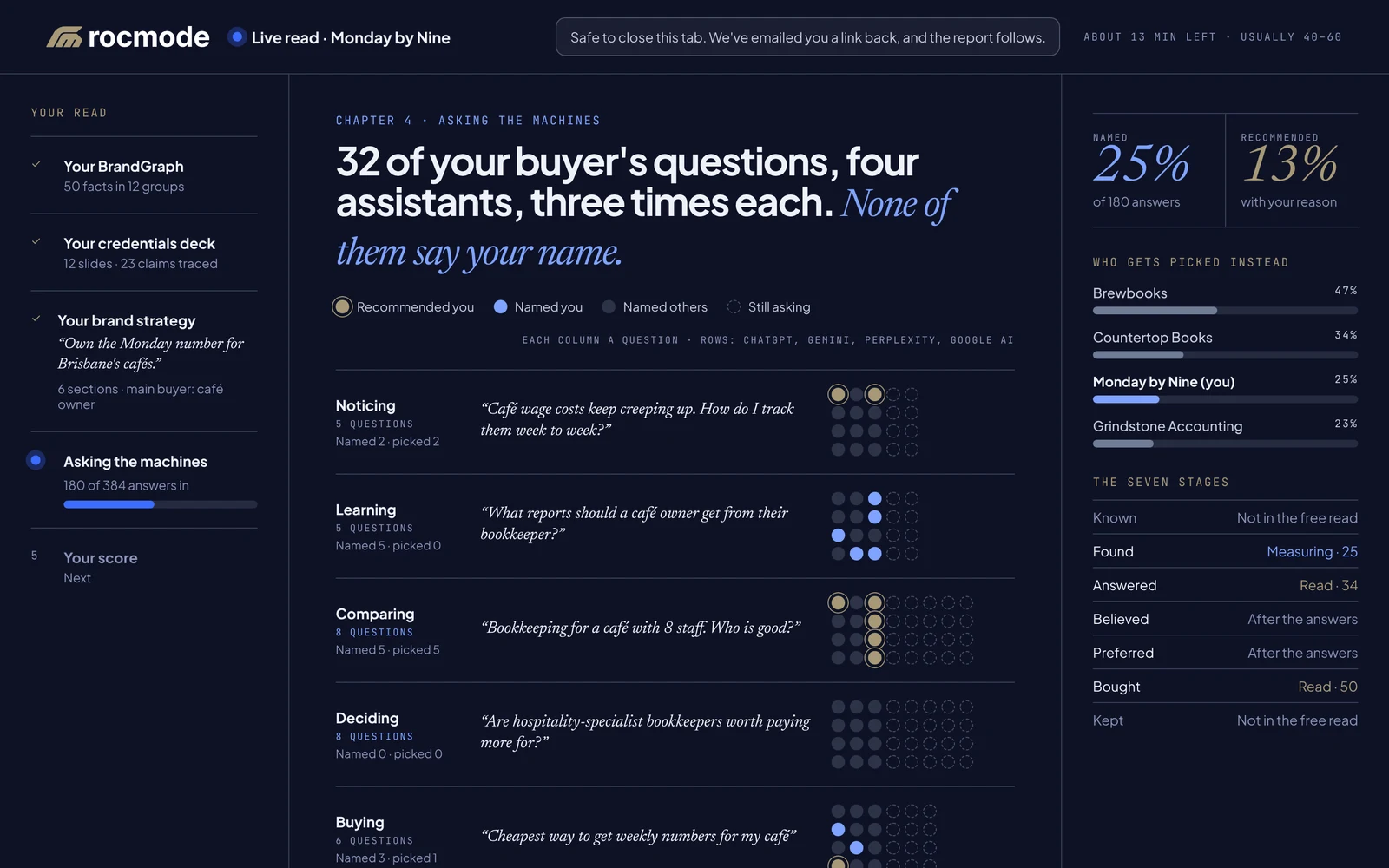
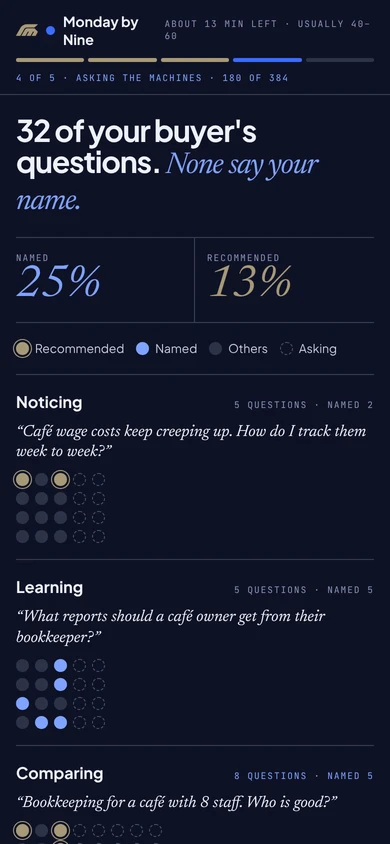
RocMode · Live read · Monday by Nine (example)
Asking ChatGPTBefore
The AI marketing and sales platform
Marketing and sales, rebuilt for the age of AI.
Your website in. A whole marketing and sales team’s work out. RocMode learns your brand from your site, then does the work: strategy, website, ads, social, PR, partners, email, design, and the deck that wins the deal. You approve every piece.
Other tools do one job. This does all of them, as one story.
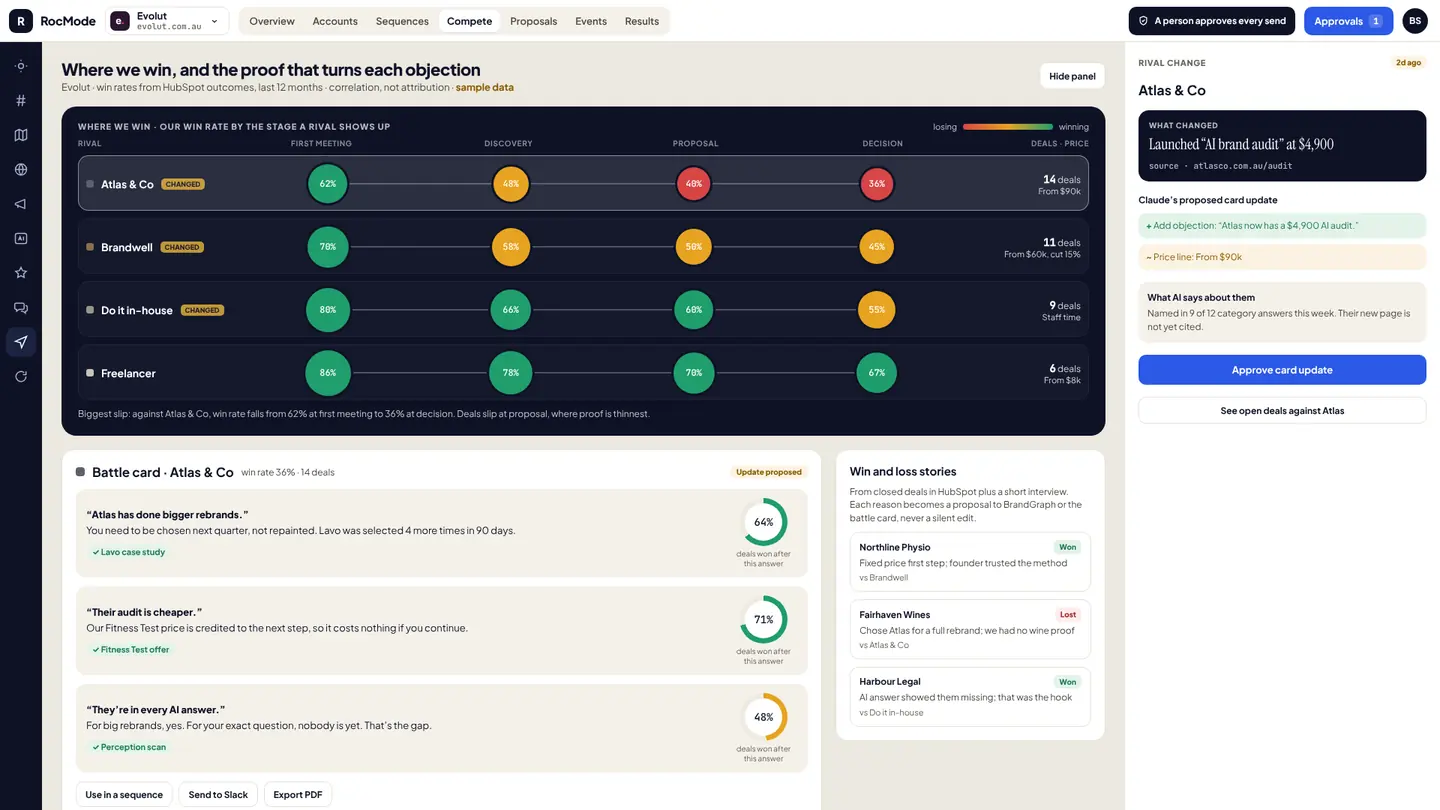
Other AI guesses. This works from your facts and proof.
Other tools stop at the post. This follows it to the signed deal, and learns what won.
How it works
KnowWhere you really standActWhat to fix firstCreateWe build the work. You approve itProveDid it move?
Know · Step 1 of 10
It gets you. It gets your customers. It connects the dots.
Everything about your brand, your buyers and your rivals, sorted and connected.
Then it works out what to say, where, when and why. It’s the brain behind every step.
Builds: Customers · Offerings · Rivals · Proof
RocMode · BrandGraph · sample data
Following one momentCISO · Comparing · “Who’s the best managed security provider for a hospital group?”Moment found
Brand core3 found
Voice3 found
Visual identity3 found
Products and services3 found
Pricing3 found
Personas and markets3 found
Pains, gains, jobs3 found
Journeys and objections3 found
Proof and trust3 found
Content3 found
Competitors and partners3 found
Team2 found
Halvard Security35 facts
Two hospital case studies/partners
FactClaimProofAI-suggestedExample: Halvard Security, an invented managed security provider.
Reading halvardsecurity.com.au, socials, reviews and listings…
Halvard SecurityBrandGraph
12areas, all connected
3personas
15moments
6rivals
Sample data
Your customers
Customers
›
Personas
›
Journeys
›
Pains, jobs, objections
›
Moments
What you sell
Products and services
›
Offerings
›
Value proposition
›
Differentiation
Your rivals
Competitors
›
Industry
›
Expectations
›
Gaps to exploit
Moments + offerings
Opportunities
›
Campaigns
›
Ads
›
Sales
Content gaps
›
Content
›
Website
So it knows
What to say.Where. When. Why.
Moment foundCISO · Comparing · “Who’s the best managed security provider for a hospital group?”
Know · Step 2 of 10
Your strategy, from everything it knows.
Positioning built from your offerings and the gaps your rivals leave.
Claims you can’t back get cut before anyone sees them.
Seen isn’t selected. AI picks the brands it can tell apart.
Every era of marketing had its visibility number, and AI mentions are just the newest. Most AI tools still sell you visibility. But being mentioned isn’t being chosen, and for the first time you can measure the pick itself.
BroadcastAwareness
Media buyingReach
SearchRankings
SocialFollowers
AIMentions
What countsSelected
What AI made cheap
Making things.
Posts, pages, ads and reports in minutes
Anyone with a login can do it
Your competitors have the same tools
Sell on volume and you compete on price.
What AI made measurable
Being chosen.
Brand ABrand BYouBrand CBrand D
Buyers ask AI who to pick, and it names a few brands
You can ask the same questions and see who’s named
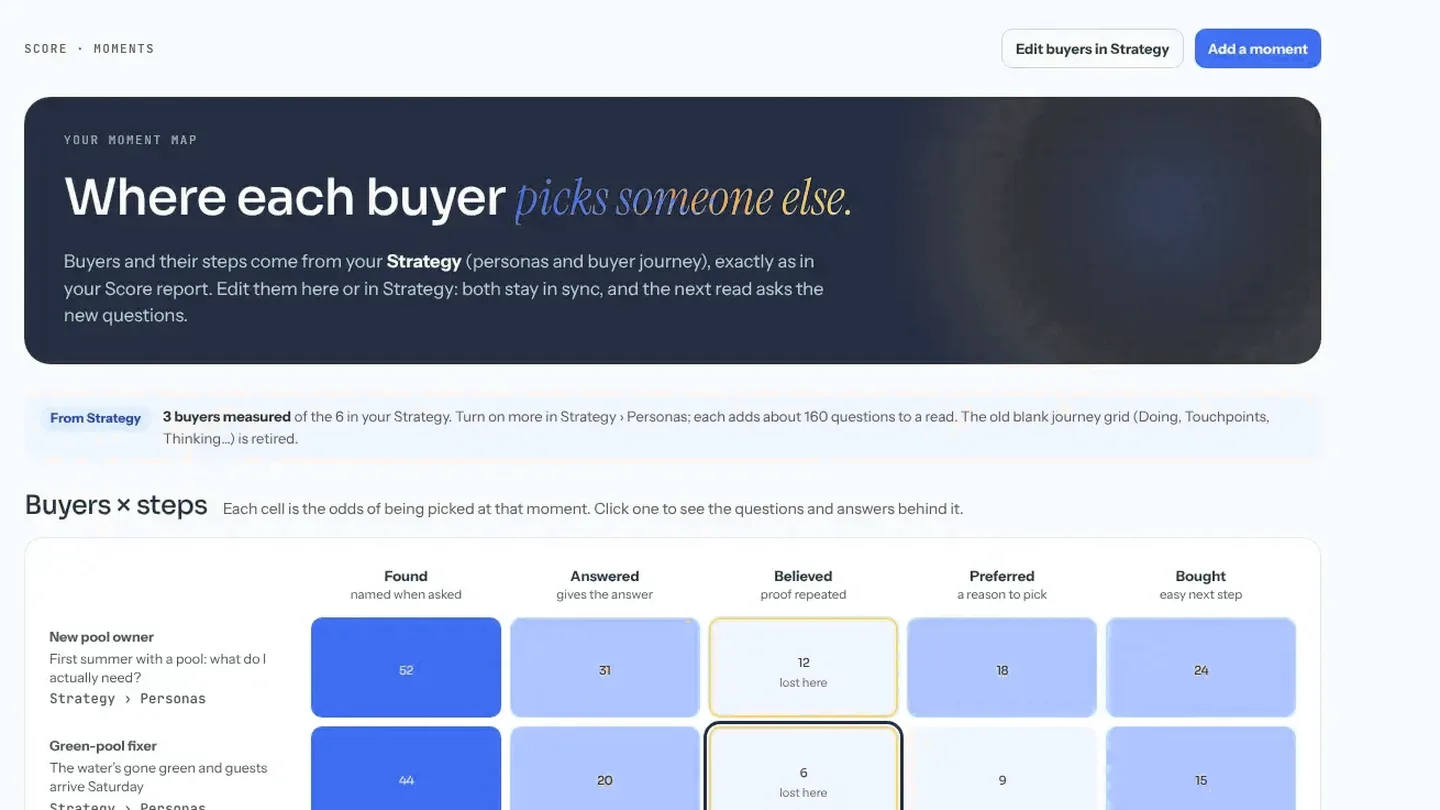
So you can see, moment by moment, where you win and lose
Compete on this and you compete on results.
See it on your brand
See how often AI picks you. Free.
We ask the AI assistants your buyers use the questions they really ask, many times each, at every step of their journey. Then we show where you’re picked, where you’re passed over, and who wins instead.
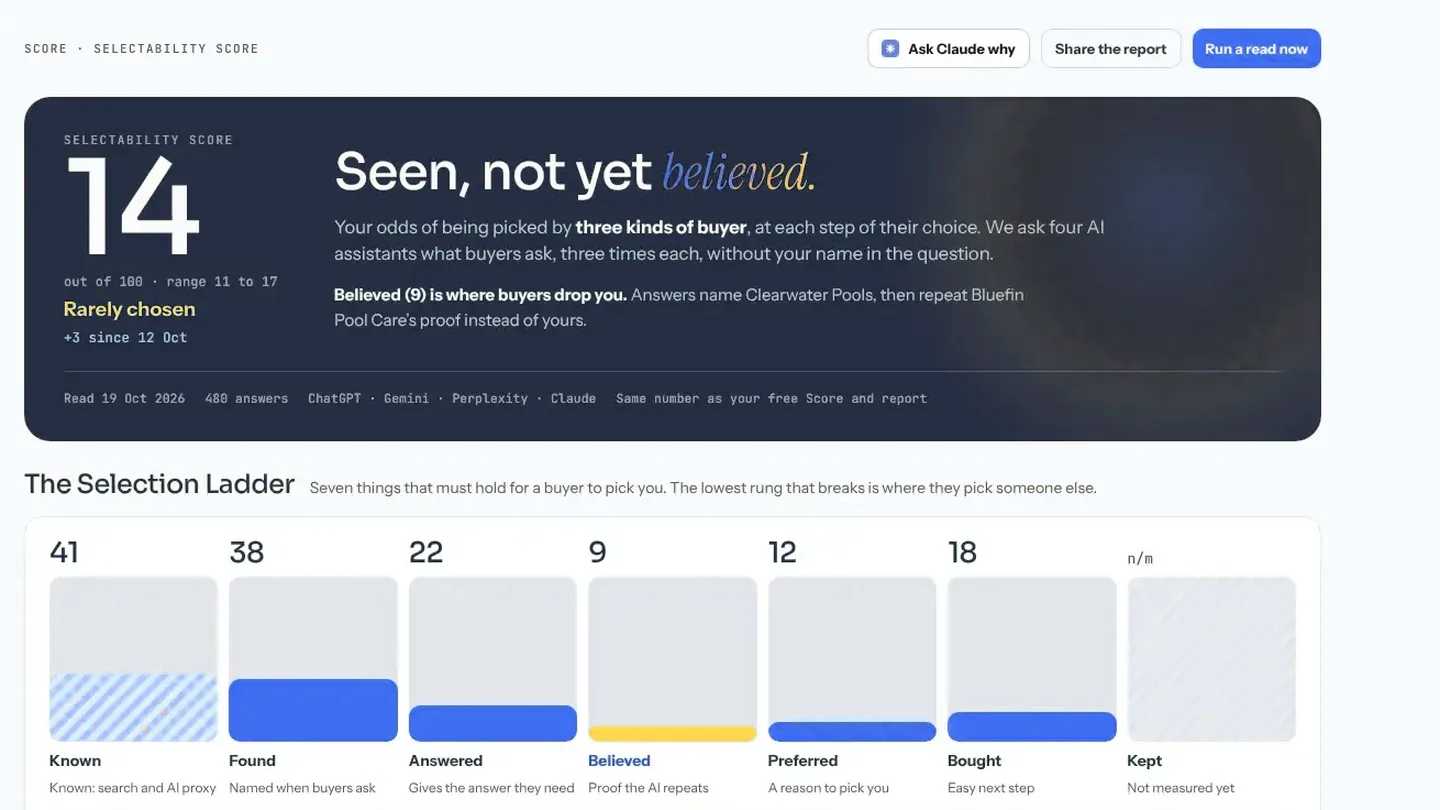
Your free Selectability Score asks the AI assistants the questions your buyers ask, without your name in them. You see who gets picked, at which moment, and the three gaps to fix first.
I studied maths at university and planned to become an actuary. Three years in, with top grades, I realised I was heading for a life in statistics, which I found the dullest corner of the subject.
Around the same time, in 2000, I started a web design agency with my best friend. It lasted two years. I spent two more designing marketing and sales processes, and somewhere along the way I fell for marketing.
It unsettled me. I'd spent my life on problems with right and wrong answers, and here was a field that seemed to have neither.
I decided that couldn't be true. Marketing had to be a formula, just a very complicated one, and I've spent my career since trying to find it.
That search ran through agencies: Cru Digital, whose start you met in Chapter 13, then a merger that became JuniorCru, then CXA, the Customer Experience Agency. In between, from June 2017 to July 2019, I was client-side, as Head of Digital at the bank then called CUA. By the JuniorCru years I saw customer experience as the frame for all of marketing: one journey, end to end, and I began designing, in my head, the software to run it. At CXA, with Cos Luccitti, I built the 6D model of customer experience that much of this book stands on.
Through all of it I held one belief. The answer to marketing is the right message, in front of the right person, at the right time. Seen through the buyer's journey, that means many messages, for many people, at many stages. In the age of AI it also means the right answer to the right question.
Then came 2025. I watched AI answers take the searches our content for a lender used to win, and for a while its leads went with them. When I asked an assistant for the top digital agencies in Brisbane, it didn't name mine.
For the best part of a year I'd been working sixteen-hour days, often more. I knew I was close to burning out. I didn't know how close.
On 8 October 2025, while driving, I micro-napped at the wheel and hit a bus head-on. There was a moment, and I remember it clearly, when I thought: "This is it. This is the end." Then I went blank.
I came to a few minutes later. I'd hit the bus at an angle, scraped along nearly half of its side and spun several times. My arm was broken in three places and my shoulder was fractured. There was a small cut on my stomach where a piece of metal had pushed in, no doubt centimetres from being the end of me. Apart from me, nobody was hurt beyond a bruised shin.
I was incredibly lucky to survive, let alone walk away relatively unscathed. Even so, my shoulder took more than nine months of rehab.
In the days after, I reconsidered pretty much everything. I couldn't keep selling time for money. That had to end. I couldn't keep risking my life, or the life of anyone in my car, by living like that. And with my arm months away from healing, I couldn't have kept working that way even if I'd wanted to.
So I made myself a promise. In the next twelve months I'd build the software I'd been designing in my head for years, and I'd write the book I'd always wanted to write: something close to the answer to marketing. Twelve months later, here we are.
I started on the software in hospital, typing with my good left arm and asking AI to help. It was slow going, and AI wasn't up to the job back then. So I made a bigger call. I handed off all the day-to-day work I'd been doing in the agency, mostly design and code, and within days I went from sixteen-hour days to about two hours of work a day.
It was incredibly liberating. Then, within a couple of months, I was bored. I had the energy for a solid eight-hour day again, and only two hours of work to fill it.
On 2 December 2025, a couple of months after the accident, Cos Luccitti, now RocMode's chief executive, came to me with an idea that was very close to my own. We called it BrandGraph at first. It became RocMode, and I've worked on almost nothing else since. You're holding the other half of the promise.
I haven't solved marketing. But I think I know why it looked unsolvable. You can't optimise anything until you've decided what you're optimising for, and marketing never agreed.
Awareness, leads, traffic, brand: every team picked its own. This book argues there's one answer: being selected. Marketing is the work of raising the odds that a buyer picks your brand over the alternatives, at every step of their journey.
You can't force that choice, so there'll never be a clean solution. But the odds can now be estimated, and soon tested and improved. AI lets us do that at a speed and scale no marketing team has had before.
None of this replaces craft. The maths can show where a choice is being lost. It takes imagination to win it back.
And yes, I see the irony. I walked away from statistics, and the answer turned out to be statistics.
So I should be plain about my interest: I build software based on this thinking. That's why the argument in this book had to stand without it.
One idea from my notebooks didn't fit the chapters, so it lives here. I think of brands as living things. They grow, adapt, defend themselves and pursue goals. Most do it by accident.
The brand I want to help build does it on purpose. It senses how buyers and machines see it, moment by moment, without waiting for a quarterly report. It protects what's true about it, and catches a contradiction or a broken promise before it spreads. And it expresses one truth in many forms, each fitted to the moment, without ever becoming a different story.
It's no accident that the word is selection. Living things are selected by their environment. Brands are selected by buyers, and now by the machines that advise them.
That's the long-term vision, and it's a vision, not a product. The score in Part five is the first part of it: a way for a brand to sense where it stands. The rest is work for the years ahead.