Your buyers ask AI who to pick. Make sure it’s you.
Gets you selected acrossChatGPTClaudeGeminiPerplexity
RocMode shows you whether AI picks you or your rival, finds the work that changes it, builds that work, and sends it to you to approve. Then it proves what moved.
We ask ChatGPT, Claude, Gemini and Perplexity the questions your buyers ask, and show where they pick you and who they pick instead. Free, no login. What’s the Score? Or sign up free and try everything for 14 days.
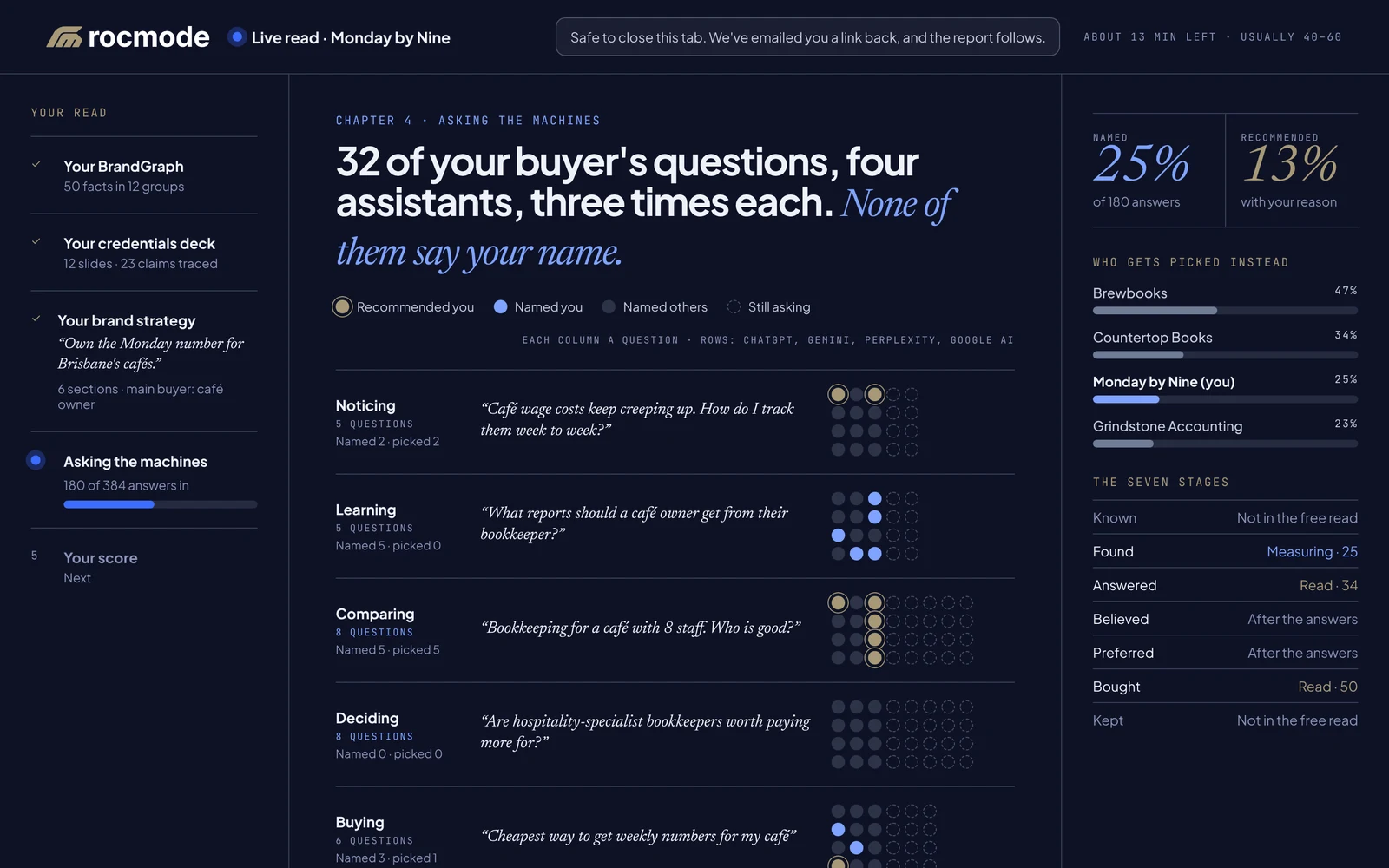
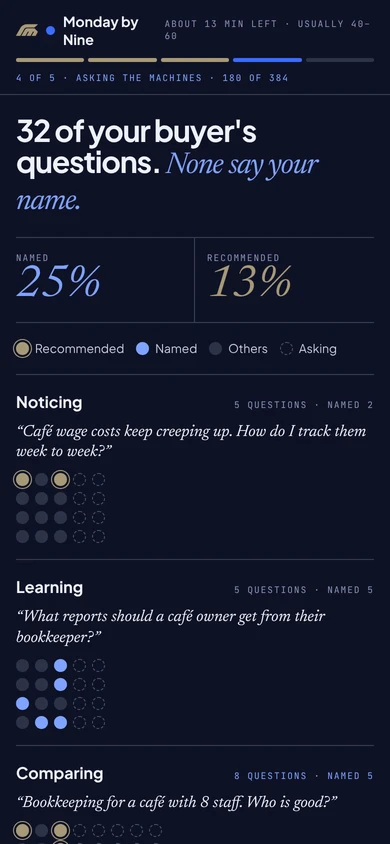
RocMode · Live read · Monday by Nine (example)
Asking ChatGPTBefore
The AI marketing and sales platform
Marketing and sales, rebuilt for the age of AI.
Your website in. A whole marketing and sales team’s work out. RocMode learns your brand from your site, then does the work: strategy, website, ads, social, PR, partners, email, design, and the deck that wins the deal. You approve every piece.
Other tools do one job. This does all of them, as one story.
Other AI guesses. This works from your facts and proof.
Other tools stop at the post. This follows it to the signed deal, and learns what won.
How it works
KnowWhere you really standActWhat to fix firstCreateWe build the work. You approve itProveDid it move?
Know · Step 1 of 10
It gets you. It gets your customers. It connects the dots.
Everything about your brand, your buyers and your rivals, sorted and connected.
Then it works out what to say, where, when and why. It’s the brain behind every step.
Builds: Customers · Offerings · Rivals · Proof
RocMode · BrandGraph · sample data
Following one momentCISO · Comparing · “Who’s the best managed security provider for a hospital group?”Moment found
Brand core3 found
Voice3 found
Visual identity3 found
Products and services3 found
Pricing3 found
Personas and markets3 found
Pains, gains, jobs3 found
Journeys and objections3 found
Proof and trust3 found
Content3 found
Competitors and partners3 found
Team2 found
Halvard Security35 facts
Two hospital case studies/partners
FactClaimProofAI-suggestedExample: Halvard Security, an invented managed security provider.
Reading halvardsecurity.com.au, socials, reviews and listings…
Halvard SecurityBrandGraph
12areas, all connected
3personas
15moments
6rivals
Sample data
Your customers
Customers
›
Personas
›
Journeys
›
Pains, jobs, objections
›
Moments
What you sell
Products and services
›
Offerings
›
Value proposition
›
Differentiation
Your rivals
Competitors
›
Industry
›
Expectations
›
Gaps to exploit
Moments + offerings
Opportunities
›
Campaigns
›
Ads
›
Sales
Content gaps
›
Content
›
Website
So it knows
What to say.Where. When. Why.
Moment foundCISO · Comparing · “Who’s the best managed security provider for a hospital group?”
Know · Step 2 of 10
Your strategy, from everything it knows.
Positioning built from your offerings and the gaps your rivals leave.
Claims you can’t back get cut before anyone sees them.
Seen isn’t selected. AI picks the brands it can tell apart.
Every era of marketing had its visibility number, and AI mentions are just the newest. Most AI tools still sell you visibility. But being mentioned isn’t being chosen, and for the first time you can measure the pick itself.
BroadcastAwareness
Media buyingReach
SearchRankings
SocialFollowers
AIMentions
What countsSelected
What AI made cheap
Making things.
Posts, pages, ads and reports in minutes
Anyone with a login can do it
Your competitors have the same tools
Sell on volume and you compete on price.
What AI made measurable
Being chosen.
Brand ABrand BYouBrand CBrand D
Buyers ask AI who to pick, and it names a few brands
You can ask the same questions and see who’s named
So you can see, moment by moment, where you win and lose
Compete on this and you compete on results.
See it on your brand
See how often AI picks you. Free.
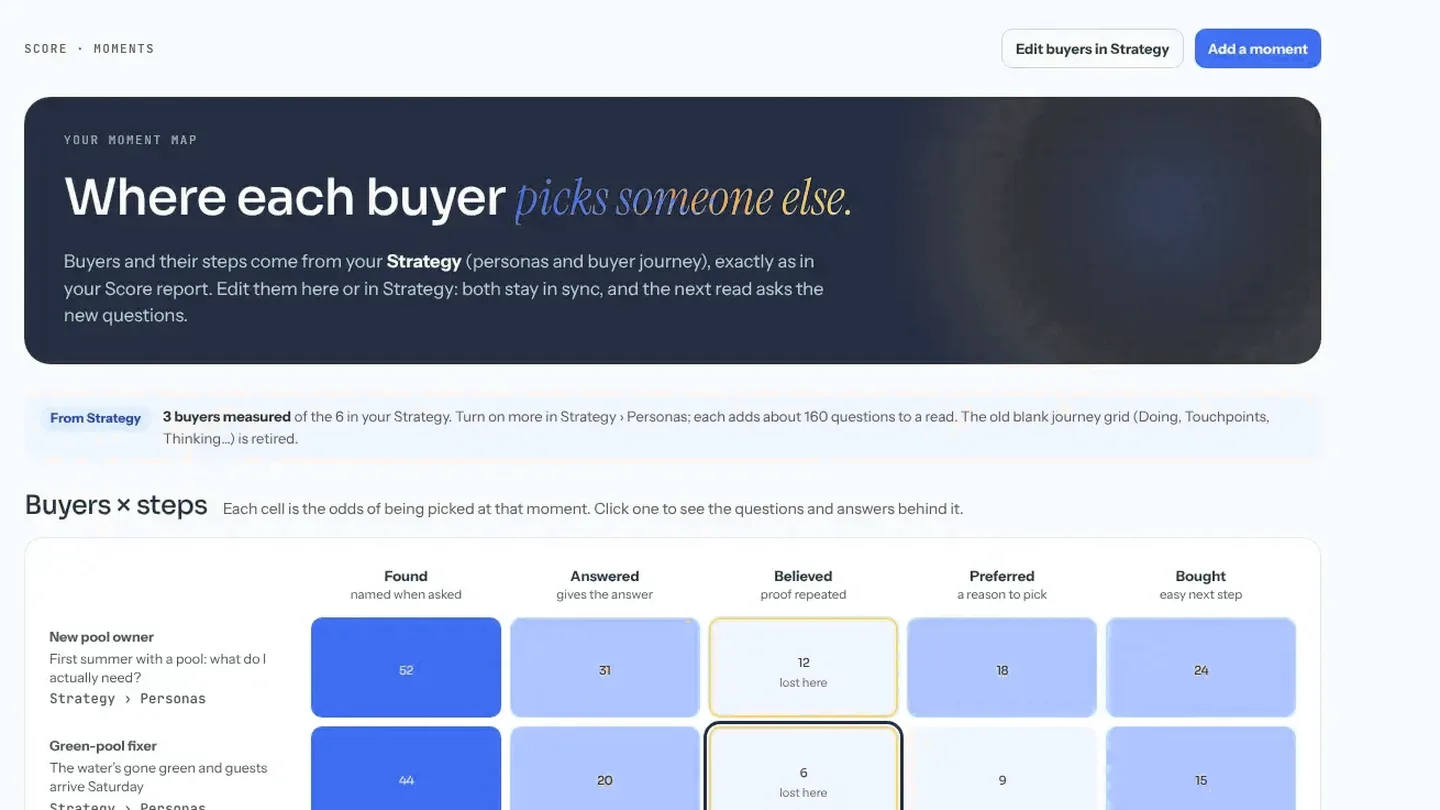
We ask the AI assistants your buyers use the questions they really ask, many times each, at every step of their journey. Then we show where you’re picked, where you’re passed over, and who wins instead.
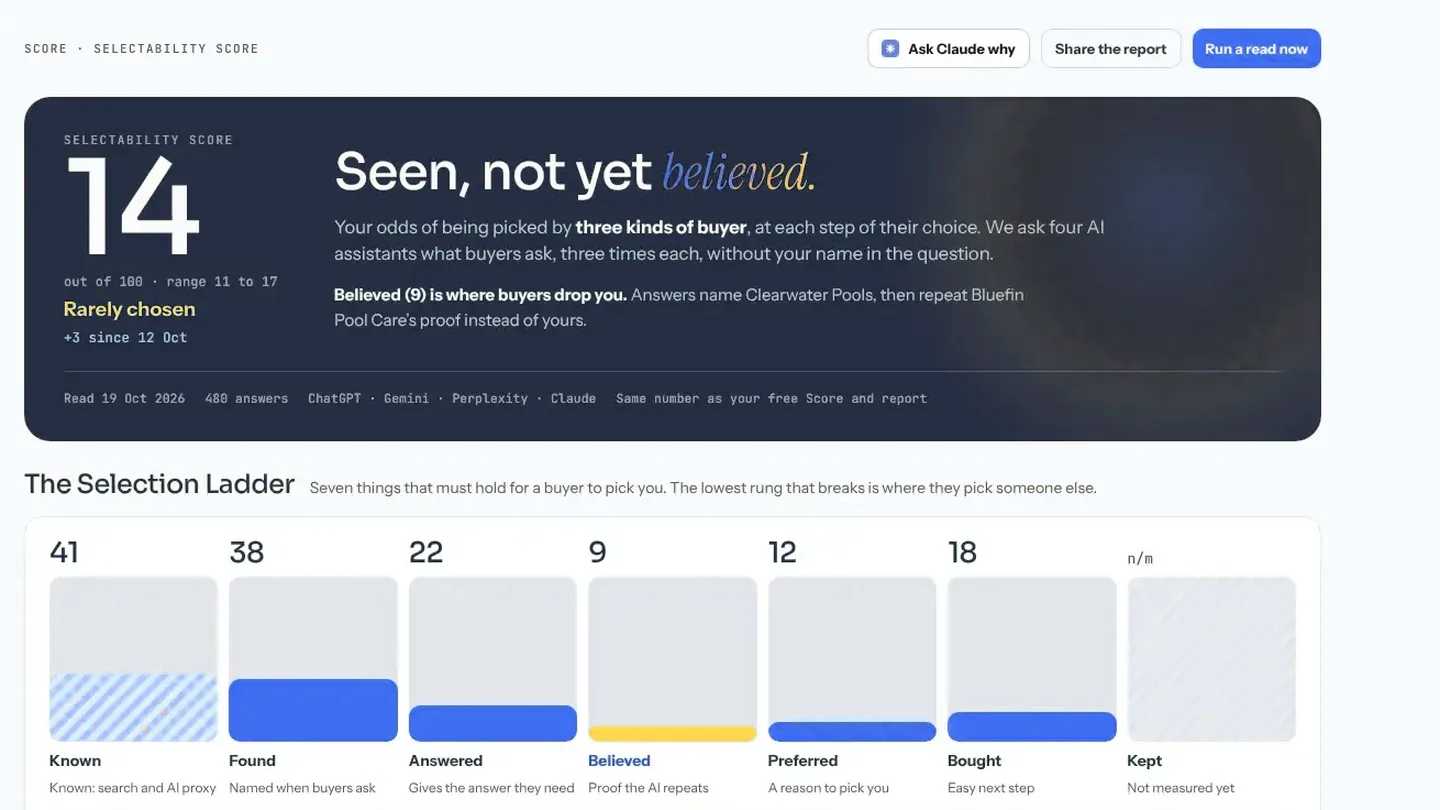
Your free Selectability Score asks the AI assistants the questions your buyers ask, without your name in them. You see who gets picked, at which moment, and the three gaps to fix first.
I've sat in more of these meetings than I'd care to count. The creative agency down one side of the table, the media agency down the other, and the client at the head of it. Each agency brought its own deck, and every deck told the same story. This quarter, we were the hero.
Reach was up. Engagement was up. The cost of something or other was down. If sales hadn't moved, that was a problem for somebody else's slide.
I can't remember anyone ever saying "that didn't work", or saying what would change next quarter beyond a promise to keep optimising.
I'd love to tell you I was the honest one in the room. I wasn't. For the first ten of my twenty-five-odd years in agencies, I was as guilty as anyone. Building a report was a craft, and I was good at it.
I knew it wasn't the whole picture. But the attitude in a lot of agencies back then, mine included, was to keep the client, whatever it takes. The report's real job was to protect the account.
I suspect the clients knew. They just lacked the knowledge to point at where we were dodging, or to say what to hold us to instead.
That meeting is still running, in boardrooms everywhere. Every number is up, the business hasn't moved, and nobody can say which part worked. These days there's one new item on the agenda: what's our AI strategy?
Never before could marketing do so much, and so often achieve so little. You can make a year of content in a week, and you have more tools than your team has people.
The buyer has moved where you can't see
AI has changed how marketing is made. It's changing how people buy too, in a way your reports barely show.
AI is now where buyers go for answers. ChatGPT has 900 million weekly users (TechCrunch). And Google, still where most searching happens, now answers with AI first: more than a billion people a month use its AI Mode (Google).
Yet in your traffic AI hardly registers. Assistants mostly answer rather than link, and people rarely click the links they do give. On Google searches with an AI summary, its links were clicked in 1% of visits (Pew Research Center). Across 101,574 websites, ChatGPT sent about one visit in three hundred in May 2026 (SE Ranking).
That number misleads. The assistant does the comparing and names a few brands, and the buyer then reaches them another way. Semrush surveyed 1,030 US shoppers who use AI. After an AI recommendation, 40% searched Google for more and 28% went straight to the brand's site (Semrush). Those visits show up as search or direct, not AI.
So AI puts you on the shortlist long before it shows in your analytics. The visits it does send are growing fast and buy more. In Adobe's US retail data, they were up 393% on a year earlier and converted 42% better than other traffic (TechCrunch).
The urgency is real, but most of it is aimed at the wrong job. The race isn't to make more. It's to be the name in the answer, and there's still time to get this right.
The tools arrived faster than the results
You aren't alone. In Marketing Week's 2026 survey of 2,350 marketers, two in three had felt overwhelmed in the past year. More than half reported emotional exhaustion (Marketing Week).
Use of generative AI in marketing tripled in two years, from 7% of activities to 22% (CMO Survey). The return hasn't followed. In the same survey, no technology activity scored above five out of seven, including the return on the technology itself.
More of everything
Graphite checked 55,400 article URLs with three AI detectors. By its estimate, about half of new articles published online in early 2026 were written mainly by machines (Graphite).
Small businesses feel it most. Among those surveyed in four countries, only 18% feel very confident their marketing works, down from 27% a year earlier. Four in ten have less than an hour a day to spend on it (Constant Contact).
Nothing is wrong with you
If this is familiar, nothing is wrong with you. Something is wrong with the job you were handed.
AI didn't create the confusion. It multiplied it. To see why, start with a question marketing has never settled: what is it for?
Whose evidence this is. Graphite sells search marketing services. SE Ranking and Semrush sell search marketing software, and Semrush's survey reports what shoppers say they do. OpenAI and Google report their own user numbers. Adobe sells analytics and commerce software. Constant Contact sells email marketing to small businesses. Marketing Week is a trade magazine, and its survey reports opinion, not measured results. Pew Research Center is a nonprofit research organisation.
Try this
List every dashboard you report from, and write beside each one what it counts: who saw you, or who chose you.