Your buyers ask AI who to pick. Make sure it’s you.
Gets you selected acrossChatGPTClaudeGeminiPerplexity
RocMode shows you whether AI picks you or your rival, finds the work that changes it, builds that work, and sends it to you to approve. Then it proves what moved.
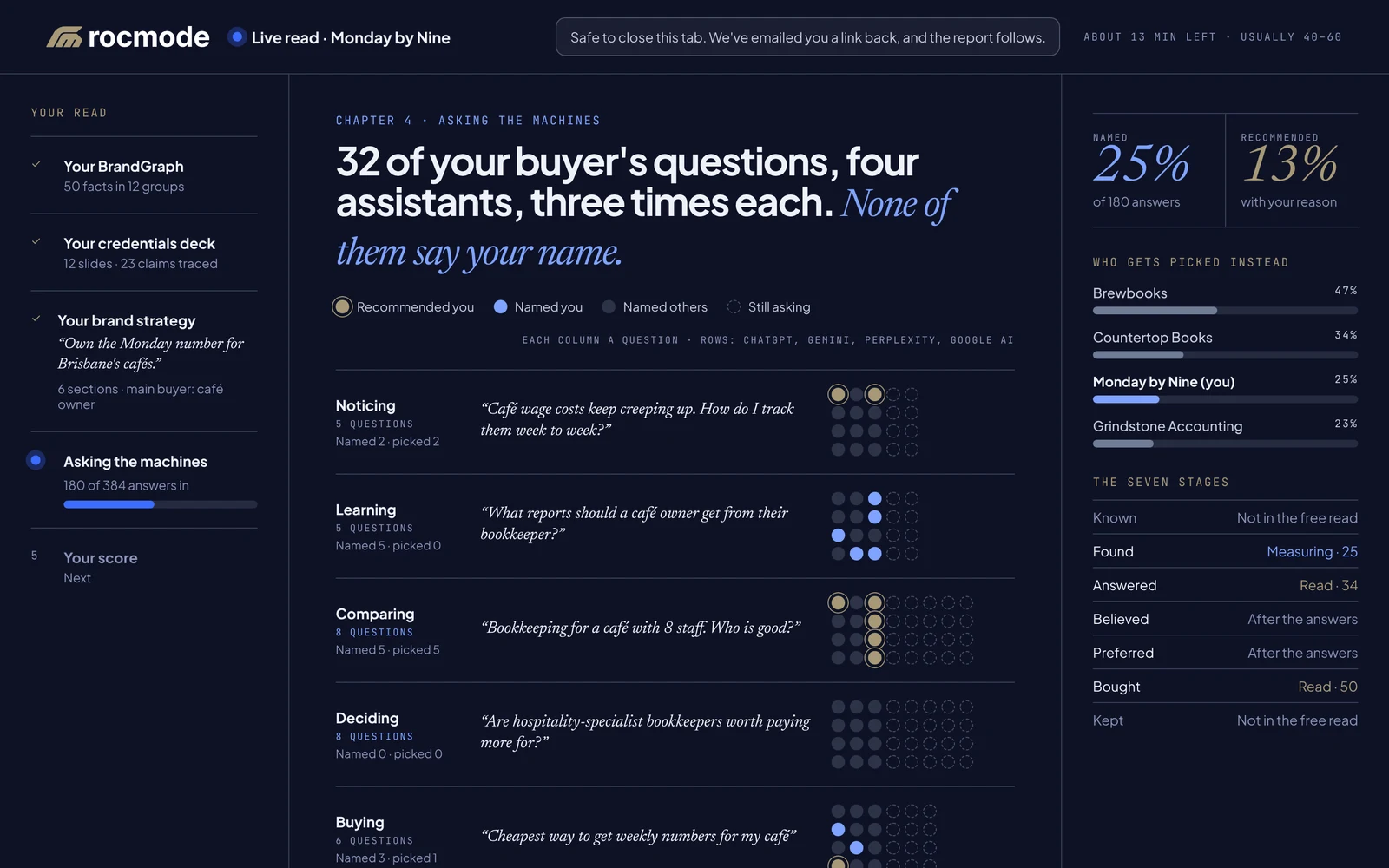
We ask ChatGPT, Claude, Gemini and Perplexity the questions your buyers ask, and show where they pick you and who they pick instead. Free, no login. What’s the Score? Or sign up free and try everything for 14 days.
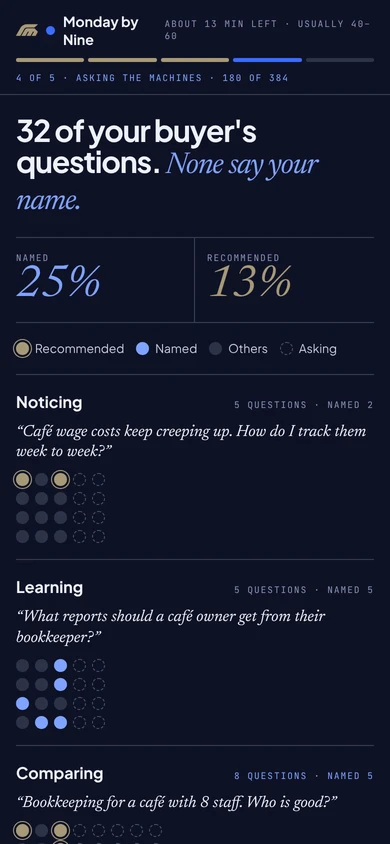
RocMode · Live read · Monday by Nine (example)
Asking ChatGPTBefore
The AI marketing and sales platform
Marketing and sales, rebuilt for the age of AI.
Your website in. A whole marketing and sales team’s work out. RocMode learns your brand from your site, then does the work: strategy, website, ads, social, PR, partners, email, design, and the deck that wins the deal. You approve every piece.
Other tools do one job. This does all of them, as one story.
Other AI guesses. This works from your facts and proof.
Other tools stop at the post. This follows it to the signed deal, and learns what won.
How it works
KnowWhere you really standActWhat to fix firstCreateWe build the work. You approve itProveDid it move?
Know · Step 1 of 10
It gets you. It gets your customers. It connects the dots.
Everything about your brand, your buyers and your rivals, sorted and connected.
Then it works out what to say, where, when and why. It’s the brain behind every step.
Builds: Customers · Offerings · Rivals · Proof
RocMode · BrandGraph · sample data
Following one momentCISO · Comparing · “Who’s the best managed security provider for a hospital group?”Moment found
Brand core3 found
Voice3 found
Visual identity3 found
Products and services3 found
Pricing3 found
Personas and markets3 found
Pains, gains, jobs3 found
Journeys and objections3 found
Proof and trust3 found
Content3 found
Competitors and partners3 found
Team2 found
Halvard Security35 facts
Two hospital case studies/partners
FactClaimProofAI-suggestedExample: Halvard Security, an invented managed security provider.
Reading halvardsecurity.com.au, socials, reviews and listings…
Halvard SecurityBrandGraph
12areas, all connected
3personas
15moments
6rivals
Sample data
Your customers
Customers
›
Personas
›
Journeys
›
Pains, jobs, objections
›
Moments
What you sell
Products and services
›
Offerings
›
Value proposition
›
Differentiation
Your rivals
Competitors
›
Industry
›
Expectations
›
Gaps to exploit
Moments + offerings
Opportunities
›
Campaigns
›
Ads
›
Sales
Content gaps
›
Content
›
Website
So it knows
What to say.Where. When. Why.
Moment foundCISO · Comparing · “Who’s the best managed security provider for a hospital group?”
Know · Step 2 of 10
Your strategy, from everything it knows.
Positioning built from your offerings and the gaps your rivals leave.
Claims you can’t back get cut before anyone sees them.
Seen isn’t selected. AI picks the brands it can tell apart.
Every era of marketing had its visibility number, and AI mentions are just the newest. Most AI tools still sell you visibility. But being mentioned isn’t being chosen, and for the first time you can measure the pick itself.
BroadcastAwareness
Media buyingReach
SearchRankings
SocialFollowers
AIMentions
What countsSelected
What AI made cheap
Making things.
Posts, pages, ads and reports in minutes
Anyone with a login can do it
Your competitors have the same tools
Sell on volume and you compete on price.
What AI made measurable
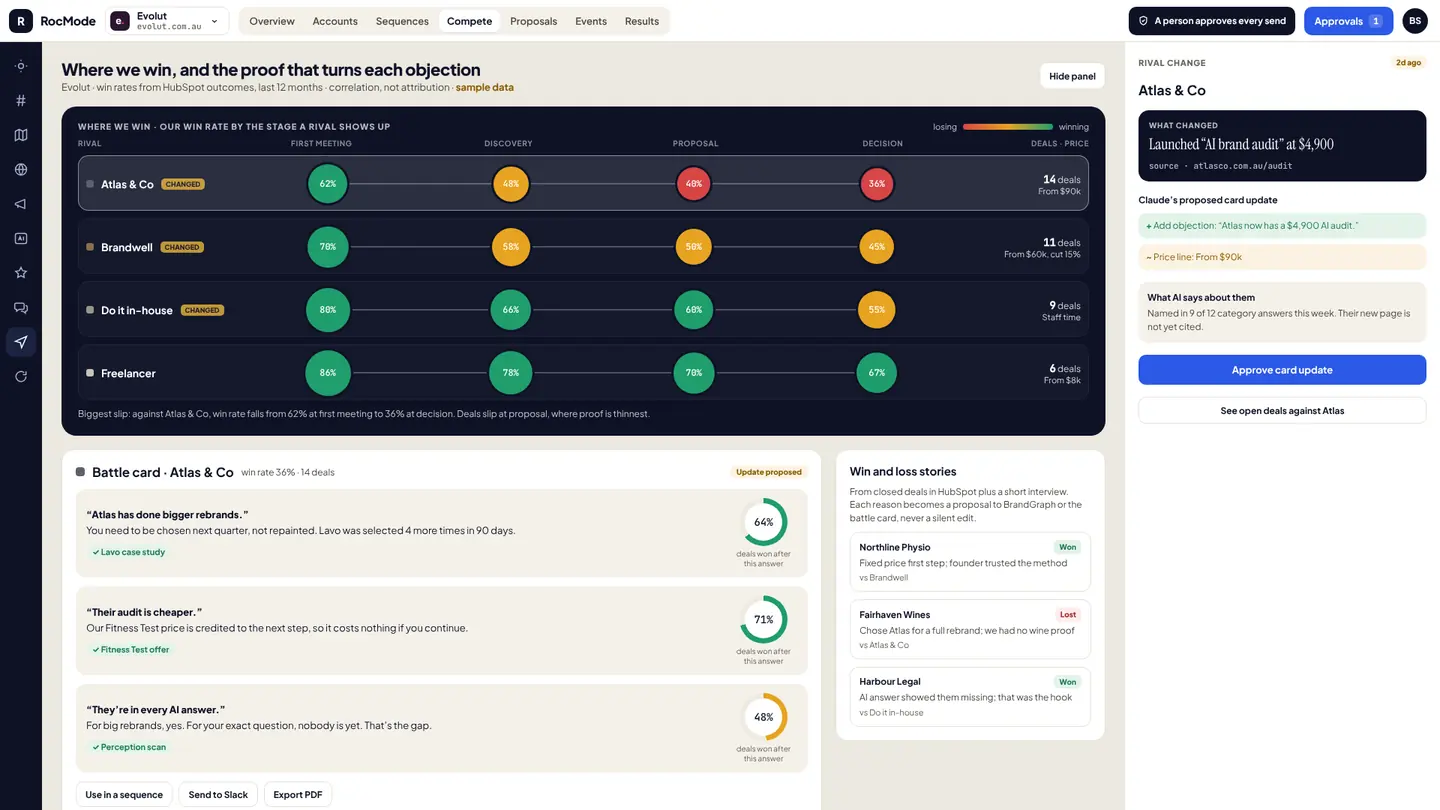
Being chosen.
Brand ABrand BYouBrand CBrand D
Buyers ask AI who to pick, and it names a few brands
You can ask the same questions and see who’s named
So you can see, moment by moment, where you win and lose
Compete on this and you compete on results.
See it on your brand
See how often AI picks you. Free.
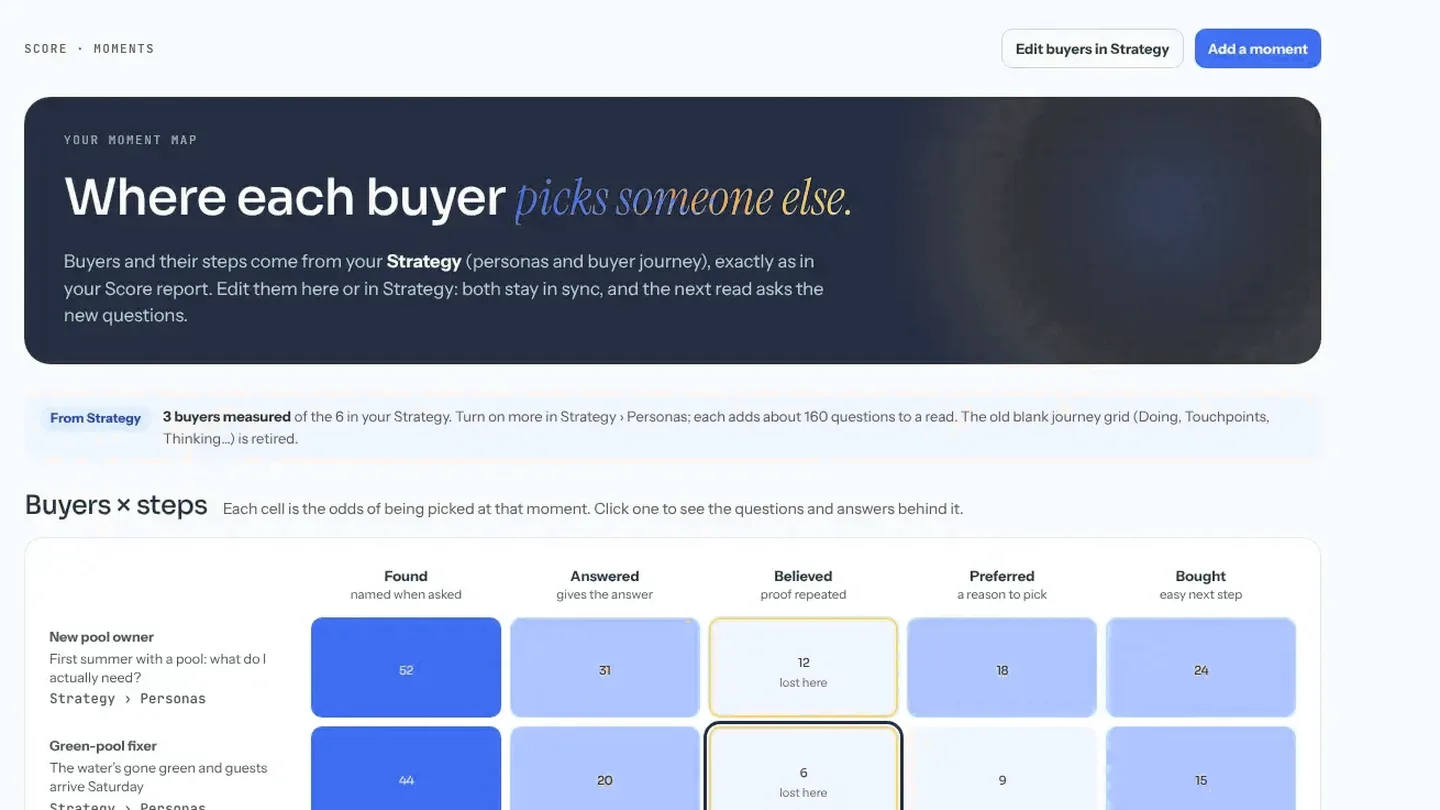
We ask the AI assistants your buyers use the questions they really ask, many times each, at every step of their journey. Then we show where you’re picked, where you’re passed over, and who wins instead.
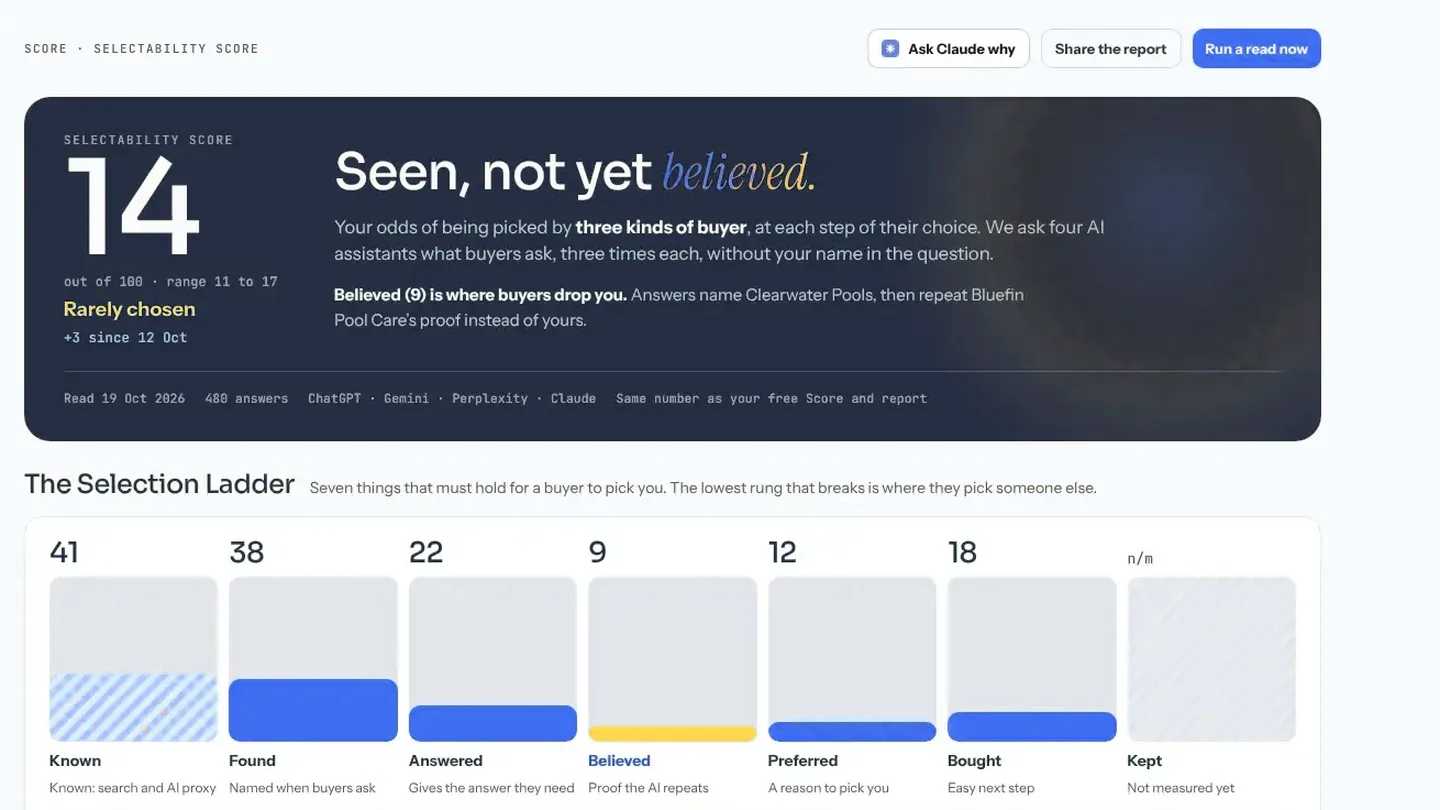
Your free Selectability Score asks the AI assistants the questions your buyers ask, without your name in them. You see who gets picked, at which moment, and the three gaps to fix first.
Being seen needs content. Being selected needs a reason.
One truth says what's so. This chapter is about the reason a buyer, or a machine, would pick you over someone just as capable. It's the most opinionated chapter in the book, and I mark where the evidence runs out.
Distinctive is not different
Distinctive means you're recognised: a name, a look or a sound people know as yours. Different means there's a reason to pick you that isn't true of the rest.
The Ehrenberg-Bass researchers, whom this book has leaned on, argue that distinctive matters more. Their evidence is real. In their surveys, most of a brand's buyers don't see it as different, and they go on buying it (Romaniuk, Sharp and Ehrenberg). In one, 77% of Apple's users didn't rate it as unique (Ehrenberg-Bass).
They don't say difference is worthless, only that it plays a smaller part than the textbooks assume. For habitual purchases I think they're right. Nobody weighs the unique selling point of a chocolate bar.
Where a reason is needed
But where a buyer, or a machine, compares options on purpose, the comparison needs a reason. An AI asked which supplier is best for a field team of forty has to say why. A brand with no reason to give leaves it nothing to say.
The machine evidence agrees. AI models pick the famous name when products are identical, then mostly drop it once a rival has better specifications (Chapter 13).
Being distinctive gets you Known and Found. Being different gets you Preferred. A brand needs both, and most work only on the first.
Why it matters more each year
Here's the part I believe and can't yet prove.
There are more businesses competing for each buyer. The US counted 30.4 million non-employer establishments in 2023, businesses with nobody on the payroll, up from 29.8 million a year earlier (US Census Bureau). Those figures predate most AI tools, so they show the direction, not the cause.
AI also makes competent work cheap, and more alike. By one search firm's estimate, about half of new articles are now written mainly by machines. People take the first option that clears the bar. When every option clears it, something else has to decide.
And the newest chooser has to give reasons. On a tie, a machine leans to the name it knows, but a recommendation still has to say why.
I think that makes a real point of view worth more every year. No study yet shows it. It's a conviction, not a finding.
What a reason is made of
Al Ries and Jack Trout called it positioning, and April Dunford has brought it up to date. A reason to choose you is usually one of four things.
A problem you solve that others treat as a sideline. You're for someone in particular, and you can name them.
A way of working you believe in and rivals don't. An opinion about how the job should be done.
Something you refuse to do. The work you turn down says who you're for.
Proof only you hold. Your data, your results, your history: what's true only of you.
I've turned down somewhere between six and a dozen projects over the years. It was rarely about the industry. It was almost always about the person across the table.
The red flags usually show up in the first meeting. Someone talks over the top of me, or my team. They don't take my advice in my own field. They care about the budget to the exclusion of the outcome. Or they promise good things down the road if we look after them now.
I can't remember ever regretting walking away. I have regretted not walking away.
One project still stands out. A professional services firm came to us with a fixed budget and a big ambition: new branding and a website, designed and built from scratch. They wanted something industry-leading, and we could have delivered it.
The flags went up during the negotiation. They pushed back on price again and again. They kept quietly adding to the scope and telling us it had already been discussed, when it never had. Twice I nearly walked away, and I told them so. Each time they backed off, nudged the budget up a little and gave some ground. And each time I knew they'd be trouble. I signed anyway.
They were. They blew through the agreed rounds of changes every time. They contradicted their own feedback. They kept bringing in new ideas and new scope.
They weren't bad people, but they were bad clients for us. As a small agency, I pride myself on going above and beyond. The wrong client is very good at taking advantage of that, and they did.
The project took twice the time we'd budgeted, and we didn't make an extra cent. It was an expensive lesson, and a valuable one. These days, when I see one of those flags, I listen to it.
The strongest reasons are opinions. Vanguard was built on the view that picking stocks is a mistake. Fidelity was built on the opposite view, that the stock-picker is the heart of the firm. Both succeeded (Roger Martin). Each gave a certain kind of investor a reason.
A reason that travelled
The best reasons are short enough for customers to pass on. Wise, the money-transfer firm, began in 2011 with two friends in London who were tired of their banks' fees and poor exchange rates (Wise).
Its reason was an opinion about the job: move money at the real, mid-market exchange rate, and show the fee. Most banks did the opposite.
Customers repeated it for the company. In its 2023 results, Wise said around two-thirds of new customers joined "as a result of someone having told them about Wise". It served about 10 million active customers that year, up 34% (Wise plc).
These are the company's own figures, and a cheaper price did much of the work. Even so, the reason was true, checkable and easy to say in a sentence.
The test
Roger Martin has a test for this. State your claim, then state its opposite. If the opposite is plainly stupid, you haven't made a choice, and every rival is saying the same thing.
"We put customers first" fails. Nobody puts them last. "We only work with cafés and restaurants" passes, because a good rival could sensibly choose to serve every trade.
Take a bookkeeper for cafés. She's an invented example, and she returns in every stage chapter. Her proof is one café's twelve months of numbers.
Claim
What it says
Its opposite
Generic
Friendly, reliable bookkeeping for small business
Unfriendly and unreliable. Nobody would say it
A reason
Bookkeeping for cafés. Your wage cost against takings, every Monday by nine
Every trade, reported monthly. A sensible rival does exactly that
The second one costs something: the plumber down the road won't call. Most brands won't pay that price, which is why most sound the same.
Then check it three ways. Is it true, with proof a buyer could check? Is it wanted, by a real buyer at a real moment? Is it yours, or could a rival say it by Friday?
Chapter 17 applies the same opposite test once the reason has left your hands, to what customers, colleagues and machines say when they repeat it.
By mode
Mode
How much a reason matters
Habitual
Little. Be distinctive and easy to find
Quick choice
Some. One clear reason, visible at a glance
Considered personal
A lot. The buyer is comparing on purpose
Owner-led business
A lot. The owner asks whether you are for a business like theirs
Committee
Most. The reason has to survive being repeated in a room you are not in
This is my reading, like the other mode tables.
This afternoon, this quarter
This afternoon: finish the sentence "choose us when". Then write its opposite. If the opposite is absurd, start again.
This quarter: ask ten customers why they chose you, and a machine why it would recommend you, and why it wouldn't. Where those accounts and your own differ, that's the work.
Next come the moments where the truth and the reason both have to be heard.
Whose evidence this is. Graphite, the source in Chapter 1, sells search marketing services. The Ehrenberg-Bass Institute is funded by sponsor brands. Wise's figures are its own results. Peer-reviewed: Romaniuk, Sharp and Ehrenberg (Australasian Marketing Journal). Official statistics: the US Census Bureau.
Try this
fill in the "choose us when" worksheet from Chapter 17, free at rocmode.com/playbooks, and strike any claim whose opposite no rival would choose.