Your buyers ask AI who to pick. Make sure it’s you.
Gets you selected acrossChatGPTClaudeGeminiPerplexity
RocMode shows you whether AI picks you or your rival, finds the work that changes it, builds that work, and sends it to you to approve. Then it proves what moved.
We ask ChatGPT, Claude, Gemini and Perplexity the questions your buyers ask, and show where they pick you and who they pick instead. Free, no login. What’s the Score? Or sign up free and try everything for 14 days.
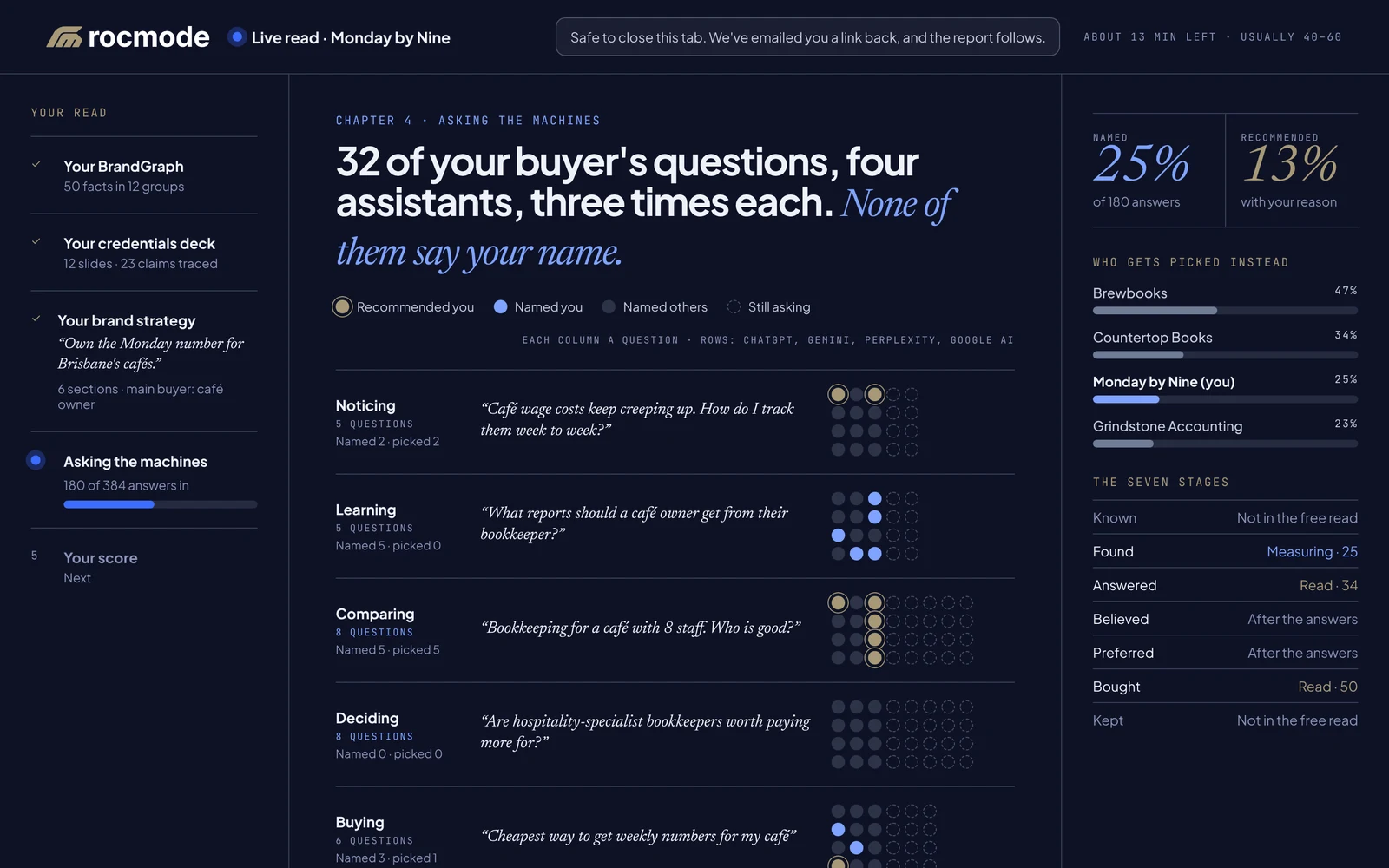
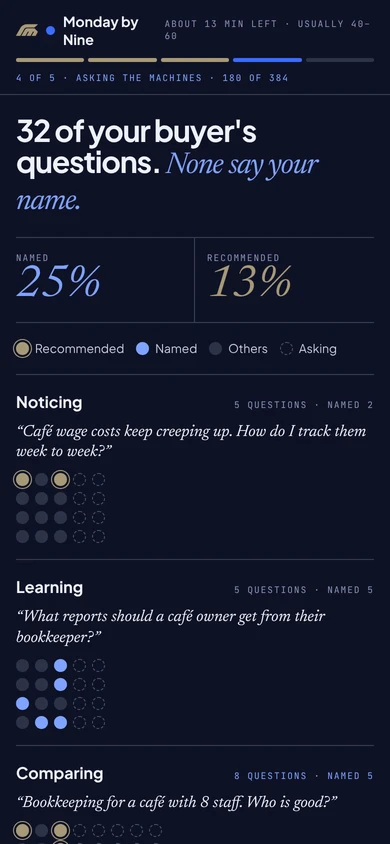
RocMode · Live read · Monday by Nine (example)
Asking ChatGPTBefore
The AI marketing and sales platform
Marketing and sales, rebuilt for the age of AI.
Your website in. A whole marketing and sales team’s work out. RocMode learns your brand from your site, then does the work: strategy, website, ads, social, PR, partners, email, design, and the deck that wins the deal. You approve every piece.
Other tools do one job. This does all of them, as one story.
Other AI guesses. This works from your facts and proof.
Other tools stop at the post. This follows it to the signed deal, and learns what won.
How it works
KnowWhere you really standActWhat to fix firstCreateWe build the work. You approve itProveDid it move?
Know · Step 1 of 10
It gets you. It gets your customers. It connects the dots.
Everything about your brand, your buyers and your rivals, sorted and connected.
Then it works out what to say, where, when and why. It’s the brain behind every step.
Builds: Customers · Offerings · Rivals · Proof
RocMode · BrandGraph · sample data
Following one momentCISO · Comparing · “Who’s the best managed security provider for a hospital group?”Moment found
Brand core3 found
Voice3 found
Visual identity3 found
Products and services3 found
Pricing3 found
Personas and markets3 found
Pains, gains, jobs3 found
Journeys and objections3 found
Proof and trust3 found
Content3 found
Competitors and partners3 found
Team2 found
Halvard Security35 facts
Two hospital case studies/partners
FactClaimProofAI-suggestedExample: Halvard Security, an invented managed security provider.
Reading halvardsecurity.com.au, socials, reviews and listings…
Halvard SecurityBrandGraph
12areas, all connected
3personas
15moments
6rivals
Sample data
Your customers
Customers
›
Personas
›
Journeys
›
Pains, jobs, objections
›
Moments
What you sell
Products and services
›
Offerings
›
Value proposition
›
Differentiation
Your rivals
Competitors
›
Industry
›
Expectations
›
Gaps to exploit
Moments + offerings
Opportunities
›
Campaigns
›
Ads
›
Sales
Content gaps
›
Content
›
Website
So it knows
What to say.Where. When. Why.
Moment foundCISO · Comparing · “Who’s the best managed security provider for a hospital group?”
Know · Step 2 of 10
Your strategy, from everything it knows.
Positioning built from your offerings and the gaps your rivals leave.
Claims you can’t back get cut before anyone sees them.
Seen isn’t selected. AI picks the brands it can tell apart.
Every era of marketing had its visibility number, and AI mentions are just the newest. Most AI tools still sell you visibility. But being mentioned isn’t being chosen, and for the first time you can measure the pick itself.
BroadcastAwareness
Media buyingReach
SearchRankings
SocialFollowers
AIMentions
What countsSelected
What AI made cheap
Making things.
Posts, pages, ads and reports in minutes
Anyone with a login can do it
Your competitors have the same tools
Sell on volume and you compete on price.
What AI made measurable
Being chosen.
Brand ABrand BYouBrand CBrand D
Buyers ask AI who to pick, and it names a few brands
You can ask the same questions and see who’s named
So you can see, moment by moment, where you win and lose
Compete on this and you compete on results.
See it on your brand
See how often AI picks you. Free.
We ask the AI assistants your buyers use the questions they really ask, many times each, at every step of their journey. Then we show where you’re picked, where you’re passed over, and who wins instead.
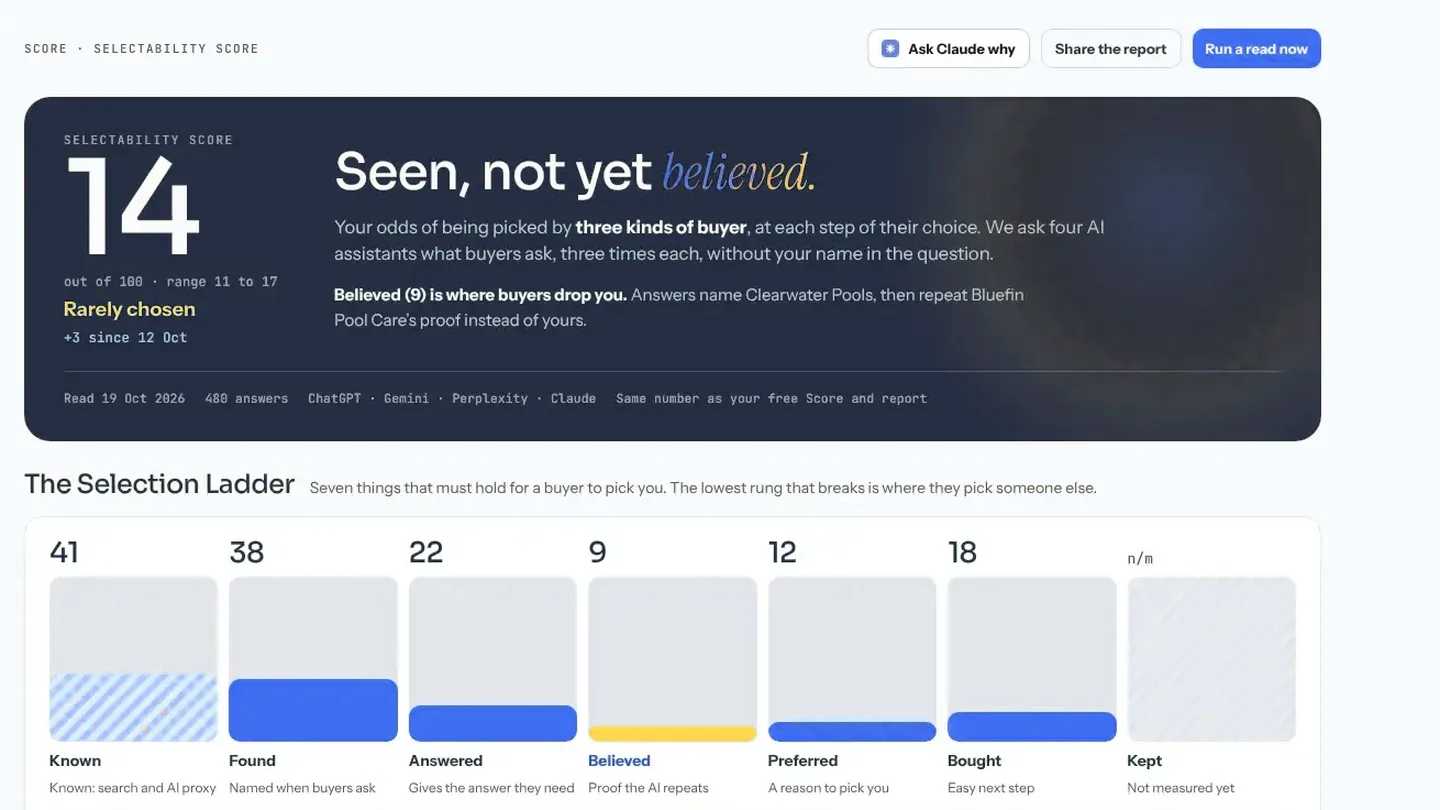
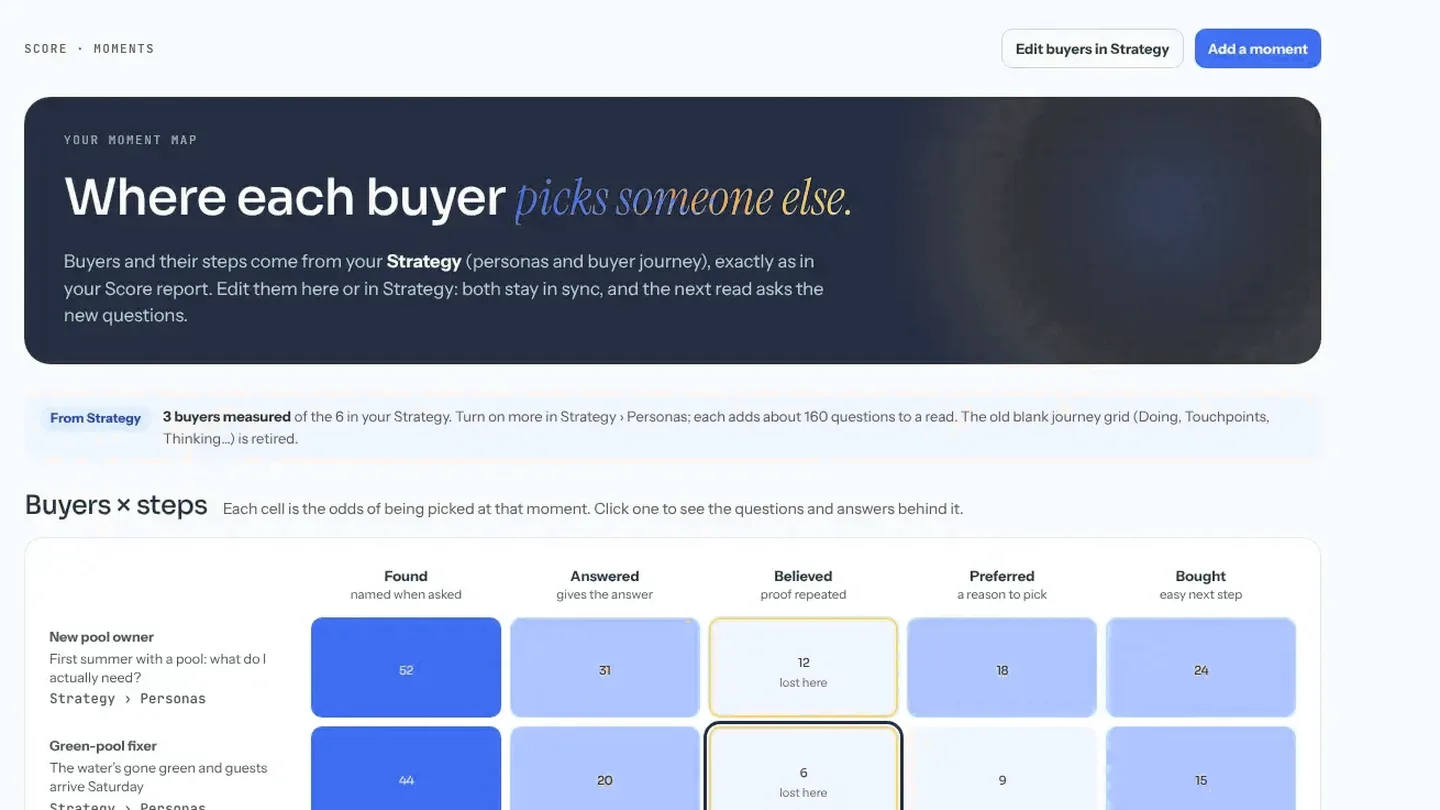
Your free Selectability Score asks the AI assistants the questions your buyers ask, without your name in them. You see who gets picked, at which moment, and the three gaps to fix first.
Answered is the stage where the buyer's real question meets what you've published. Being found brought them to you. Being answered decides whether they take the next step, or leave to ask someone else.
Most brands answer the questions they like: what we do, why we're good, how to get in touch. What they want is what it costs, what goes wrong, who it suits and how it compares.
Those are the questions most businesses leave for the sales call. The buyer, and now the machine, rarely waits for the call. If you don't answer, someone else will, and the buyer takes their answer with them.
The avoided list
Every business has a list of questions it would rather not answer. That list is the content plan.
The idea isn't mine. Marcus Sheridan set it out in They Ask, You Answer (2017), with his "Big 5": cost, problems, comparisons, reviews and "best of" lists. This chapter builds on his framework. What it adds is the chain behind each question, and the machine that now asks the chain for the buyer.
The list is much the same everywhere. It rarely runs past six items:
What does it cost? Including the parts that aren't on the quote.
What goes wrong? The common problems, and what happens when they do.
Who is it not for? The buyers you would rather turn away.
How do you compare? Against the named rival, and against doing nothing.
How long does it take? And what the buyer has to do along the way.
What if I want to leave? Contracts, exit costs, getting my data back.
Each is avoided for a reason that feels sensible from the inside. But the buyer must settle every one before they can say yes.
River Pools, Sheridan's own firm, is the case most often told. It sold fibreglass pools in Virginia, and the 2008 crash nearly sank it. The New York Times reported that orders fell from about six a month to barely two in 2009. The company overdrew its bank account (NYT reprint, SupplyChainBrain).
Its owners cut the marketing budget from about $250,000 to about a tenth of that. They started writing answers to the questions buyers asked, beginning with the awkward ones. The company later passed its pre-crash revenue.
The best-known article answers the question every pool company dodged: what a fibreglass pool really costs. It's still live, updated in December 2025, and gives turn-key ranges of $85,000 to $200,000 (River Pools).
In 2014 Sheridan tweeted that the article had generated "over $2 million" (Heidi Cohen). That's his own figure, and later talks quote larger sums I couldn't trace. What holds up is the pattern: the pages that mattered were the ones the industry avoided.
Yale Appliance, a Boston store, did the same with candid comparisons. Its president reported visitors rising from 40,000 to 150,000, monthly leads from 800 to 2,300, and revenue up 40% since 2009 (MarTech). Those figures are self-reported too.
Why disclosure works, and where it stops
Telling buyers what you would rather not tell them can raise sales, under conditions.
Bhavya Mohan, Ryan Buell and Leslie John ran six studies, two of them in the field. Showing buyers how a price broke down raised purchase probability by 21% and wallet sales by 22% (INFORMS; paper).
The condition matters. The effect held when the firm chose to disclose, and not when the law required it. My reading: a voluntary answer signals good faith, and a compelled one signals nothing.
Martin Eisend pooled the published experiments on two-sided messages, the kind that admit a weakness (Eisend). They raised the credibility of the source, with small positive effects on brand attitude and purchase intention.
But the same meta-analysis found the curve bends. Past a point, more negative information made attitudes worse. How much you admit, where you put it, and whether the firm chose to say it all changed the result.
Shai Ein-Gar, Baba Shiv and Zakary Tormala found something sharper. A minor flaw, placed after the positives, made a product more attractive (Ein-Gar, Shiv and Tormala). The effect held only for people reading lightly. When readers scrutinised, or the flaw came first, it reversed.
So "confess everything" is the wrong rule. Ayn Crowley and Wayne Hoyer set out when a drawback needs refuting and which ones to disclose (Crowley and Hoyer). My working rule from all four papers:
Disclose by choice, before anyone forces you.
Keep the drawbacks a minority of what you say.
Link each one to a benefit or a fix.
Be specific. A vague admission reads like a dodge.
Put them after the strengths, but don't rely on the order.
That last point needs care. The order effect is a low-involvement effect. A committee or a considered buyer reads closely, which is exactly where Ein-Gar's result reverses. For those buyers, what carries the drawback is the fix and the proof, not where it sits on the page.
Buyers also say they want the answers. TrustRadius found that 71% of software buyers would be more likely to buy if a vendor's site showed pricing. And 81% want to find pricing themselves (TrustRadius). The sample size isn't published.
Gartner reported in 2019 that sellers who helped buyers sort conflicting information closed a high-quality, low-regret deal 80% of the time (Gartner, September 2019). The release gives no method, but the point is useful: settle the doubt, rather than add to it. An open doubt is how a serious purchase ends in no decision at all.
An answer is finished only when it removes the next question
Buyers don't ask one question. They ask in chains: a question, then a follow-up, then an objection. An answer is finished only when it removes the next question.
Take "how much does a fibreglass pool cost?". Then "why such a wide range?", then "what pushes it to the top?", then the objection: "concrete looks cheaper, so why fibreglass?". Every link left open is a reason to keep looking.
AI conversations make these chains visible, and the machine now asks some of them for the buyer. Google says AI Mode "uses our query fan-out technique, breaking down your question into subtopics and issuing a multitude of queries simultaneously" (Google). Sundar Pichai said AI Mode queries are on average twice as long as ordinary searches (Alphabet).
That doesn't mean buyers sit typing follow-ups for an hour. Semrush studied 5,054 shared ChatGPT conversations from 2023, and the median was three messages (Semrush). WebFX studied 13,252 shared conversations published in 2025. Sessions averaged about 1.7 messages, but opening prompts averaged 103 words (WebFX).
My reading is that the chain is often packed into one long question, or the engine unpacks it by fanning out. Either way, you have to answer the follow-ups in advance.
Buyers are doing more of this alone. Of 646 business buyers Gartner surveyed in 2025, 67% preferred to buy without a sales rep. And 45% had used AI in a recent purchase (Gartner, 2026). The chain your sales team answered on the call is now answered before the call, or not at all.
The answer page
Each avoided link gets one page, built the same way. I call it the answer page, and the build chapters in Part four use the same anatomy:
The question, in the buyer's words, as the heading.
The answer, in two sentences: the number, the range or the yes or no, first.
The detail: what drives the answer, and the typical case.
The proof: a case, a sourced figure, a customer's words.
The risks: what can go wrong, each with its fix, and who this isn't for.
The next step: one small, clear action.
The machine repeats what's specific. Pages with sourced figures and quotations are cited more often than vague ones, and keyword stuffing does worse than nothing (Chapter 10). A price range, a failure rate and a named comparison are exactly what an answer page contains. The pages you've been avoiding are also the most quotable ones you could write.
How to tell it is failing
Sales calls open with the same three questions every time, and none of them are answered on the site.
Your pricing page says "contact us" and nothing else.
You ask an assistant what you cost, and it quotes a competitor, an old listing or a guess.
Deals stall at "we need to think about it", and nobody knows which question is still open.
The method: the question chain map
A question chain map follows each buyer question to the end of its chain. It shows which links you answer, which you avoid, and which to write first. You build one per moment from your map in Chapter 12.
Pick one moment. One kind of buyer at one step. "Café owner, after a bad quarter, wondering whether to get help" is a moment. "Small businesses" isn't.
Write the first question in their words. Take it from sales notes, support emails, call recordings or assistant prompts.
Follow the chain. For each answer, ask "and then what would they ask?". Write each follow-up beneath the one before it.
Add the objections. Mark the links where the buyer pushes back: "too expensive", "we tried that", "what if it fails?". Objections are questions with a doubt attached.
Stop when nothing is left. The chain ends when the next step is to buy, book or rule you out. If it never ends, the moment is too broad.
Mark what you avoid. Flag every link you don't answer in public, or answer vaguely. If the sales team says "we explain that on the call", it's avoided.
Answer the avoided links first. Write each as an answer page. Agree the price, risk and comparison pages with legal and any channel partners before you start, not after.
Test with a machine. Put the first question to two or three assistants and note the follow-ups they raise. Any follow-up your pages don't answer is the next page to write.
The price question, without a price list
Answering the price question doesn't mean publishing a price list. It means the buyer leaves knowing roughly what they will pay and why.
There's a real case for hiding price. Glenn and Sara Fisher Ellison found that where comparison engines made prices easy to compare, retailers obscured them to protect margins (Ellison and Ellison).
So firms that obscure price can be acting rationally, and I concede it.
The cost is the buyer who leaves to find an answer. Increasingly the machine fills the gap with someone else's figure. River Pools shows the middle way: ranges, the factors that move the cost, and typical totals. A rival learns little from a band that one sales call wouldn't tell them. That's my judgement, not a finding.
The numbers show the trade. HockeyStack looked at 80 software firms and 31 million visitors (HockeyStack). Pricing pages that showed prices converted 2.8% of visitors to a form, against 4.6% for pages that hid them.
But leads from the transparent pages turned into sales pipeline at 17.5%, against 10.3%. Multiply through and pipeline per visitor comes out about the same, near 0.5% either way. The gain is the same pipeline from fewer, better leads, and fewer wasted sales calls.
Partners and lawyers raise the other objection. Bring both in at step 7, and publish what they can live with: ranges rather than list prices, and real problems with their fixes.
The bookkeeper's question chain map
The bookkeeper for cafés is an invented example: "Bookkeeping for cafés. Your wage cost against takings, every Monday by nine." Her moment: a café owner after a bad quarter, wondering whether a bookkeeper would help. Here's the chain.
Link
The buyer's question
Kind
Answered today?
1
Do I need a bookkeeper, or just better software?
First question
Yes, on the home page
2
What does it cost each month?
Follow-up
Avoided: "get in touch for a quote"
3
Why is it more than my accountant charges for the year-end?
Objection
Avoided
4
What exactly do I get on Monday morning?
Follow-up
Partly: a screenshot, no explanation
5
What if my till system doesn't connect?
Objection
Avoided
6
Is this for a café my size?
Follow-up
Avoided: no "who it's not for"
7
Has it helped a café like mine?
Follow-up
Yes: the twelve-month case
8
How do I start, and can I stop?
Follow-up
Partly: a contact form, no terms
Four of the eight links are avoided: the price, the risk and the fit among them. She has been answering them on the phone, to people who already rang. The owners who never rang were lost at link 2.
So she writes three answer pages first. One gives her monthly fee in bands by café size, and what drives the band. One says which till systems connect and what happens if yours doesn't. One says plainly that she isn't for a café with no staff, because with no wage cost there's nothing to watch.
Fieldline's question chain map
At Northgate, the invented contractor, Dana wants Fieldline and Ravi has a rival's sheet. Now Mei, the IT manager, starts her own checks. Her chain is the one Fieldline had avoided.
Link
Mei's question
Kind
Fieldline's site before
1
Does it integrate with our accounts system?
First question
A logo wall, no detail
2
What happens when the integration fails?
Objection
Avoided
3
Where is our data held?
Follow-up
Avoided: "contact sales"
4
What is the total price, with setup and training?
Follow-up
Avoided: "request a demo"
Mei put the chain to an AI assistant. It was vague on link 1, cited a rival's integration guide on links 2 and 3, and quoted an old reseller listing on link 4. Mei wrote "integration risk unclear" in her notes, and the committee slowed.
Fieldline answered the chain in public. It published an integrations page naming each accounts system, with what syncs and how often. It added a page on what happens when a sync fails: how the customer is told, what's queued, and how fast it's fixed. It stated where data is held. And it published price bands by fleet size, with setup and training shown.
A fortnight later the assistant answered each link from Fieldline's own pages. Mei's objection dropped, and she told Dana so.
By mode
The chain's length changes with the mode. A habitual chain is often a single link, so accurate product facts and price wherever they shop come first. A quick choice runs two or three links: does it do the job, what does it cost, can I have it now? Considered personal chains are long, with comparisons and "what goes wrong". An owner asks about cost, time and risk, then "will it work for a business like mine?". A committee runs several chains at once, so write one answer page per role's avoided question, linked from a single hub.
How Answered connects to the other stages
Answered needs Found and one truth: an answer nobody reaches answers nobody, and the price on your answer page must match the price everywhere else. It feeds Believed, because an answer with proof and an honest drawback is the raw material others repeat. And it feeds Bought: the last links in every chain are "how do I start?" and "can I stop?". The question chain map is also the brief for the website and content builds in Part four.
What not to do
Don't confess everything. A long list of flaws, or flaws placed first, turns the effect around.
Don't build a FAQ dump. One page per real question, answered to the end of its chain, does more than a list of short answers.
Don't borrow someone else's numbers as your own. If a case figure is self-reported, as River Pools' is, say so.
How you know it worked
The Selectability Score (Part five) checks one thing for this stage. Does what you publish answer what this buyer needs to know? It counts the share of the buyer's questions and objections your site answers, moment by moment.
Your own numbers add to that:
The share of links in each chain that you now answer in public.
How many sales calls still open with an avoided question.
Lead quality, not just lead volume, after the pricing page changes.
Whether the assistants cite your answer pages when asked your price, your problems and how you compare.
How many deals end in "no decision", before and after.
This afternoon
write down your avoided list. Ask your sales or service team which questions they always answer on the call and never in writing. Pick the one that comes up most.
This quarter
build a question chain map for your three most important moments. Write an answer page for every avoided link, price and risk first. Then put each first question to the assistants, log what they ask next, and close the gaps.
Toolkit
1. Building a question chain. The process behind the question chain map. Run it once per moment, with someone from sales or service in the room.
Read the top row left to right, then follow the loop. The chain ends only when an assistant raises no follow-up you leave open.
2. The answer page template. One page per avoided question, in the anatomy above. Fill every section, even the uncomfortable ones. Before it goes live, get sign-off from legal and any partner whose prices or terms it touches. A month after, ask the assistants the question again and note whether they cite the page.
# [The buyer's question, in their words]

**The answer:** [Two sentences that settle the question.
Give the number, range or yes/no first.]

## The detail
[What drives the answer. The factors, the ranges, the typical case.]

## The proof
[A case, a figure with its source, a quotation from a customer.]

## The risks
[The real problems customers meet, each with what we do about it.
Then who this isn't for, and why.]

## The next step
[One small, clear action. What happens after they take it.]

---
Sign-off: legal [name, date] · partners [name, date]
Citation check: [date] · assistants asked · cited? (Y/N) · what they quoted
Every template for this stage is in the free Selectability Playbooks at rocmode.com/playbooks.
What we don't know
No study I found measures which questions settle a purchase. The thesis rests on disclosure research and on cases, and the best-known cases are self-reported.
Nobody has tested whether answering price, risk or comparison questions on your site changes how often AI recommends you. The GEO paper tests how content is written, not which topics it covers.
How long buying conversations with AI really are is unclear. The two datasets disagree and use only shared conversations.
Where the drawback curve turns from helpful to harmful has no number. My rule of "a minority, with the fix" is a working rule, not a measured threshold.
Whose evidence this is. Marcus Sheridan sells the method through an agency and a book, and his agency promotes Yale Appliance as a client story. TrustRadius sells vendors paid pricing pages. Gartner sells advisory research on buyer behaviour. HockeyStack sells attribution software, Semrush sells search software and WebFX is a marketing agency. Peer-reviewed sources: Mohan, Buell and John; Eisend; Ein-Gar, Shiv and Tormala; Crowley and Hoyer; Ellison and Ellison.