Your buyers ask AI who to pick. Make sure it’s you.
Gets you selected acrossChatGPTClaudeGeminiPerplexity
RocMode shows you whether AI picks you or your rival, finds the work that changes it, builds that work, and sends it to you to approve. Then it proves what moved.
We ask ChatGPT, Claude, Gemini and Perplexity the questions your buyers ask, and show where they pick you and who they pick instead. Free, no login. What’s the Score? Or sign up free and try everything for 14 days.
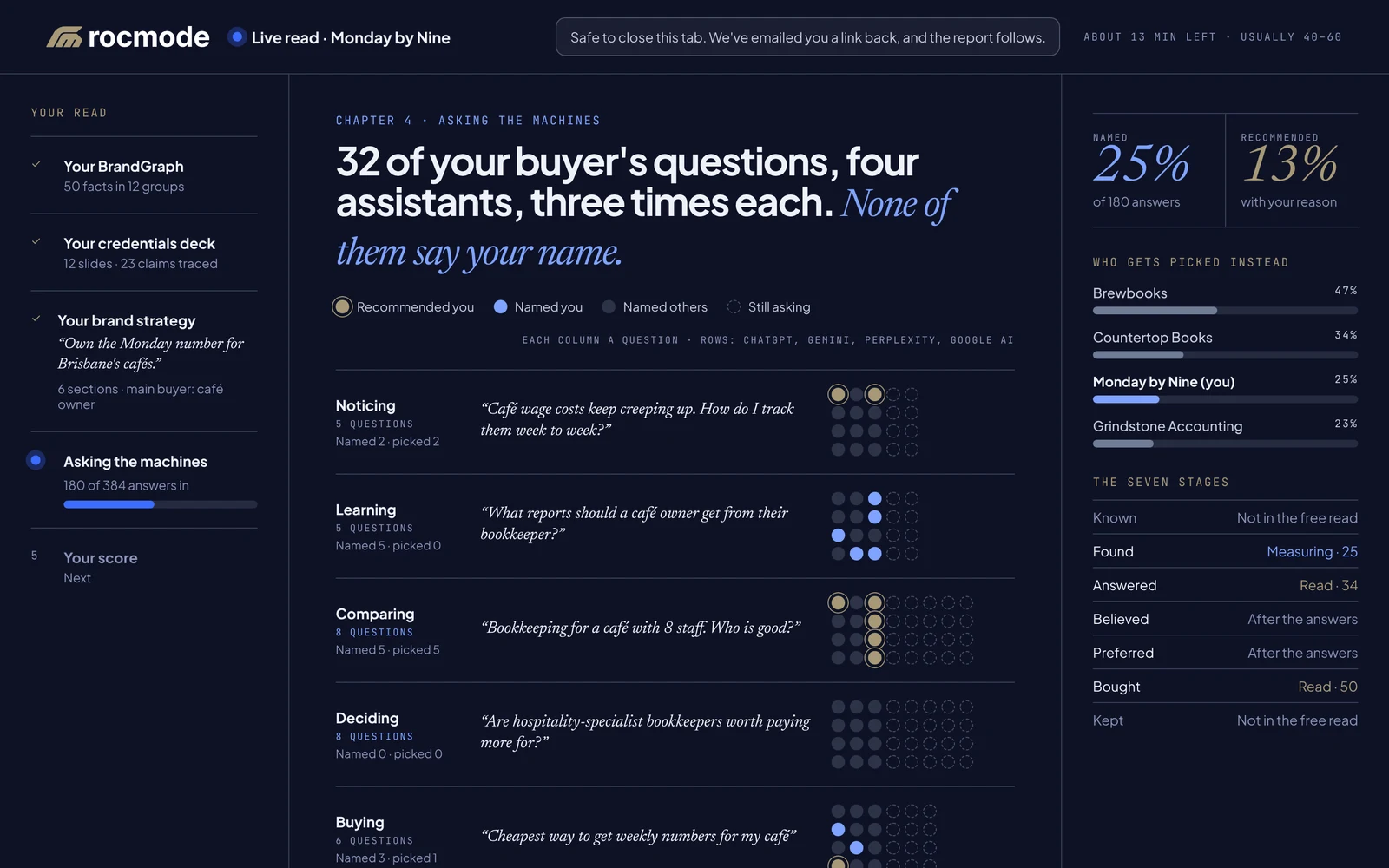
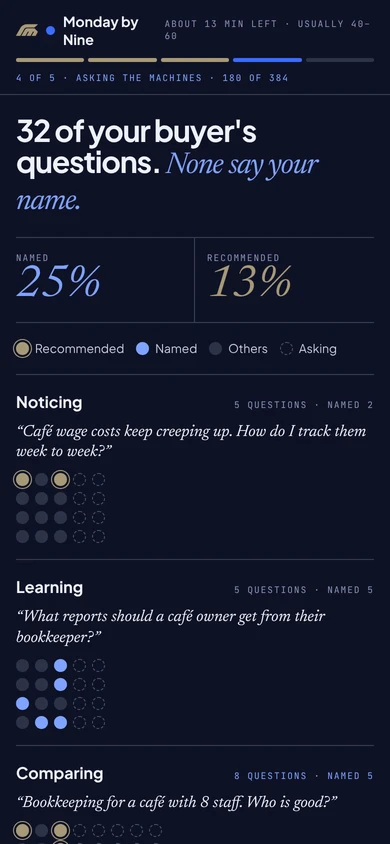
RocMode · Live read · Monday by Nine (example)
Asking ChatGPTBefore
The AI marketing and sales platform
Marketing and sales, rebuilt for the age of AI.
Your website in. A whole marketing and sales team’s work out. RocMode learns your brand from your site, then does the work: strategy, website, ads, social, PR, partners, email, design, and the deck that wins the deal. You approve every piece.
Other tools do one job. This does all of them, as one story.
Other AI guesses. This works from your facts and proof.
Other tools stop at the post. This follows it to the signed deal, and learns what won.
How it works
KnowWhere you really standActWhat to fix firstCreateWe build the work. You approve itProveDid it move?
Know · Step 1 of 10
It gets you. It gets your customers. It connects the dots.
Everything about your brand, your buyers and your rivals, sorted and connected.
Then it works out what to say, where, when and why. It’s the brain behind every step.
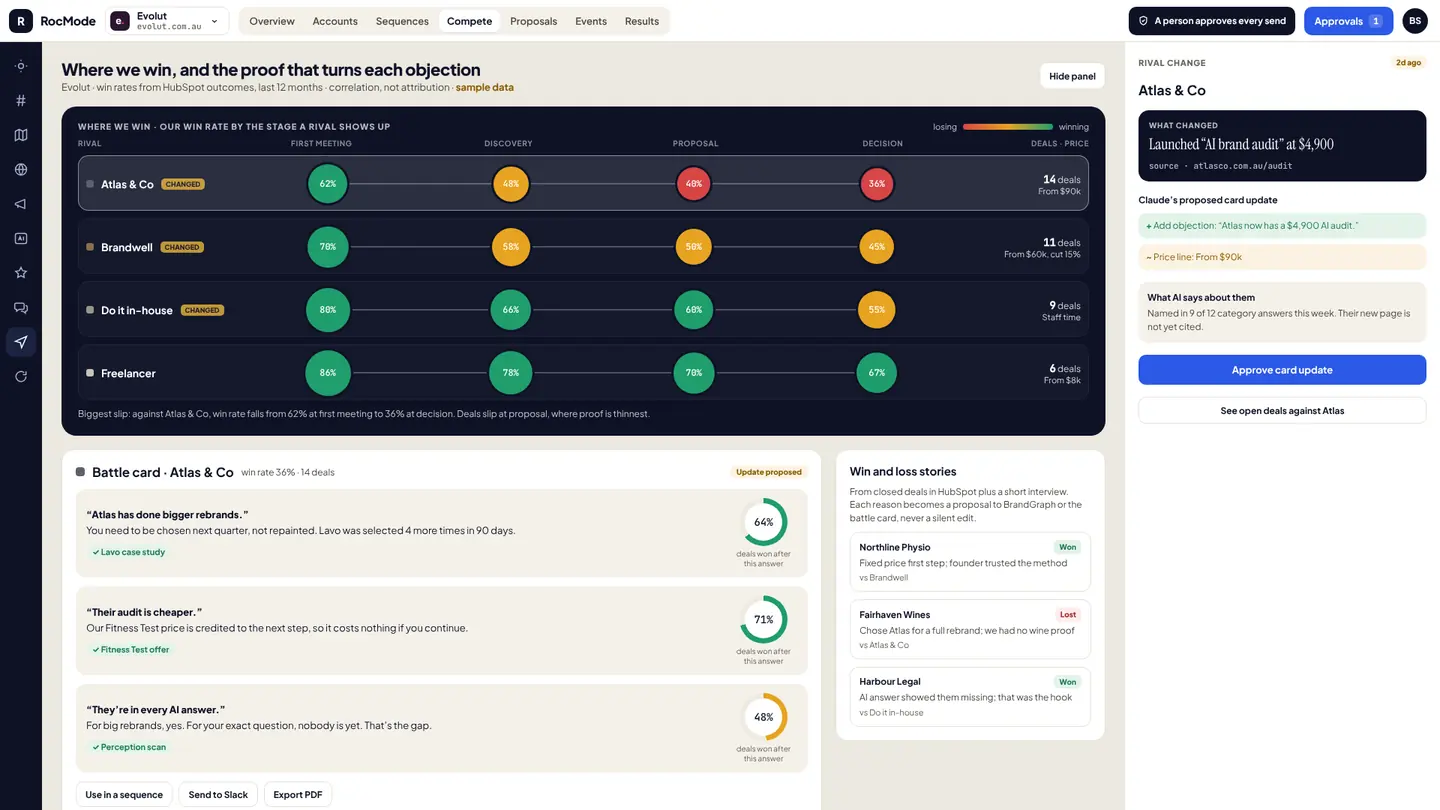
Builds: Customers · Offerings · Rivals · Proof
RocMode · BrandGraph · sample data
Following one momentCISO · Comparing · “Who’s the best managed security provider for a hospital group?”Moment found
Brand core3 found
Voice3 found
Visual identity3 found
Products and services3 found
Pricing3 found
Personas and markets3 found
Pains, gains, jobs3 found
Journeys and objections3 found
Proof and trust3 found
Content3 found
Competitors and partners3 found
Team2 found
Halvard Security35 facts
Two hospital case studies/partners
FactClaimProofAI-suggestedExample: Halvard Security, an invented managed security provider.
Reading halvardsecurity.com.au, socials, reviews and listings…
Halvard SecurityBrandGraph
12areas, all connected
3personas
15moments
6rivals
Sample data
Your customers
Customers
›
Personas
›
Journeys
›
Pains, jobs, objections
›
Moments
What you sell
Products and services
›
Offerings
›
Value proposition
›
Differentiation
Your rivals
Competitors
›
Industry
›
Expectations
›
Gaps to exploit
Moments + offerings
Opportunities
›
Campaigns
›
Ads
›
Sales
Content gaps
›
Content
›
Website
So it knows
What to say.Where. When. Why.
Moment foundCISO · Comparing · “Who’s the best managed security provider for a hospital group?”
Know · Step 2 of 10
Your strategy, from everything it knows.
Positioning built from your offerings and the gaps your rivals leave.
Claims you can’t back get cut before anyone sees them.
Seen isn’t selected. AI picks the brands it can tell apart.
Every era of marketing had its visibility number, and AI mentions are just the newest. Most AI tools still sell you visibility. But being mentioned isn’t being chosen, and for the first time you can measure the pick itself.
BroadcastAwareness
Media buyingReach
SearchRankings
SocialFollowers
AIMentions
What countsSelected
What AI made cheap
Making things.
Posts, pages, ads and reports in minutes
Anyone with a login can do it
Your competitors have the same tools
Sell on volume and you compete on price.
What AI made measurable
Being chosen.
Brand ABrand BYouBrand CBrand D
Buyers ask AI who to pick, and it names a few brands
You can ask the same questions and see who’s named
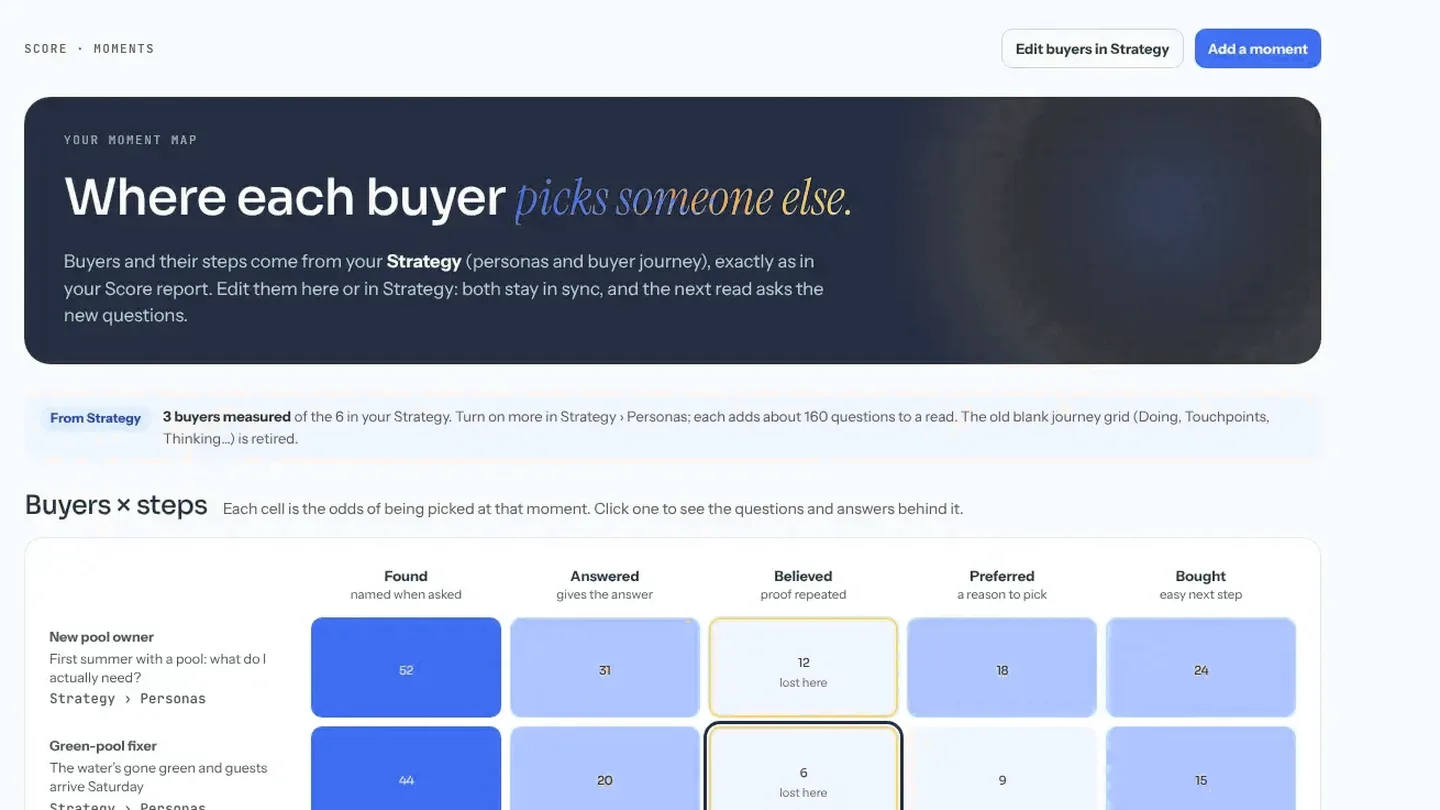
So you can see, moment by moment, where you win and lose
Compete on this and you compete on results.
See it on your brand
See how often AI picks you. Free.
We ask the AI assistants your buyers use the questions they really ask, many times each, at every step of their journey. Then we show where you’re picked, where you’re passed over, and who wins instead.
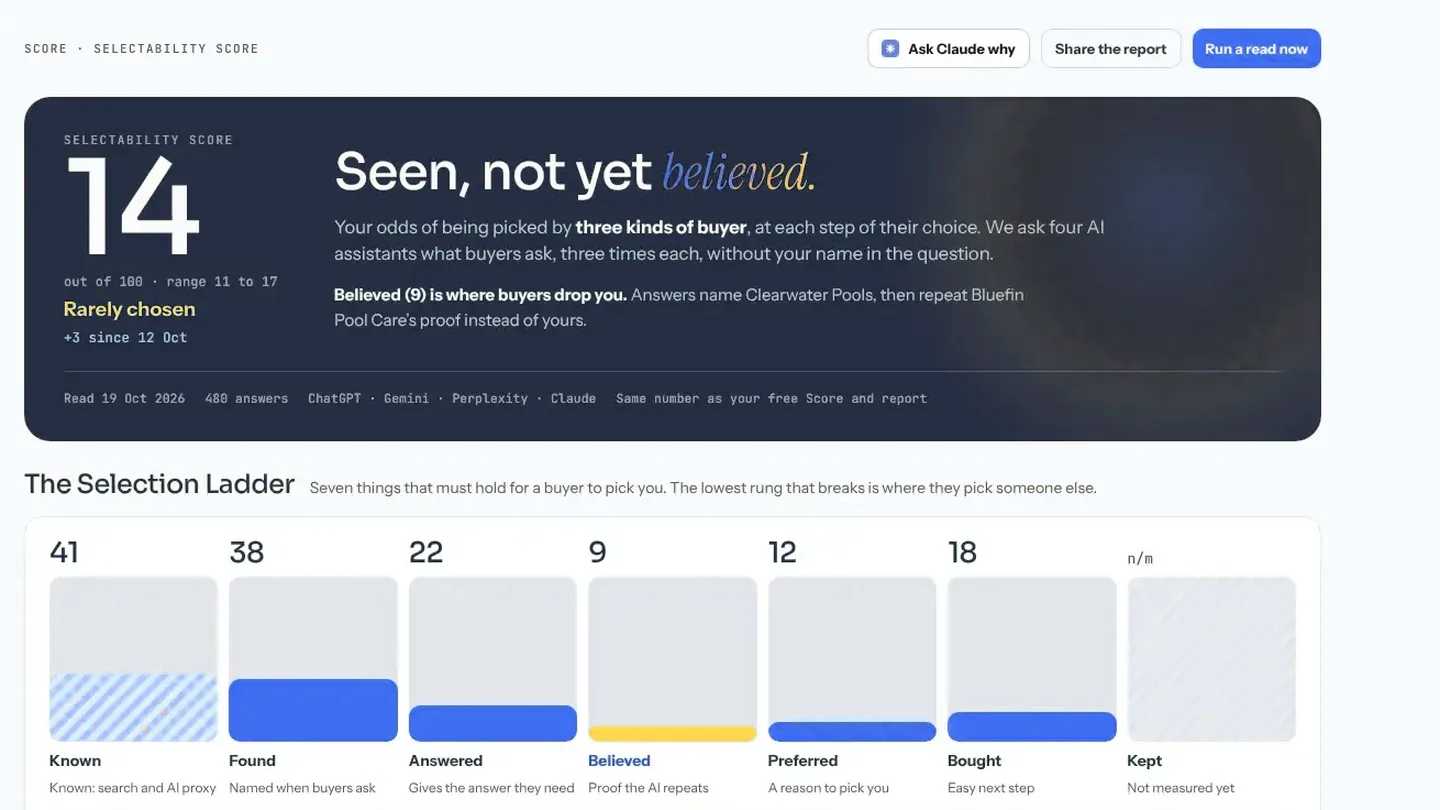
Your free Selectability Score asks the AI assistants the questions your buyers ask, without your name in them. You see who gets picked, at which moment, and the three gaps to fix first.
Search optimisation and answer optimisation are one job: be named, be recommended, and be right.
What changed
Search is usually run as a ranking business. An agency picks keywords, reports positions each month and counts the traffic. Lately a second agency, or a second line on the invoice, offers the same for AI answers under a new acronym.
The work is the same. Google says so: "There are no additional requirements to appear in AI Overviews or AI Mode, nor other special optimizations necessary" (Google Search Central). The entry ticket is ordinary search.
What has changed is the test. Clicks have stopped being the score. Ahrefs studied 300,000 keywords. It estimated an AI Overview cut the top page's click-through rate by 58%, and calls the result a correlation (Ahrefs). And one buyer question now becomes many: Google says its AI features may use "query fan-out", issuing related searches across subtopics. The page that wins answers the follow-ups too.
What it is for
The job has three tests. When a buyer asks without naming you, you're named: that's Found. You're the one recommended: that's Preferred. And what's said about you is right, your price, terms and claims repeated accurately and backed by others: that's Believed.
It also serves Answered in part, because both kinds of answer draw on pages that settle the question.
Named isn't recommended. Picture five names in an answer, with a rival called "best for teams like yours". That's a loss that looks like a win. Most AI-visibility reports count the mention and ignore the verdict.
This build doesn't create Known. A large recent preprint found Google search interest was the strongest predictor of how often AI named a brand (Chapter 13). That interest is made by memory work. This build harvests memory; it rarely creates it. Nor does it close the sale at Bought. Where the buyer lands is the website's job.
The anatomy of a good one
A good programme is a loop. It starts with what buyers ask, ends with what the machines said, then fixes the sources behind the answer.
The buying questions, per moment (Found). Start from your map of moments and the question bank in Chapter 14, not a keyword tool. Write the questions in buyers' own long, specific words.
Answer pages, in plain text (Answered). Each buying question gets one owning page, with the follow-ups the engine will ask on the same page. Keep it in text, not in an image or a gated PDF.
Technical access (Found). Crawlable, fast and consistent. It's a gate, not a lever. Cloudflare, which says it handles traffic for 20% of the web, began blocking AI crawlers by default in July 2025 (Cloudflare). AI firms run separate crawlers for training and for search, and blocking one doesn't block the other.
Other people's pages (Believed). Citations, reviews and lists. The machine weighs what others say about you above what you say. Each source is small and the list shifts, so rebuild it each quarter from your own questions.
Sampled presence (Found · Preferred). Ask the same unbranded questions many times on the assistants your buyers use. Record named, recommended and right, and which sources each answer cites.
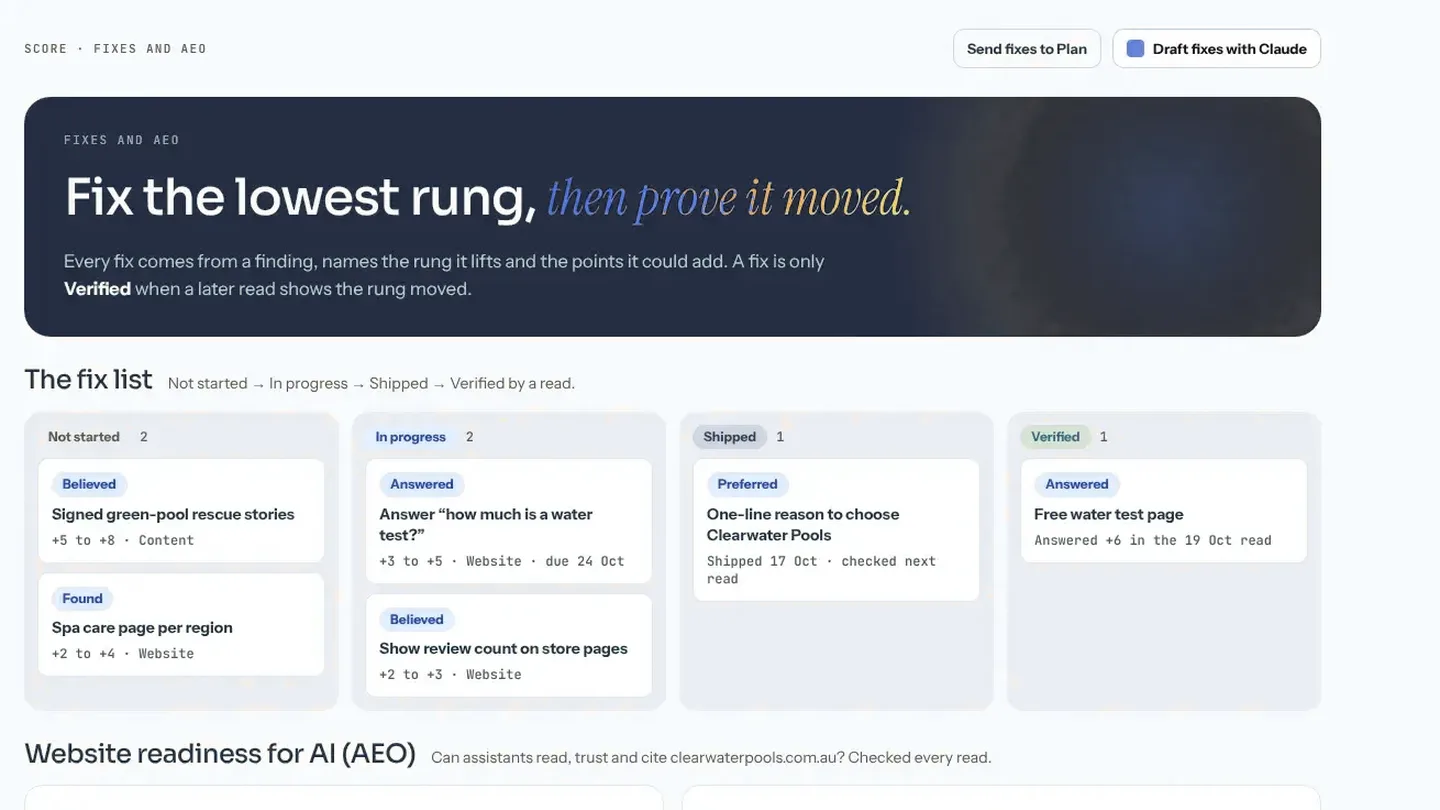
Fix the source, then ask again (Believed). Never chase the answer. Fix the page it came from: correct it if it's yours, earn a place or a correction if it's someone else's.
The mistake most teams make
They buy tricks. There's no special markup: Google says you don't need "new machine readable files, AI text files, or markup". Manipulating answers is now spam. Google's spam policies cover "attempting to manipulate generative AI responses in Google Search" (Google).
Hidden instructions are treated as an attack. Microsoft's security researchers found more than 50 such prompts from 31 companies over 60 days, hidden in "Summarize with AI" buttons (Microsoft). Microsoft calls it "AI Recommendation Poisoning".
The quieter mistake is buying search and AI separately. Same questions, pages and sources. Two agencies means two reports and nobody owning the gap. And most teams keep publishing on their own site while the verdict is written on other people's pages.
How you know it's working
Report three rates per moment, per assistant, with their margins: named, recommended and right. Then ask new enquiries how they found you, and log the moment. Ask buyers, because Google counts AI Overview and AI Mode traffic inside Search Console's ordinary "Web" figures (Google). Keep rankings and traffic as diagnostics, never goals.
Fieldline's search-and-answer programme
Fieldline, the invented scheduling-software firm, had a search agency and a separate AI-visibility retainer. Both reported green, because both tracked the operations question about drive time.
Then a deal stalled. The buyer's IT manager had asked an assistant which scheduling tools connect to their accounting software. Two rivals were named. Fieldline wasn't.
The team mapped the sources behind her question. Its integration guides were PDFs behind a sign-up form. A security review had blocked "all AI bots" at the CDN, including the search crawlers. And a review site's listing showed an integration Fieldline had retired.
The fixes were dull: publish the guides as text, allow the search crawlers, correct the listing. Two months later the IT question named Fieldline in about a third of answers. The stalled deal didn't wait that long; it went to a rival.
The full playbook. The Search and AI Answers Playbook, with the search-and-answer audit scorecard, the page map and the citation source map, is free at rocmode.com/playbooks.
Whose evidence this is. Ahrefs sells SEO and AI-visibility tools. Microsoft sells security products. Google, Microsoft and Cloudflare describe their own systems. No peer-reviewed source is used in this chapter beyond the preprint in Chapter 13.