Your buyers ask AI who to pick. Make sure it’s you.
Gets you selected acrossChatGPTClaudeGeminiPerplexity
RocMode shows you whether AI picks you or your rival, finds the work that changes it, builds that work, and sends it to you to approve. Then it proves what moved.
We ask ChatGPT, Claude, Gemini and Perplexity the questions your buyers ask, and show where they pick you and who they pick instead. Free, no login. What’s the Score? Or sign up free and try everything for 14 days.
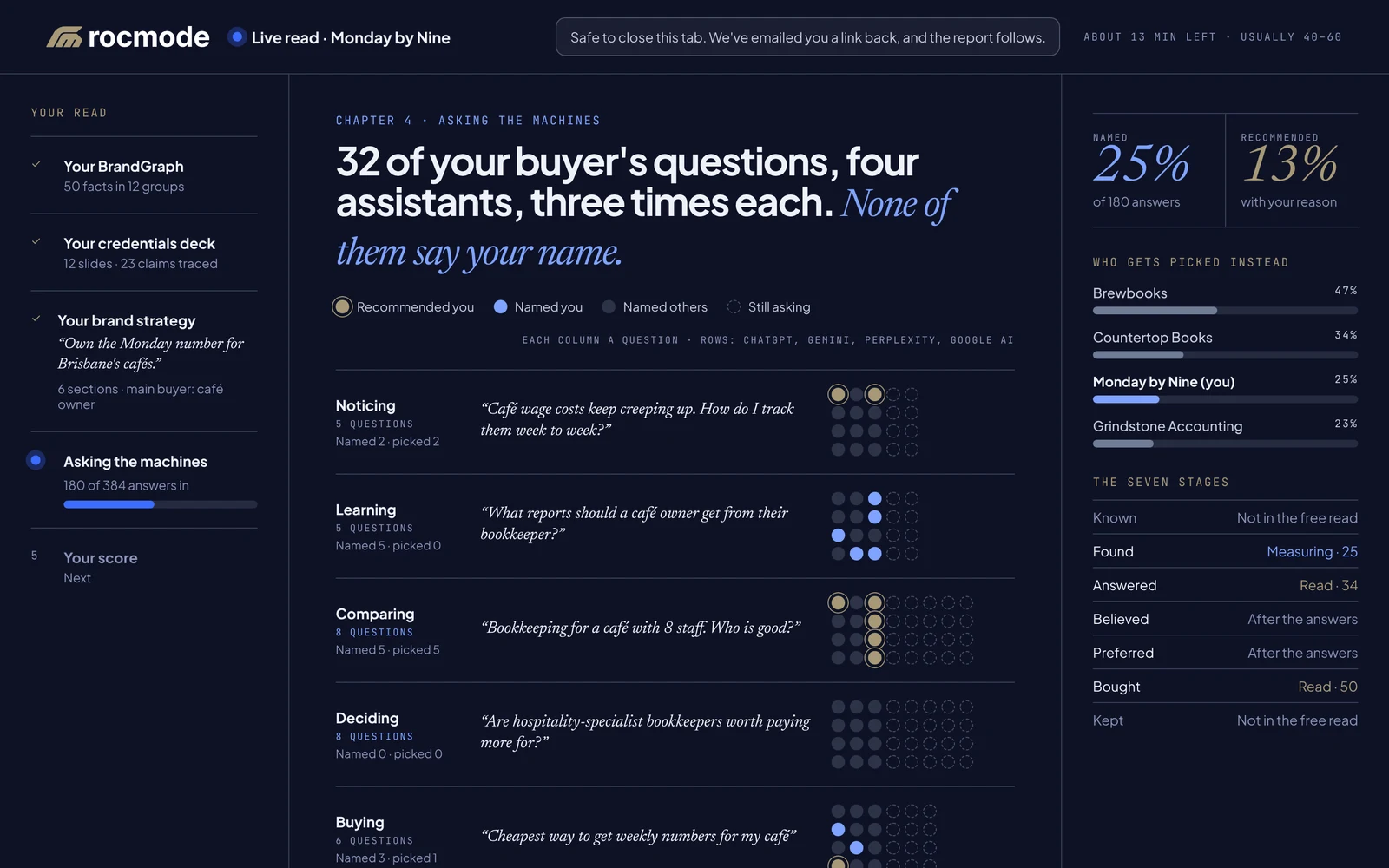
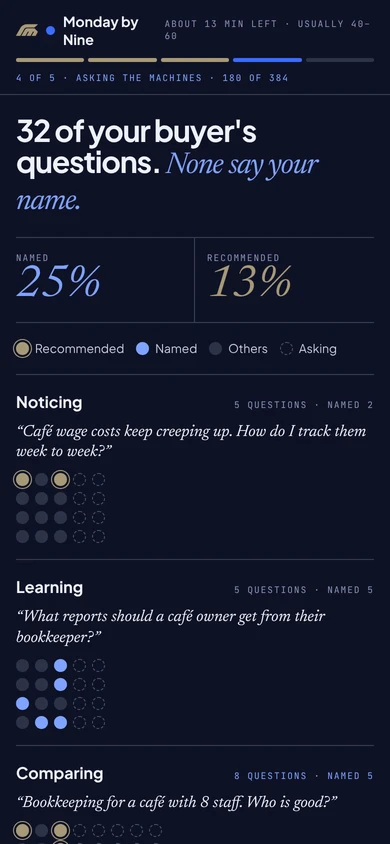
RocMode · Live read · Monday by Nine (example)
Asking ChatGPTBefore
The AI marketing and sales platform
Marketing and sales, rebuilt for the age of AI.
Your website in. A whole marketing and sales team’s work out. RocMode learns your brand from your site, then does the work: strategy, website, ads, social, PR, partners, email, design, and the deck that wins the deal. You approve every piece.
Other tools do one job. This does all of them, as one story.
Other AI guesses. This works from your facts and proof.
Other tools stop at the post. This follows it to the signed deal, and learns what won.
How it works
KnowWhere you really standActWhat to fix firstCreateWe build the work. You approve itProveDid it move?
Know · Step 1 of 10
It gets you. It gets your customers. It connects the dots.
Everything about your brand, your buyers and your rivals, sorted and connected.
Then it works out what to say, where, when and why. It’s the brain behind every step.
Builds: Customers · Offerings · Rivals · Proof
RocMode · BrandGraph · sample data
Following one momentCISO · Comparing · “Who’s the best managed security provider for a hospital group?”Moment found
Brand core3 found
Voice3 found
Visual identity3 found
Products and services3 found
Pricing3 found
Personas and markets3 found
Pains, gains, jobs3 found
Journeys and objections3 found
Proof and trust3 found
Content3 found
Competitors and partners3 found
Team2 found
Halvard Security35 facts
Two hospital case studies/partners
FactClaimProofAI-suggestedExample: Halvard Security, an invented managed security provider.
Reading halvardsecurity.com.au, socials, reviews and listings…
Halvard SecurityBrandGraph
12areas, all connected
3personas
15moments
6rivals
Sample data
Your customers
Customers
›
Personas
›
Journeys
›
Pains, jobs, objections
›
Moments
What you sell
Products and services
›
Offerings
›
Value proposition
›
Differentiation
Your rivals
Competitors
›
Industry
›
Expectations
›
Gaps to exploit
Moments + offerings
Opportunities
›
Campaigns
›
Ads
›
Sales
Content gaps
›
Content
›
Website
So it knows
What to say.Where. When. Why.
Moment foundCISO · Comparing · “Who’s the best managed security provider for a hospital group?”
Know · Step 2 of 10
Your strategy, from everything it knows.
Positioning built from your offerings and the gaps your rivals leave.
Claims you can’t back get cut before anyone sees them.
Seen isn’t selected. AI picks the brands it can tell apart.
Every era of marketing had its visibility number, and AI mentions are just the newest. Most AI tools still sell you visibility. But being mentioned isn’t being chosen, and for the first time you can measure the pick itself.
BroadcastAwareness
Media buyingReach
SearchRankings
SocialFollowers
AIMentions
What countsSelected
What AI made cheap
Making things.
Posts, pages, ads and reports in minutes
Anyone with a login can do it
Your competitors have the same tools
Sell on volume and you compete on price.
What AI made measurable
Being chosen.
Brand ABrand BYouBrand CBrand D
Buyers ask AI who to pick, and it names a few brands
You can ask the same questions and see who’s named
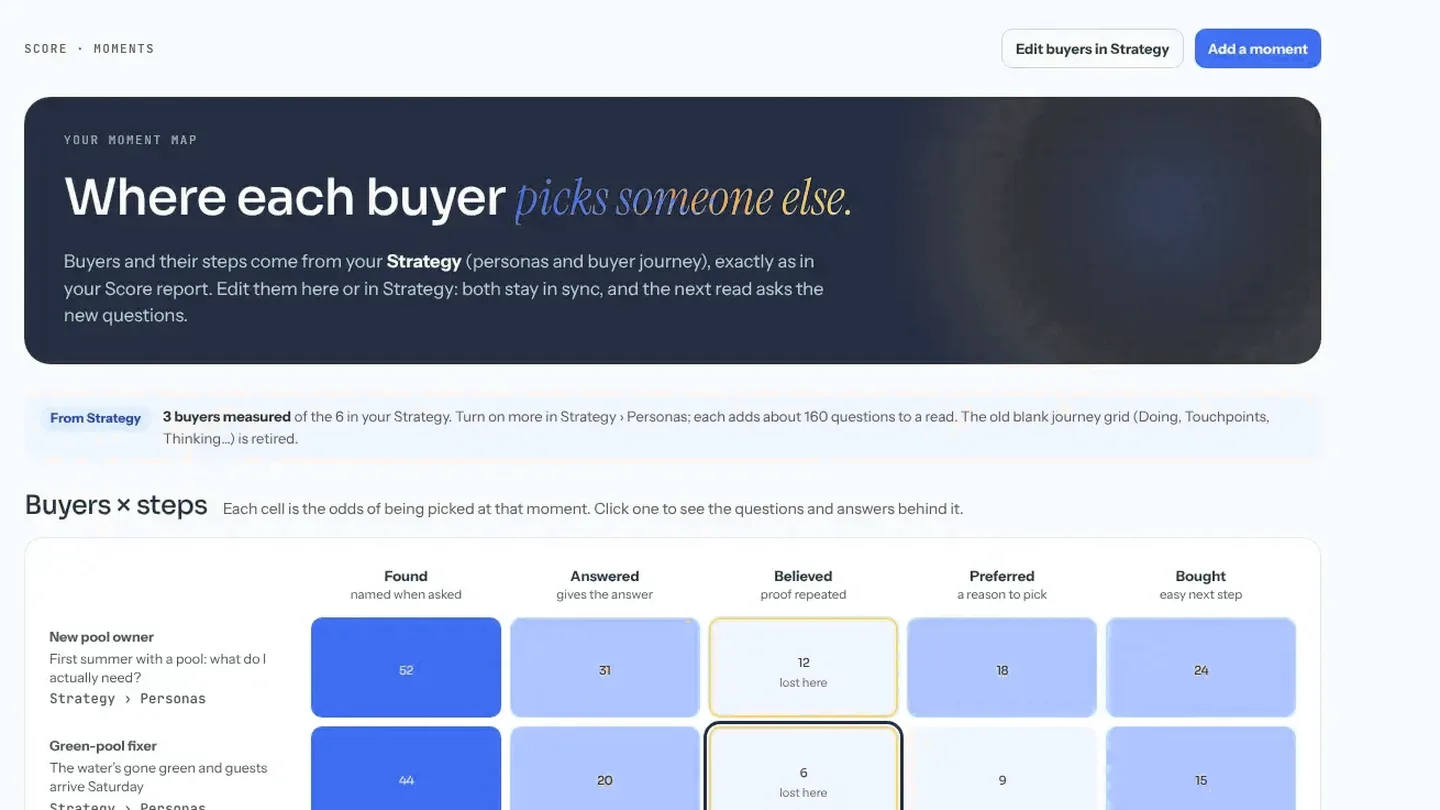
So you can see, moment by moment, where you win and lose
Compete on this and you compete on results.
See it on your brand
See how often AI picks you. Free.
We ask the AI assistants your buyers use the questions they really ask, many times each, at every step of their journey. Then we show where you’re picked, where you’re passed over, and who wins instead.
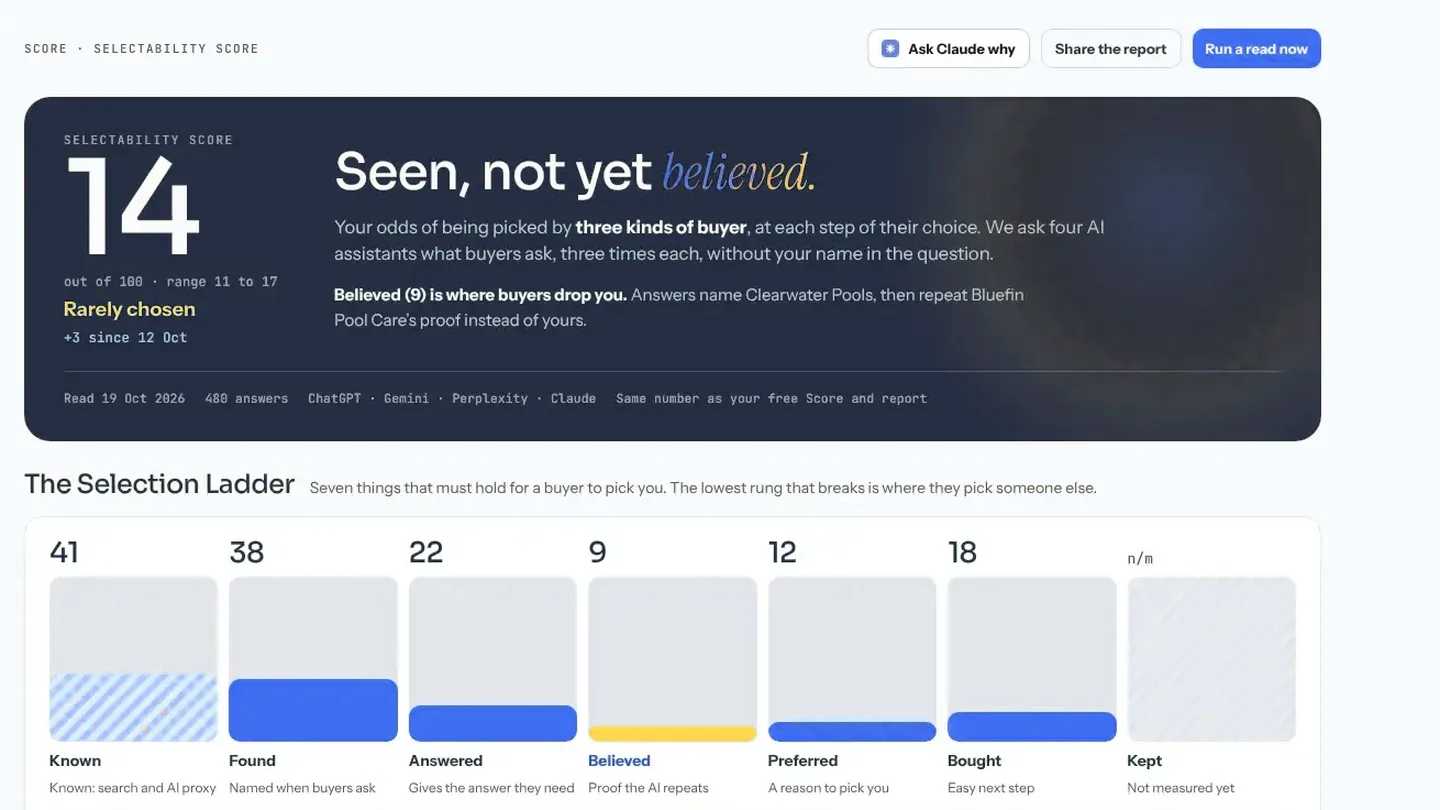
Your free Selectability Score asks the AI assistants the questions your buyers ask, without your name in them. You see who gets picked, at which moment, and the three gaps to fix first.
PR's job is no longer coverage. It is getting into the sources the machine quotes, with something only you have.
What changed
PR is usually judged by its clippings: how many pieces ran, how many people they reached, and what the same space would have cost as advertising. That last figure is the advertising value equivalent, or AVE. The industry's own measurement body gave up on it long ago. AMEC's 2020 Barcelona Principles are blunt: "AVEs are not the value of communication" (AMEC). In my experience, it still turns up in reports.
Reviews get run as a score to protect. Someone watches the star rating, chases a few happy customers when it dips, and leaves the bad reviews unanswered.
Neither habit asks what the buyer, or now the machine, read at the moment of checking.
What it is for
PR and reviews have one job once the goal is being selected. They put other people's words about you into the places buyers and machines check.
That makes this the main build for Believed. Judgements about you are only accepted from others, and this build is how you earn them.
It serves three more stages. It builds Known in the machine's memory: news mentions went with AI prominence in Chapter 13's exploratory study. It serves Found, because the sources cited for a buying question decide who gets named. And it supplies the reason at Preferred, in someone else's voice.
It depends on Kept. Reviews come from customers whose promises were kept. PR can't fix a product that lets people down; it'll only spread the news faster. And it doesn't do the work of Answered or Bought. Your facts, prices and terms belong on your own site.
The anatomy of a good one
It runs as two tracks on their own clocks. Reviews turn every week; PR turns once a quarter. For most small firms, reviews are the Monday task, so start there.
Reviews, asked at the right moment [Believed]. Ask when the job is done, at the first win. Never gate: the US Federal Trade Commission says, "Don't ask for reviews only from customers you think will leave positive ones" (FTC).
A public reply to every review [Believed · Kept]. The next buyer reads it. Davide Proserpio and Georgios Zervas found that when hotels began responding, their ratings rose by 0.12 stars on average, and they received 12% more reviews (Proserpio and Zervas). Hotels got fewer but longer negative reviews, once unhappy guests knew someone would read them.
The questions buyers ask, and the sources cited [Found]. Ask your buying questions in the assistants your buyers use, many times each, and read the citations. Those are your target list. A trade newsletter may matter more than a national paper.
Something only you have [Preferred]. Proprietary data, a finding or a clear point of view. Cision surveyed 1,899 journalists, who named original research, expert access and embargoed information as what they value (Cision). The finding should carry your reason, so it travels whenever the number is quoted.
The right outlets [Believed]. Take the finding to the sources your map turned up, starting with those cited most.
Ask again [Found]. Rerun the same questions each quarter and check whether you now appear.
The mistake most teams make
They pitch announcements to big lists: a new hire, a new office, an award. Nobody else needs to quote any of it. The same Cision survey found 72% of journalists say fewer than a quarter of pitches they receive are relevant.
The second mistake is on the reviews side: leaving bad reviews unanswered, or filtering them. That's now law, not just manners. The FTC's rule on fake reviews took effect on 21 October 2024 (FTC), and in the UK hiding negative reviews is banned too (CMA). Answer the bad ones first, because the next buyer reads them first. Own what was wrong and say what changed.
And don't write your own Wikipedia entry. Wikipedia is among the sources assistants cite most, and paid advocates are "very strongly discouraged" from editing their own articles (Wikipedia). Earn the independent coverage its editors can cite, and let them write it.
How you know it's working
Retire coverage counts, AVE and the star rating as goals. Steer by the share of your buying questions where you appear in at least one cited source; the number of top-cited sources you're in, quarter on quarter; whether your finding is quoted with your reason attached; reviews in the last 90 days; and the share of reviews answered, with the time taken on the negative ones.
An example
Fieldline, the invented scheduling-software firm, found a G2 review saying the travel savings "never showed up after the pilot". Nobody had replied. The customer team answered that week: the customer hadn't switched on route grouping, here were the drive-time figures since the fix, and here was a named contact. A month later, the finance question returned the review and the reply together.
The PR track went less well. The trade magazine ran Fieldline's drive-time finding as a feature, but two quarters on the assistants still cited an industry survey instead. The weekly track is faster. The quarterly one may yet fail.
The full playbook. The PR and Reviews Playbook, with the source map and PR target list, the data-story pitch and the review response guide, is free at rocmode.com/playbooks.
Whose evidence this is. Cision sells PR and media software. AMEC is the measurement industry's own body. The FTC and CMA are regulators. Peer-reviewed: Proserpio and Zervas, whose study used hotels, so other categories are untested.