Your buyers ask AI who to pick. Make sure it’s you.
Gets you selected acrossChatGPTClaudeGeminiPerplexity
RocMode shows you whether AI picks you or your rival, finds the work that changes it, builds that work, and sends it to you to approve. Then it proves what moved.
We ask ChatGPT, Claude, Gemini and Perplexity the questions your buyers ask, and show where they pick you and who they pick instead. Free, no login. What’s the Score? Or sign up free and try everything for 14 days.
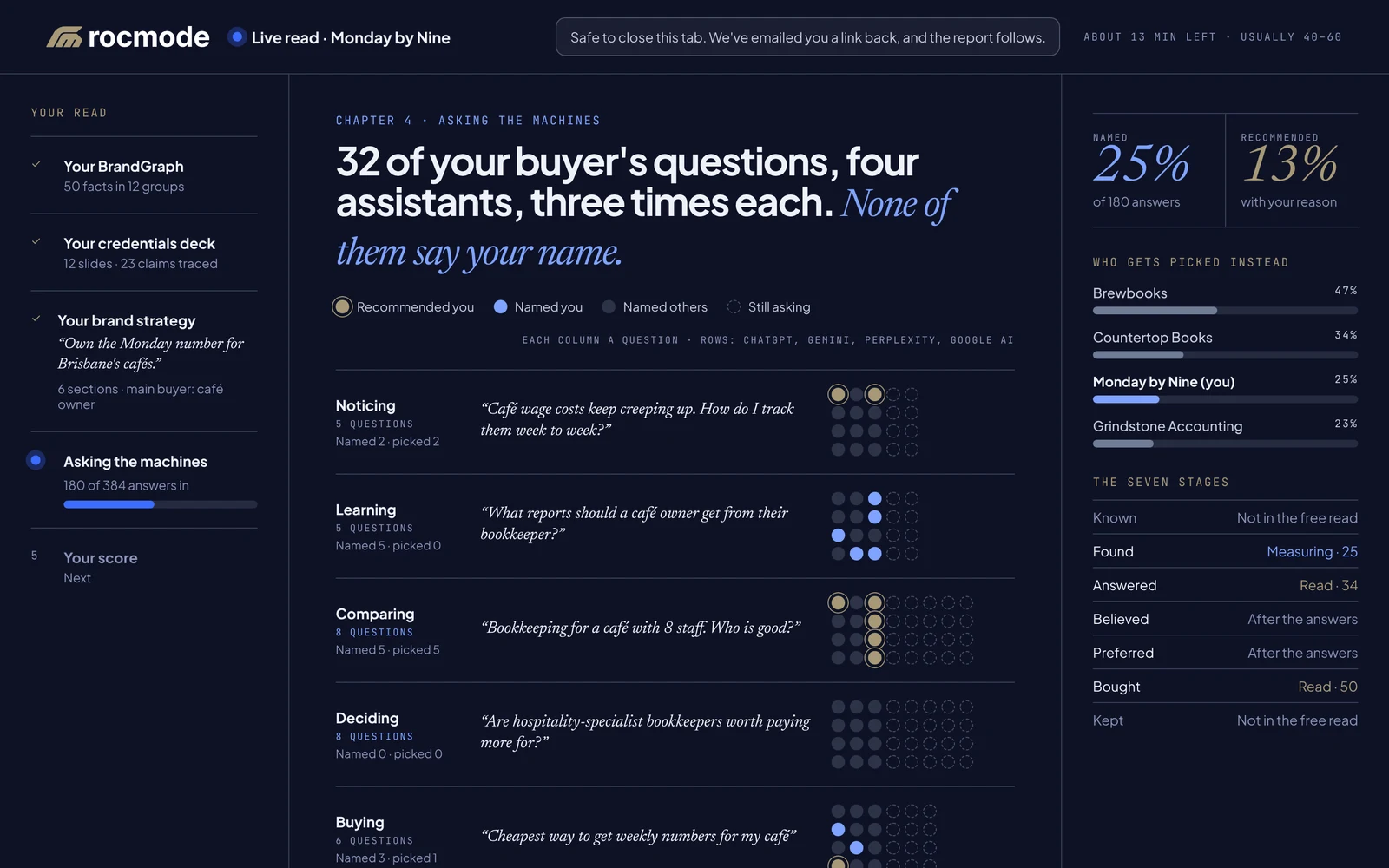
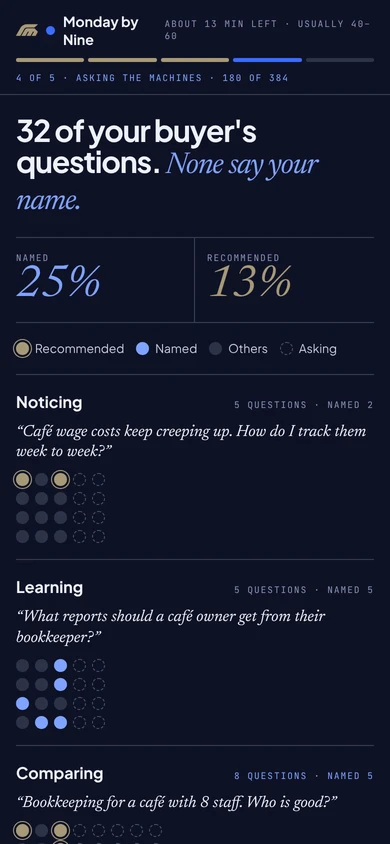
RocMode · Live read · Monday by Nine (example)
Asking ChatGPTBefore
The AI marketing and sales platform
Marketing and sales, rebuilt for the age of AI.
Your website in. A whole marketing and sales team’s work out. RocMode learns your brand from your site, then does the work: strategy, website, ads, social, PR, partners, email, design, and the deck that wins the deal. You approve every piece.
Other tools do one job. This does all of them, as one story.
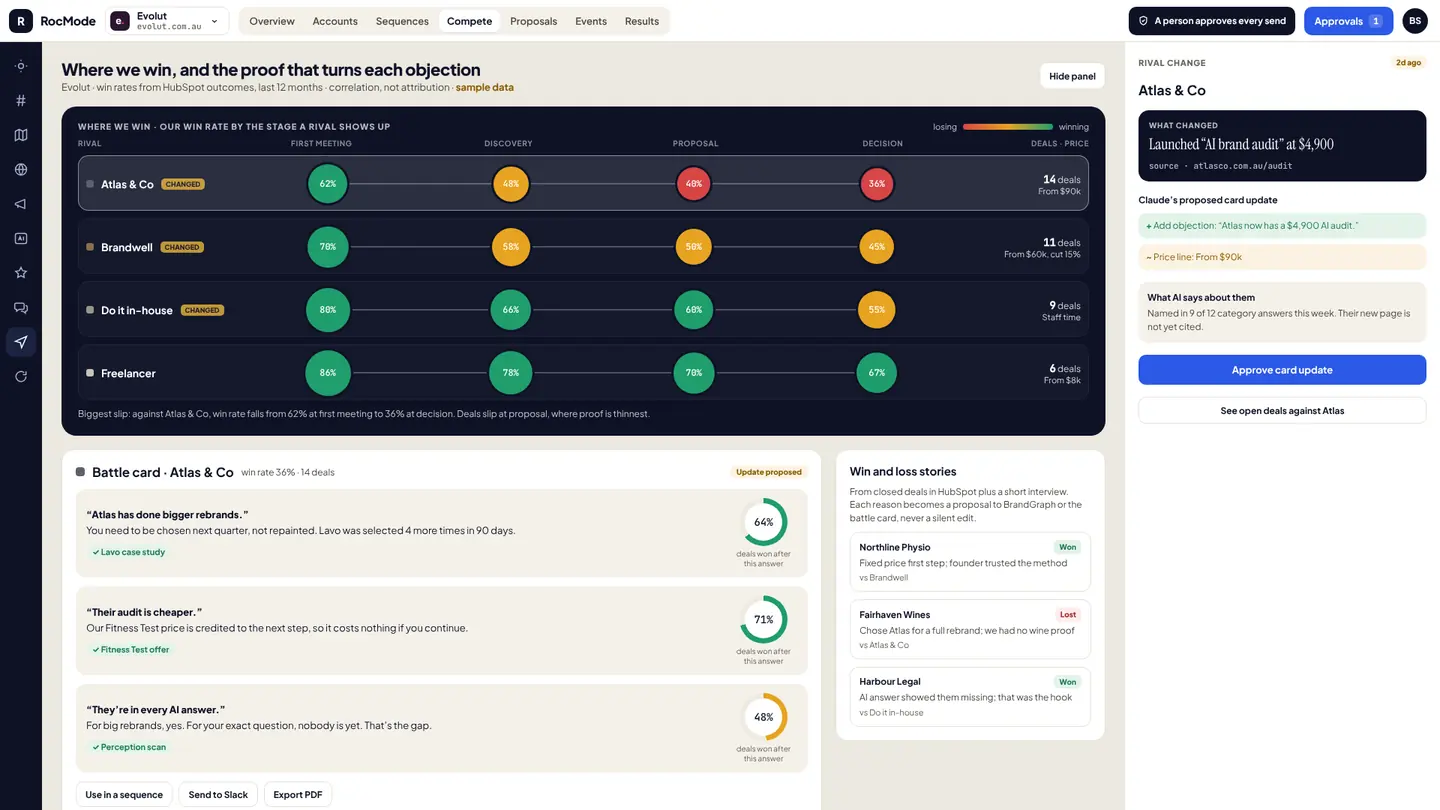
Other AI guesses. This works from your facts and proof.
Other tools stop at the post. This follows it to the signed deal, and learns what won.
How it works
KnowWhere you really standActWhat to fix firstCreateWe build the work. You approve itProveDid it move?
Know · Step 1 of 10
It gets you. It gets your customers. It connects the dots.
Everything about your brand, your buyers and your rivals, sorted and connected.
Then it works out what to say, where, when and why. It’s the brain behind every step.
Builds: Customers · Offerings · Rivals · Proof
RocMode · BrandGraph · sample data
Following one momentCISO · Comparing · “Who’s the best managed security provider for a hospital group?”Moment found
Brand core3 found
Voice3 found
Visual identity3 found
Products and services3 found
Pricing3 found
Personas and markets3 found
Pains, gains, jobs3 found
Journeys and objections3 found
Proof and trust3 found
Content3 found
Competitors and partners3 found
Team2 found
Halvard Security35 facts
Two hospital case studies/partners
FactClaimProofAI-suggestedExample: Halvard Security, an invented managed security provider.
Reading halvardsecurity.com.au, socials, reviews and listings…
Halvard SecurityBrandGraph
12areas, all connected
3personas
15moments
6rivals
Sample data
Your customers
Customers
›
Personas
›
Journeys
›
Pains, jobs, objections
›
Moments
What you sell
Products and services
›
Offerings
›
Value proposition
›
Differentiation
Your rivals
Competitors
›
Industry
›
Expectations
›
Gaps to exploit
Moments + offerings
Opportunities
›
Campaigns
›
Ads
›
Sales
Content gaps
›
Content
›
Website
So it knows
What to say.Where. When. Why.
Moment foundCISO · Comparing · “Who’s the best managed security provider for a hospital group?”
Know · Step 2 of 10
Your strategy, from everything it knows.
Positioning built from your offerings and the gaps your rivals leave.
Claims you can’t back get cut before anyone sees them.
Seen isn’t selected. AI picks the brands it can tell apart.
Every era of marketing had its visibility number, and AI mentions are just the newest. Most AI tools still sell you visibility. But being mentioned isn’t being chosen, and for the first time you can measure the pick itself.
BroadcastAwareness
Media buyingReach
SearchRankings
SocialFollowers
AIMentions
What countsSelected
What AI made cheap
Making things.
Posts, pages, ads and reports in minutes
Anyone with a login can do it
Your competitors have the same tools
Sell on volume and you compete on price.
What AI made measurable
Being chosen.
Brand ABrand BYouBrand CBrand D
Buyers ask AI who to pick, and it names a few brands
You can ask the same questions and see who’s named
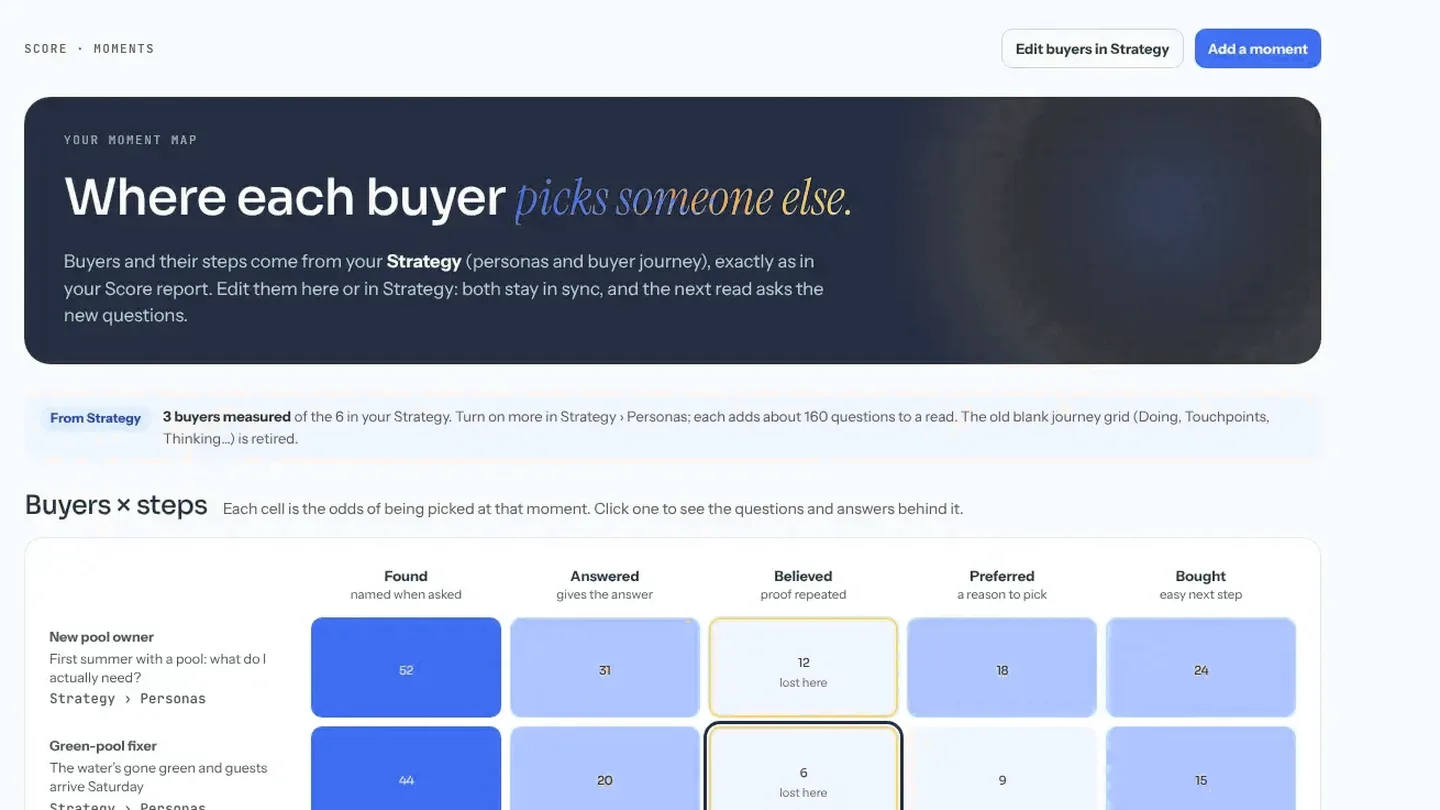
So you can see, moment by moment, where you win and lose
Compete on this and you compete on results.
See it on your brand
See how often AI picks you. Free.
We ask the AI assistants your buyers use the questions they really ask, many times each, at every step of their journey. Then we show where you’re picked, where you’re passed over, and who wins instead.
Your free Selectability Score asks the AI assistants the questions your buyers ask, without your name in them. You see who gets picked, at which moment, and the three gaps to fix first.
In October 2025, I asked an AI assistant a simple question, the kind a buyer would ask: "Who are the top digital agencies in Brisbane, Australia?"
It came back with about ten names. I'd heard of most of them. Evolut wasn't one. Not in the list, not in a footnote, nowhere.
I laughed. Then it stopped being quite so funny. I felt we did better work than most of the agencies on that list. But they were clearly doing a better job of being found.
It wasn't for lack of content. Our website is far denser than most agencies' sites, and it's full of case studies. The problem was that almost all of it was us talking about us. There was little or nothing outside our own site to back any of it up, and the machine had no one else's word to go on.
Around then I decided I was going to master this new game of getting brands into AI answers.
For the first time, something other than a person is reading your market. It reads far more of it than any buyer could, and it will tell you what it thinks. It isn't a careful referee, though.
The newest adviser
Buyers have always leaned on advisers: the retailer who decides what goes on the shelf, the broker who recommends a lender, the friend who knows cars. An AI assistant is the newest. It isn't yet the buyer, but it's moving that way. Today people use it to compare options, then decide for themselves. It already writes much of the shortlist, and that's most of the choice. Next it will place the order, starting with the repeat purchase and the routine reorder.
In a 2026 Ipsos study across 15 markets, 27% of consumers who knew of AI tools used them for product research. Only 9% would let them buy without asking (Ipsos). That's an attitude, not observed behaviour.
Use is growing fast. BCG found nearly a third of consumers now use AI somewhere in a purchase, about triple the rate of 18 months earlier (BCG).
You can ask it
No marketer could ever interview the retailer, the broker and the friend about every buying moment in the market. The machine will answer all day.
Ask it the questions your buyers ask, many times over, because one answer is one draw. Where it prefers a rival it will often say why, and the why is a list of work to do.
How much it matters so far
The effect is strongest where the purchase is complex. The best evidence is peer-reviewed. Kaiser and Schulze analysed 973 online stores, with more than US$20 billion in combined revenue, from August 2024 to July 2025 (Marketing Science).
Sites in complex categories drew 4.6 times the share of ChatGPT referrals that simple categories did. On those sites, visitors sent by ChatGPT converted better than five traditional channels, organic search and email among them. Across all 973 sites, AI referrals were under 0.2% of visits, and overall they converted below every traditional channel except paid social.
It is growing and improving quickly. Adobe's retail data, reported by Decrypt, shows AI-sent visitors converting 38% worse than others in March 2025. A year later they converted 42% better (Decrypt). By May 2026 the gap was 54% (Digital Commerce 360).
Similarweb counted 770.7 million visits a month sent by AI assistants worldwide in the year to May 2026, up 117% on the year before (Similarweb). It's still a small share of all visits, and that's the point: most of the choosing now happens inside the answer, before anyone clicks.
The shortlist moves to the machine
The list is written early, and AI has started to write it. The machine leans on its own memory. In one preprint experiment, AI models picked the famous brand on a tie, but dropped it when a rival offered better specifications.
So AI doesn't level the field for challengers. Where information is thin, the known brand wins the tie. A challenger wins by giving the machine better evidence, not more content. Tally, a ten-person maker of online forms, says AI assistants now bring it a large share of its new users.
There is no page one
When volunteers asked AI assistants the same request for brand recommendations, they almost never got the same list twice. So there's no position to hold, and a tool that reports your rank in an AI answer is mostly reporting noise.
What did hold steady was how often each brand appeared across many runs. Selection by a machine is a rate, not a rank. Chapter 14 shows how to measure it.
Named is not recommended
An AI can name five brands and recommend one. Counting how often you're named is visibility. Counting how often you're the one recommended, and why, is Selectability.
The gap is wide: in one adviser's sample of 31,200 answers, the brands it tracked were the first choice in under a third. And it changes what people do. In one 2026 preprint, a recommendation moved people to search for a brand two to three times more than a neutral mention (Iannelli and Ai).
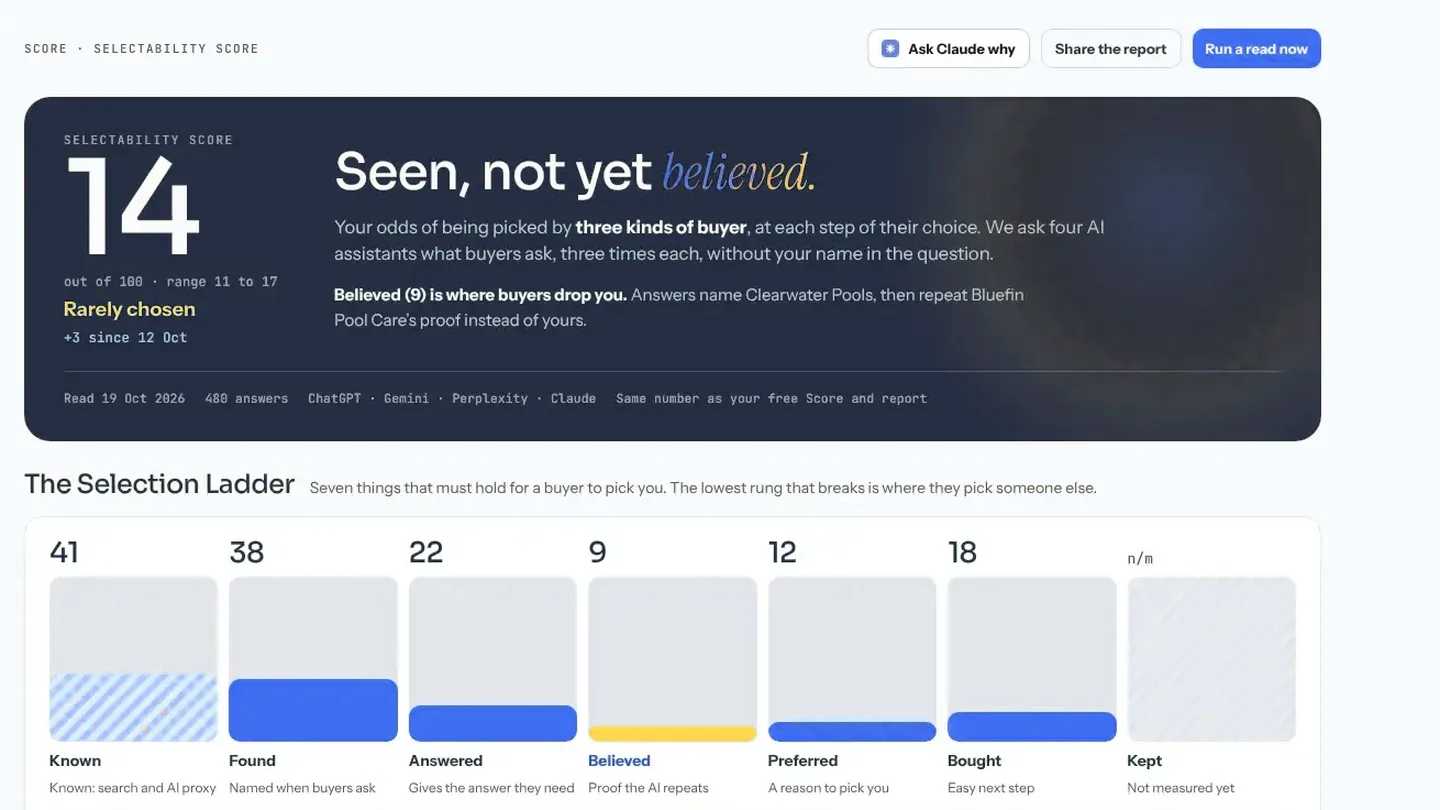
The seven stages apply to the machine as they do to a person: does it know you, find you, believe you and prefer you?
The buyer checks the machine
The machine advises and the buyer audits, harder when more is at stake. In a 2026 TrustRadius survey of 1,862 technology buyers, 63% used AI in their research. And 94% fact-checked what it told them at least some of the time (TrustRadius).
So in a considered purchase, the machine's answer starts the checking, often on your own website. What the buyer finds there has to match what the machine said.
Two memories
Marketing works by leaving a memory. There are now two memories to leave: one in the buyer, one in the machine. The buyer's is built by experience and advertising. The machine's is built from what has been written about you, much of it by other people.
Studies of what AI cites disagree widely on how much. My reading is that your own site supplies the facts, and others supply the verdict.
The machine can be fooled
In March 2026 China's state broadcaster showed how easily. An insider used software bought openly online to invent a smartwatch, with fake reviews and experts who didn't exist. Soon a popular chatbot was recommending it (China Media Project).
Nobody yet knows for how long that will work. Two things still favour real evidence. Buyers check the machine when the stakes are high, and the platforms now treat manufactured evidence as spam.
The machine reads what you have published, and what's said about you, in one sitting. So what should it find?
Whose evidence this is. Ipsos sells market research. BCG sells consulting. Adobe sells analytics and commerce software. TrustRadius runs a software review site. Similarweb sells web analytics. Peer-reviewed source: Kaiser and Schulze, in Marketing Science. Iannelli and Ai is a preprint.
Try this
Ask two AI assistants the question your best customer asked before buying, ten times each. Count how often you're named, and how often you're the one recommended.