Your buyers ask AI who to pick. Make sure it’s you.
Gets you selected acrossChatGPTClaudeGeminiPerplexity
RocMode shows you whether AI picks you or your rival, finds the work that changes it, builds that work, and sends it to you to approve. Then it proves what moved.
We ask ChatGPT, Claude, Gemini and Perplexity the questions your buyers ask, and show where they pick you and who they pick instead. Free, no login. What’s the Score? Or sign up free and try everything for 14 days.
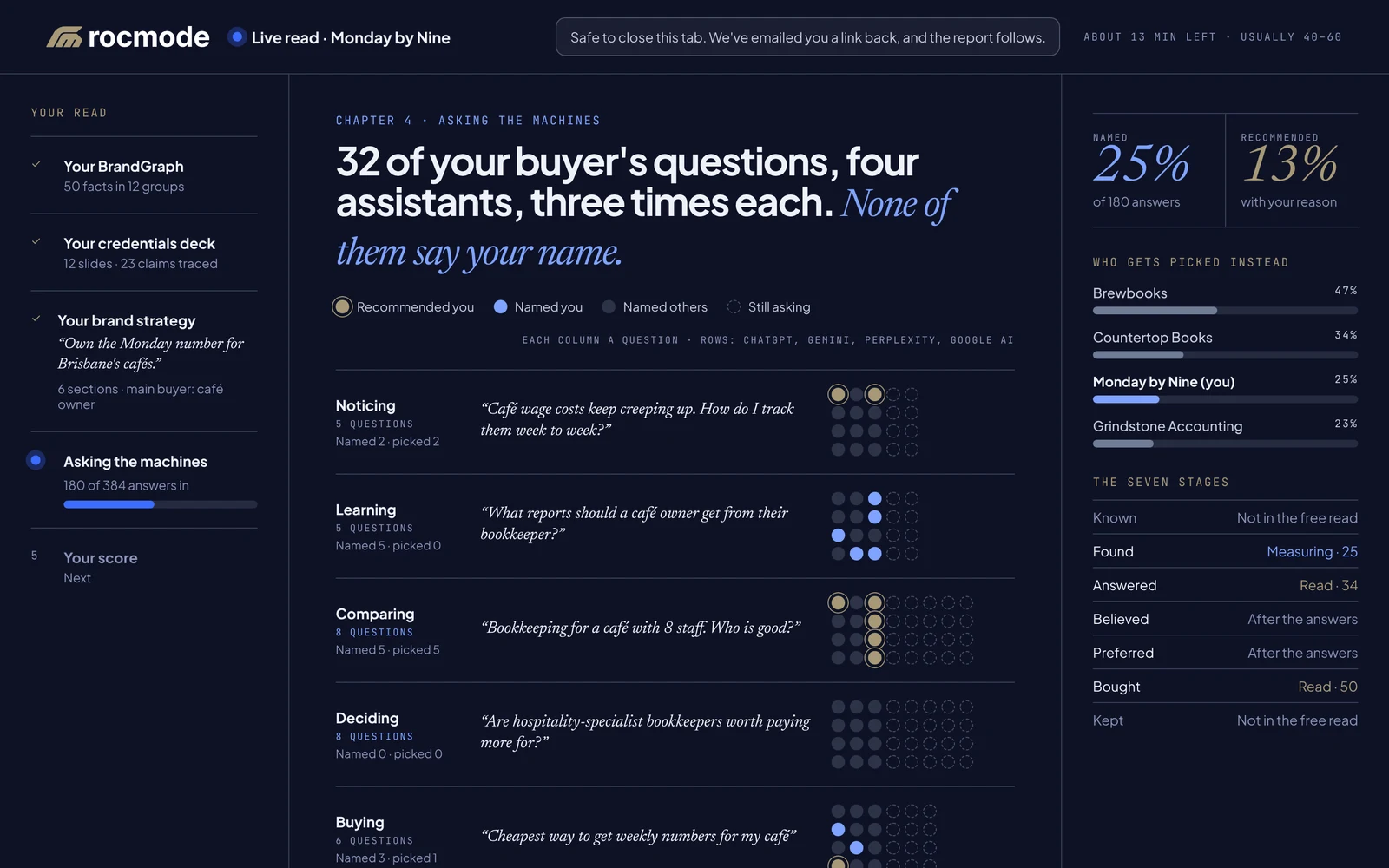
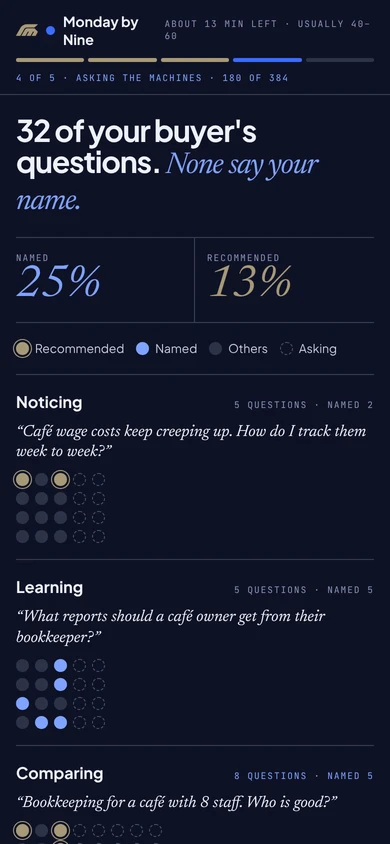
RocMode · Live read · Monday by Nine (example)
Asking ChatGPTBefore
The AI marketing and sales platform
Marketing and sales, rebuilt for the age of AI.
Your website in. A whole marketing and sales team’s work out. RocMode learns your brand from your site, then does the work: strategy, website, ads, social, PR, partners, email, design, and the deck that wins the deal. You approve every piece.
Other tools do one job. This does all of them, as one story.
Other AI guesses. This works from your facts and proof.
Other tools stop at the post. This follows it to the signed deal, and learns what won.
How it works
KnowWhere you really standActWhat to fix firstCreateWe build the work. You approve itProveDid it move?
Know · Step 1 of 10
It gets you. It gets your customers. It connects the dots.
Everything about your brand, your buyers and your rivals, sorted and connected.
Then it works out what to say, where, when and why. It’s the brain behind every step.
Builds: Customers · Offerings · Rivals · Proof
RocMode · BrandGraph · sample data
Following one momentCISO · Comparing · “Who’s the best managed security provider for a hospital group?”Moment found
Brand core3 found
Voice3 found
Visual identity3 found
Products and services3 found
Pricing3 found
Personas and markets3 found
Pains, gains, jobs3 found
Journeys and objections3 found
Proof and trust3 found
Content3 found
Competitors and partners3 found
Team2 found
Halvard Security35 facts
Two hospital case studies/partners
FactClaimProofAI-suggestedExample: Halvard Security, an invented managed security provider.
Reading halvardsecurity.com.au, socials, reviews and listings…
Halvard SecurityBrandGraph
12areas, all connected
3personas
15moments
6rivals
Sample data
Your customers
Customers
›
Personas
›
Journeys
›
Pains, jobs, objections
›
Moments
What you sell
Products and services
›
Offerings
›
Value proposition
›
Differentiation
Your rivals
Competitors
›
Industry
›
Expectations
›
Gaps to exploit
Moments + offerings
Opportunities
›
Campaigns
›
Ads
›
Sales
Content gaps
›
Content
›
Website
So it knows
What to say.Where. When. Why.
Moment foundCISO · Comparing · “Who’s the best managed security provider for a hospital group?”
Know · Step 2 of 10
Your strategy, from everything it knows.
Positioning built from your offerings and the gaps your rivals leave.
Claims you can’t back get cut before anyone sees them.
Seen isn’t selected. AI picks the brands it can tell apart.
Every era of marketing had its visibility number, and AI mentions are just the newest. Most AI tools still sell you visibility. But being mentioned isn’t being chosen, and for the first time you can measure the pick itself.
BroadcastAwareness
Media buyingReach
SearchRankings
SocialFollowers
AIMentions
What countsSelected
What AI made cheap
Making things.
Posts, pages, ads and reports in minutes
Anyone with a login can do it
Your competitors have the same tools
Sell on volume and you compete on price.
What AI made measurable
Being chosen.
Brand ABrand BYouBrand CBrand D
Buyers ask AI who to pick, and it names a few brands
You can ask the same questions and see who’s named
So you can see, moment by moment, where you win and lose
Compete on this and you compete on results.
See it on your brand
See how often AI picks you. Free.
We ask the AI assistants your buyers use the questions they really ask, many times each, at every step of their journey. Then we show where you’re picked, where you’re passed over, and who wins instead.
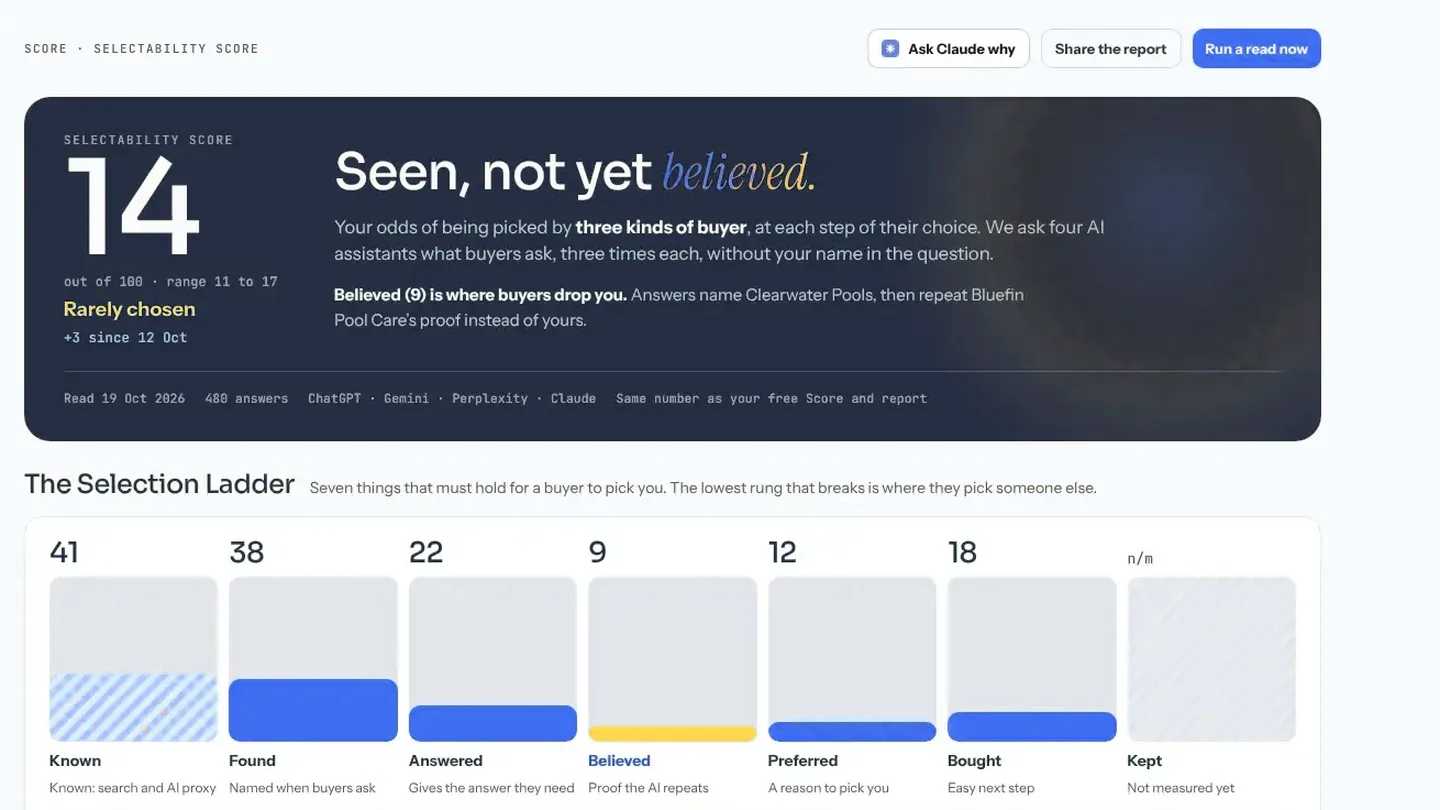
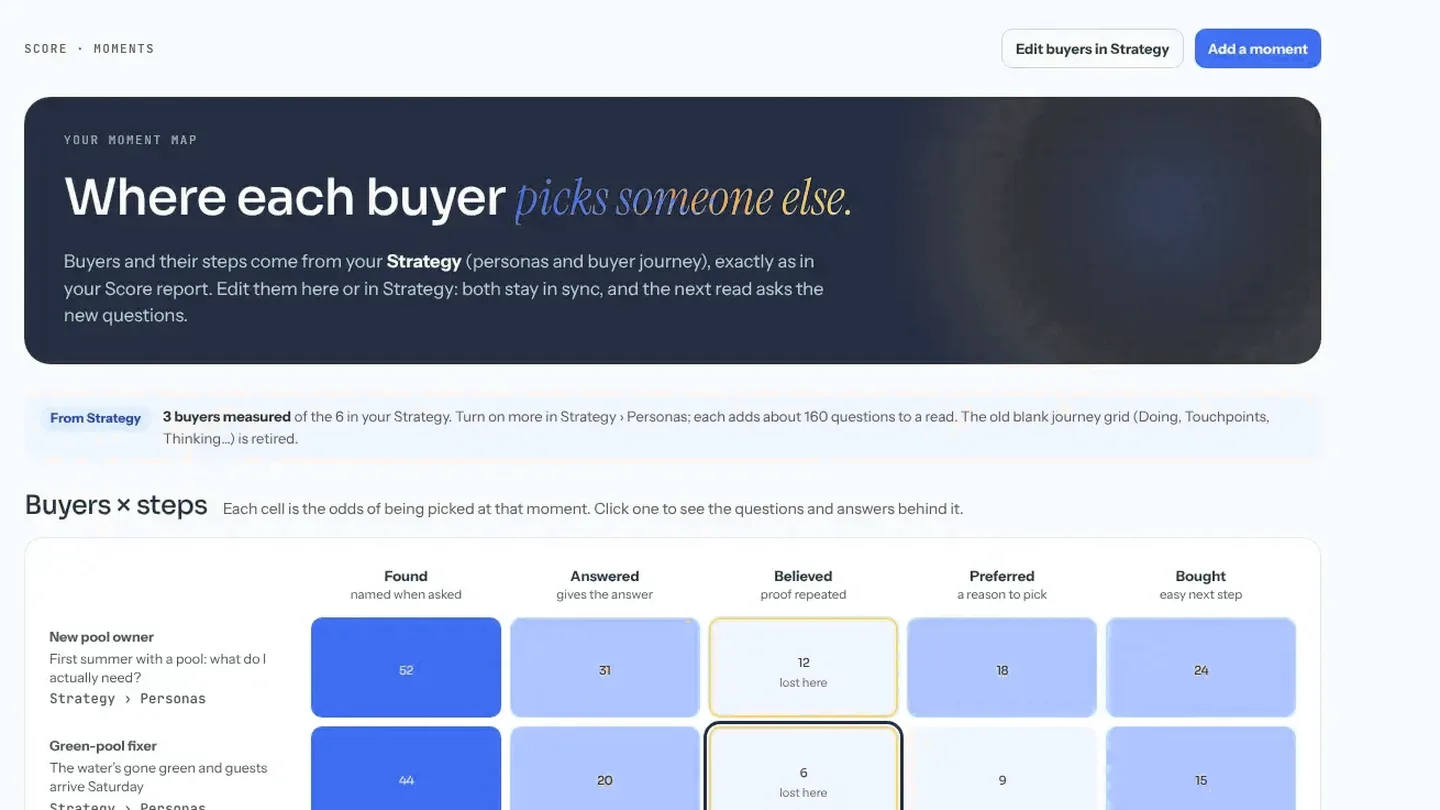
Your free Selectability Score asks the AI assistants the questions your buyers ask, without your name in them. You see who gets picked, at which moment, and the three gaps to fix first.
Found means you appear when a buyer asks without naming you. They describe a need, and a search page, an assistant or a marketplace puts names in front of them. Either yours is among them or it isn't.
Known was about memory. Found is about the moment. A buyer can know your name and still never be shown it when the need arrives.
Most brands get Found wrong in two ways. They measure it as a position, which no longer holds still. Worse, they're found in the wrong moments, where nobody is buying, so the numbers rise while selection doesn't.
There is no position to hold
An AI answer has no fixed order, so a rank inside it means very little. The same question, asked twice, gets a different list.
Rand Fishkin of SparkToro tested this with Patrick O'Donnell of Gumshoe (SparkToro). Six hundred volunteers ran twelve requests for brand recommendations 2,961 times. They used ChatGPT, Claude and Google's AI Overviews and AI Mode, in November and December 2025.
For ChatGPT and Google's AI, the chance of the same list of brands in two responses was under one in a hundred. The chance of the same list in the same order was about one in a thousand. Lists ran from two or three names to more than ten.
The authors are open about the limits. The study isn't peer reviewed, and they couldn't control chat history, device or the model's randomness. O'Donnell joined Gumshoe during the work, and Fishkin flags the possible conflict himself.
Google's own AI surfaces move constantly. Ahrefs watched more than 43,000 keywords for a month (Ahrefs). An AI Overview had a 70% chance of changing between observations, and changed every 2.15 days on average.
The meaning held steady, though. Ahrefs scored the Overviews' meaning at 0.95 for consistency between updates. Yet each update replaced 45.5% of the citations, and only 54% of the named brands and other entities survived from one version to the next.
Profound found that 40% to 60% of cited domains changed within a month for identical prompts (Profound). That counts source pages, not brand mentions, but the pattern is the same.
Part of the reason is that one question is no longer one search. Google says AI Mode works by "breaking down your question into subtopics and issuing a multitude of queries simultaneously on your behalf" (Google). A buyer types one question, and many hidden searches decide the answer.
So "rank for a keyword" has no fixed meaning on these surfaces. Fishkin's own verdict is blunt: any tool claiming "a 'ranking position in AI' is full of baloney".
Leaders appear almost every time
There's no stable position in any single answer. Across many answers, though, how often a brand appears holds steady, and the leaders appear almost every time.
In the SparkToro study, City of Hope appeared in 97% of 71 ChatGPT answers to an unbranded request for the best cancer hospital. Bose, Sony, Sennheiser and Apple appeared in 55% to 77% of 994 headphone answers.
That held even though the volunteers wrote their own prompts. Their wording barely overlapped, with a mean similarity of just 0.081. Very different questions still surfaced the same leaders.
Small firms can lead too. Smartsites, a digital marketing agency, appeared in 85 of 95 answers to a request for e-commerce consulting. Its moment is narrow, and it owns it. The Northwestern study of AI recommendations found the same shape at the top: five drill brands appeared in every run.
So the stable number is a rate. Leaders are found almost every time; everyone else is found some of the time, and only a rate shows the difference. A rank of "third" tells you nothing when third place moves on every asking.
A rate has limits of its own. It's a rate over the questions you chose, not over every buyer. Choose the questions well and it tells you where you stand in those moments.
One vendor claims more stability than this. BrightEdge reports that 96.8% of cited domains didn't change week to week (BrightEdge). It doesn't publish its method. My reading is that weekly totals smooth out the noise in single answers, which is the point of a rate.
Most brands are found in the wrong moments
Most brands that are found are found where nobody is buying. They rank for questions people ask while learning, not while choosing. Traffic rises, and selection doesn't move.
The Northwestern study shows the clearest form of it. Famous brands such as Craftsman and L.L.Bean were never named on plain category prompts. They were named most of the time when the prompt used their own positioning. They went missing whenever buyers didn't describe the need in the brand's terms.
Buyers now ask long questions. Prompts to assistants run far longer than search keywords, and most match no keyword at all (Chapter 6). A long prompt carries the buyer's situation: who they are, what went wrong, what they need. That's where positioning words live.
Learning questions lose their clicks. When an AI summary appears on an informational search, people click through far less, though brands cited inside it fare better (Chapter 21).
HubSpot said it plainly. On its 2025 second-quarter earnings call, chief executive Yamini Rangan said: "Just 10% of our leads come from blog traffic" (MarketBeat transcript). She added that "clicks from LLMs convert much better than organic search because buyers are deep in the research".
That doesn't prove blog readers never buy. It does show that a firm's biggest source of traffic and its source of leads had come apart. Outside estimates put a large fall in HubSpot's blog traffic around then. I couldn't verify them, so I leave the number out.
Put together, the diagnosis is simple. Traffic measured where people learn tells you little about presence where people choose. You can win the first and lose the second.
Measure it like a poll, not a league table
Found is measured over many askings, in the moments you chose, the way a pollster samples. A ranking reports one result as if it were the truth. A poll asks a defined group many times and reports a share, with a margin.
The pollster's hardest choice is who to ask. Poll people who can't vote, and the answer is precise and useless, which is what you get when you measure Found on learning questions.
So the moment comes first. The moments you chose to win are your sample frame, and nothing outside them counts.
Branded questions never count. A question that names you tests Known, not Found. "Is Fieldline any good?" will always name Fieldline. It tells you nothing about whether a buyer who had never heard of you would meet you.
Each assistant is its own electorate. In one study of 250 queries, three AI models agreed on the top brand 41.6% of the time (Żatuchin). Ahrefs found that AI Overviews and AI Mode shared only 13.7% of their citations for the same question. They agreed on what to say about 9 times in 10 (Ahrefs). So you take a rate for each assistant, never one rate for "AI".
Classic search still runs on rank. On the page of blue links, position one gets 27.6% of clicks and position ten gets 2.44% (Backlinko), so rank still matters there. The claim here is narrower: on AI surfaces, rank has no stable meaning.
How to tell it is failing
Your SEO report is green, and enquiries are flat.
An agency or tool reports your "AI rank" or "position", with no number of runs behind it.
The questions you track contain your own brand name.
You appear when a buyer uses your words, and vanish when they describe their problem in theirs.
The method: the presence sample
A presence sample is a small, repeated poll of the places buyers ask. It tells you how often you're named, and recommended, in the moments you chose. It takes an afternoon to set up and an hour or two each month to run.
Choose the moments. Take three to five moments from your map in Chapter 12. Tag each one: learning, comparing or buying. Most of your sample should sit in comparing and buying.
Write the questions as buyers would. For each moment, write five or more unbranded phrasings, long and specific, with the buyer's situation in them. Real buyers barely overlap, so vary the wording.
Strip every brand. No question may name you. Keep questions that name a rival in a separate list, tagged as comparisons.
Pick the surfaces. Use the two or three assistants your buyers use, run separately. Add classic search for the short form of each question, and any marketplace, review site or map your buyers search directly. For "near me" questions, set the location to where your buyers are, and record it.
Run each question several times. Use a fresh session each time, logged out where you can, so history doesn't tilt the answer. Spread runs across days, because AI Overviews change every couple of days.
Record two things per answer. Were you named at all? Were you recommended? Count "recommended" only when the answer picks you, or puts you first with a reason, rather than listing you among others. Note any rival named in your place.
Report shares, with a margin. For each moment and assistant, divide the answers naming you by the answers collected. Do the same for recommended. Never report a position.
Repeat on a schedule. Run the same sample monthly, and weekly for any moment you're actively working on. Change the questions only between periods, never within one.
How many runs make a stable rate. No published guidance says. Northwestern used 40 runs per model, SparkToro 60 to 100 runs per prompt, and Ranqo 50 prompts run 10 times each (Ranqo).
Plain statistics gives a rough guide. With n answers, a 95% margin is at most about one divided by the square root of n. That's standard maths, not a finding from any study.
Answers per moment, per assistant
Rough margin
What it can tell you
20 (e.g. 5 phrasings × 4 runs)
±22 points
Absent, sometimes there, or almost always there
100
±10 points
Whether a quarter's work moved the rate
400
±5 points
Small shifts against a close rival
My own working rule, from standard binomial maths; not tested against sales.
The maths assumes each answer is an independent draw, and repeat runs of one phrasing aren't. They lean the same way, so the true margin is wider than the table shows. Add phrasings before you add reruns: twenty phrasings run once beat five phrasings run four times.
Twenty answers sounds thin, but it's enough for the question most brands need answered first. The Northwestern gap ran from 0% to more than 80%. Any sample sees a gap that size.
Reading the sample fairly
A presence sample is noisy by design. A few habits keep it useful.
Compare like with like. Same questions, same assistants, same number of runs. A rate that rose because you added easier questions hasn't risen.
Read the margin before the headline. A move from 30% to 40% on 20 answers is within noise. The same move on 400 answers is real.
Watch the rivals too. A share of answers is a share of a contest.
Keep named and recommended apart. Being named is Found. Being recommended is Preferred. Both come from the same answers, so record both now.
Add share of search as an early signal. Les Binet, of the agency adam&eveDDB, found that share of search tracked market share in cars, energy and phones. It could lead market share by "up to a year for cars" (IPA). He calls it "not a perfect predictor".
The bookkeeper's presence sample
The bookkeeper for cafés is an invented example. She sells "Bookkeeping for cafés. Your wage cost against takings, every Monday by nine." She ran a small sample across two assistants. The figures are invented to show the method.
Moment
Example unbranded phrasing
Stage
Named (ChatGPT, 20 answers)
Named (Google AI Mode, 20 answers)
Owner wants a bookkeeper
"Good bookkeeper for a small business near me"
Buying
0%
0%
Owner learning about wage cost
"What percentage of takings should café wages be?"
Learning
0%
5%
Owner losing margin to wages
"I own two cafés and my wages are eating my margin. Who can show me wage cost against sales every week?"
Comparing
45%
30%
Owner switching from a general accountant
"My accountant only sends numbers at year end. I run a café and need weekly figures. What are my options?"
Buying
35%
20%
The generic buying question gave her nothing. Dozens of firms compete for it, and she says nothing that sets her apart there. The learning question gave her nothing too, and it would bring her little if it did.
Where the café owner described the problem in her terms, she appeared often. Her positioning was doing the work, much as it did for Craftsman. Her job now is to be the clearest public answer in those two moments, and to ignore the generic one.
Fieldline's presence sample
Fieldline's deal with Northgate, the invented contractor, moves on. Dana has put Fieldline on her list. Before the first meeting, Ravi, the finance lead, does his own homework.
He asks two AI assistants which field-service software makes job costs match invoices. He asks it several ways, over a couple of days. Fieldline is absent from his runs. Two rivals appear in most of them.
Ravi downloads one rival's comparison sheet and brings it to the first meeting. Fieldline now starts behind with the person who controls the budget. Nobody at Fieldline can see why.
After the meeting, Fieldline's marketing team ran a presence sample, one moment per committee member. The figures are invented.
Committee member
Moment
Named (60 answers across 3 assistants)
Recommended
Dana, operations
Technicians lose too much time driving
70%
40%
Ravi, finance
Job costs that match invoices
10%
0%
Mei, IT
Fits our existing systems, secure enough
5%
0%
Fieldline was found by the person who already cared most, in its own words. It was missing for the two people who could block the sale.
The fix wasn't more content about travel time. It was public, specific answers on job costing for finance, and on integration for IT.
By mode
Where Found happens changes with the mode. Habitual buyers are found on the shelf and in the reorder list, and Found matters most when a habit breaks. Quick choices happen on maps, marketplaces and quick questions to an assistant, so accurate listings come first. Considered personal buyers ask long questions, then search to check. An owner asks an assistant, a peer or a local search, so own one narrow moment in the owner's words. In a committee each member asks separately, so run a presence sample per member.
How Found connects to the other stages
Found needs Known and the moments: the machine names brands it has filed under a need, and your map of moments is the sample frame. It feeds Answered, which makes sure what buyers find answers their question. And it feeds Preferred, because the same sample records whether you were recommended.
What not to do
Don't mistake traffic for presence. Visits from learning questions aren't visits from buyers.
Don't change the sample mid-period. New questions in the middle of a period make the rate meaningless.
Don't abandon classic search. Rank still decides clicks on the page of blue links.
How you know it worked
The Selectability Score (Part five) checks one thing for this stage. Do you appear when they ask without naming you? It counts the share of answers to unbranded questions that name you. Branded questions never count.
Your own numbers:
Named rate per moment, per assistant, with its margin.
Recommended rate on the same answers.
The gap between learning, comparing and buying moments. Most of your rate should sit in the last two.
Your rate beside your two closest rivals' rates.
Share of search in your category, as an early signal.
This afternoon
pick one buying moment. Write five unbranded questions a buyer might ask in it, long and specific. Ask each one twice in two assistants, in fresh sessions. Count how many of the 20 answers name you.
This quarter
build the full presence sample for three to five moments. Run it monthly. Choose the one moment with the biggest gap between you and a rival, and work on it. Judge the work by the rate, not by traffic.
An agency can sell this sample as a monthly managed service. Run well, with fixed questions and honest margins, it's worth more than another rank report.
Toolkit
1. Running a presence sample. Use this process each month, or whenever you change positioning or publish for a moment. It turns a pile of answers into a rate you can act on.
Read it along the top row, then back along the bottom. Choose the moments before writing any question, and loop back each period with the same questions.
2. The presence tracking sheet. Log one row per question, per assistant, per period. Read the shares by moment, never by single answer. Margin = 1 ÷ √(answers), as a rough upper bound; widen it when most answers come from reruns of the same phrasing.
Period
Moment
Question ID
Assistant or surface
Runs
Answers naming you
Answers recommending you
Share named
Share recommended
Rivals named most
Margin (± = 1/√runs)
Every template for this stage is in the free Selectability Playbooks at rocmode.com/playbooks.
What we don't know
No independent, peer-reviewed study yet says how many runs make a stable rate. My table is arithmetic, not evidence.
The strongest support for "found in the wrong moments" is the Northwestern preprint from September 2026. It should be rechecked before it carries more weight.
No study yet links a presence rate to pipeline or sales. The rate measures the moment of choice, not the sale.
There's no verified small-business case of traffic falling while sales rose. The pattern is plausible, and the proof so far comes from large firms.
Whose evidence this is. SparkToro sells audience research, and Gumshoe, Ahrefs, Profound, BrightEdge and Semrush sell AI-visibility or SEO tools; Backlinko is owned by Semrush. Ranqo's and Żatuchin's authors work with tracking vendors. HubSpot sells a product for appearing in AI answers. Their incentives point towards measurement looking necessary. Binet's share-of-search work was published by the IPA, a trade body. None of the AI-visibility studies here is peer reviewed.