Your buyers ask AI who to pick. Make sure it’s you.
Gets you selected acrossChatGPTClaudeGeminiPerplexity
RocMode shows you whether AI picks you or your rival, finds the work that changes it, builds that work, and sends it to you to approve. Then it proves what moved.
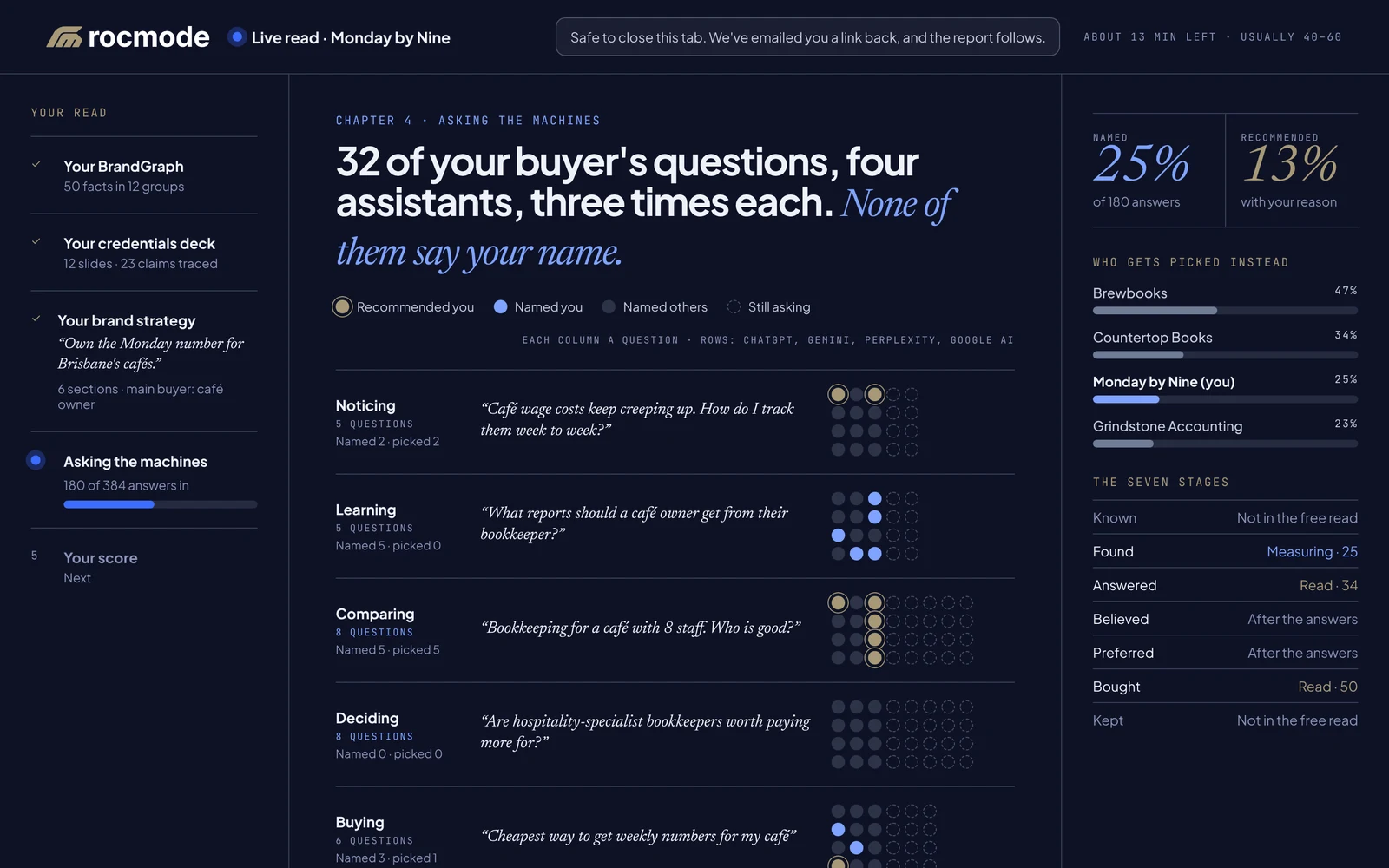
We ask ChatGPT, Claude, Gemini and Perplexity the questions your buyers ask, and show where they pick you and who they pick instead. Free, no login. What’s the Score? Or sign up free and try everything for 14 days.
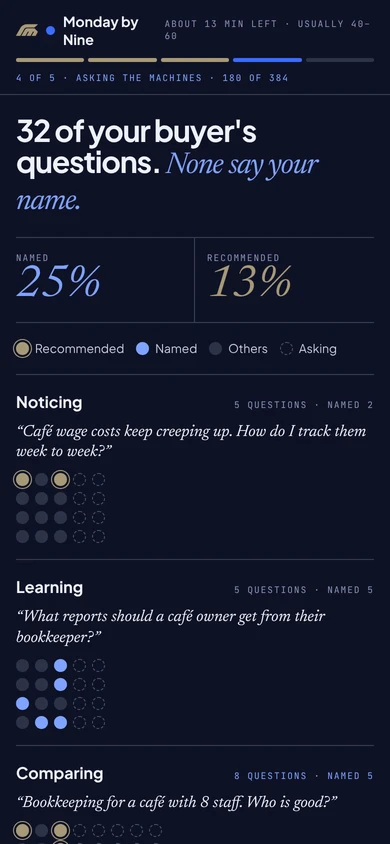
RocMode · Live read · Monday by Nine (example)
Asking ChatGPTBefore
The AI marketing and sales platform
Marketing and sales, rebuilt for the age of AI.
Your website in. A whole marketing and sales team’s work out. RocMode learns your brand from your site, then does the work: strategy, website, ads, social, PR, partners, email, design, and the deck that wins the deal. You approve every piece.
Other tools do one job. This does all of them, as one story.
Other AI guesses. This works from your facts and proof.
Other tools stop at the post. This follows it to the signed deal, and learns what won.
How it works
KnowWhere you really standActWhat to fix firstCreateWe build the work. You approve itProveDid it move?
Know · Step 1 of 10
It gets you. It gets your customers. It connects the dots.
Everything about your brand, your buyers and your rivals, sorted and connected.
Then it works out what to say, where, when and why. It’s the brain behind every step.
Builds: Customers · Offerings · Rivals · Proof
RocMode · BrandGraph · sample data
Following one momentCISO · Comparing · “Who’s the best managed security provider for a hospital group?”Moment found
Brand core3 found
Voice3 found
Visual identity3 found
Products and services3 found
Pricing3 found
Personas and markets3 found
Pains, gains, jobs3 found
Journeys and objections3 found
Proof and trust3 found
Content3 found
Competitors and partners3 found
Team2 found
Halvard Security35 facts
Two hospital case studies/partners
FactClaimProofAI-suggestedExample: Halvard Security, an invented managed security provider.
Reading halvardsecurity.com.au, socials, reviews and listings…
Halvard SecurityBrandGraph
12areas, all connected
3personas
15moments
6rivals
Sample data
Your customers
Customers
›
Personas
›
Journeys
›
Pains, jobs, objections
›
Moments
What you sell
Products and services
›
Offerings
›
Value proposition
›
Differentiation
Your rivals
Competitors
›
Industry
›
Expectations
›
Gaps to exploit
Moments + offerings
Opportunities
›
Campaigns
›
Ads
›
Sales
Content gaps
›
Content
›
Website
So it knows
What to say.Where. When. Why.
Moment foundCISO · Comparing · “Who’s the best managed security provider for a hospital group?”
Know · Step 2 of 10
Your strategy, from everything it knows.
Positioning built from your offerings and the gaps your rivals leave.
Claims you can’t back get cut before anyone sees them.
Seen isn’t selected. AI picks the brands it can tell apart.
Every era of marketing had its visibility number, and AI mentions are just the newest. Most AI tools still sell you visibility. But being mentioned isn’t being chosen, and for the first time you can measure the pick itself.
BroadcastAwareness
Media buyingReach
SearchRankings
SocialFollowers
AIMentions
What countsSelected
What AI made cheap
Making things.
Posts, pages, ads and reports in minutes
Anyone with a login can do it
Your competitors have the same tools
Sell on volume and you compete on price.
What AI made measurable
Being chosen.
Brand ABrand BYouBrand CBrand D
Buyers ask AI who to pick, and it names a few brands
You can ask the same questions and see who’s named
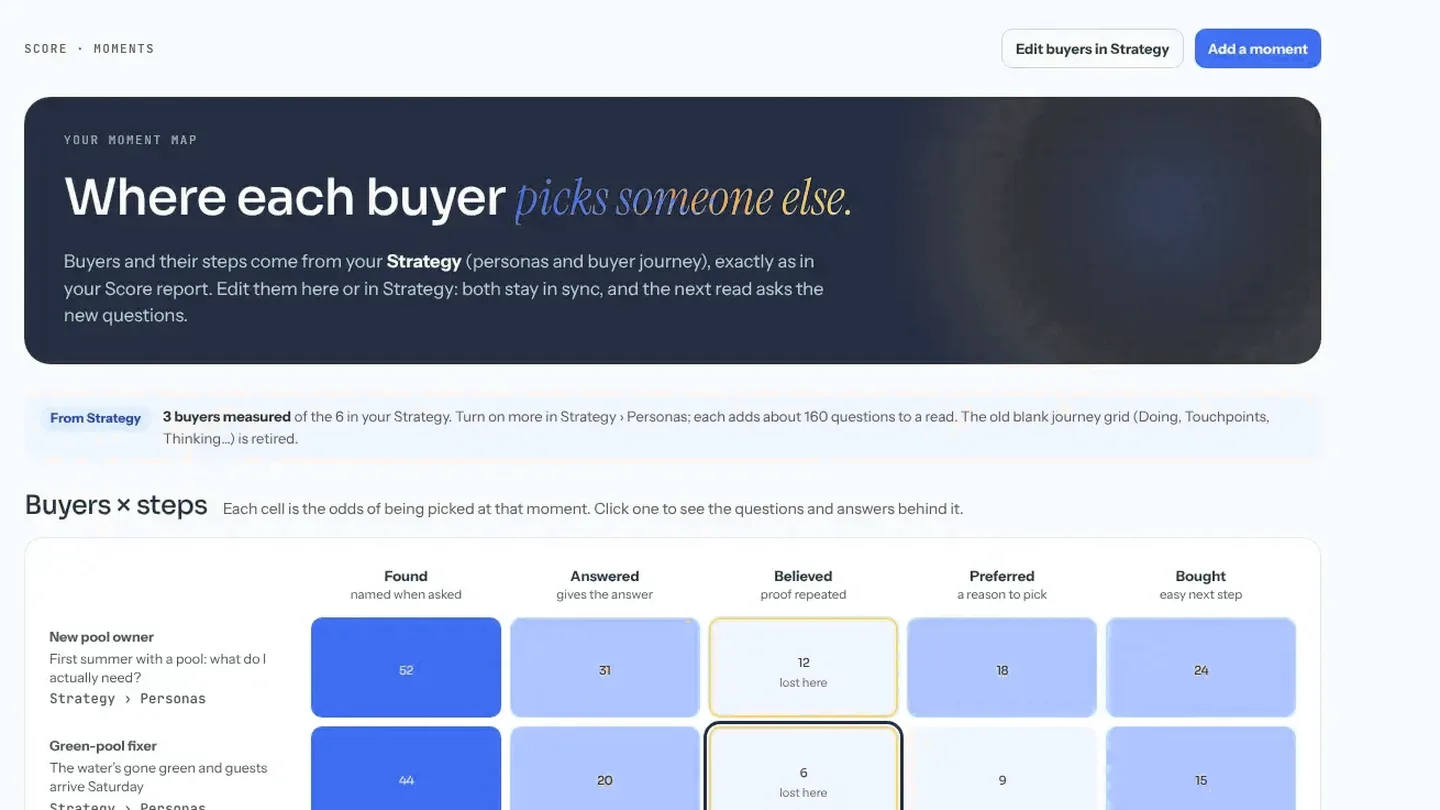
So you can see, moment by moment, where you win and lose
Compete on this and you compete on results.
See it on your brand
See how often AI picks you. Free.
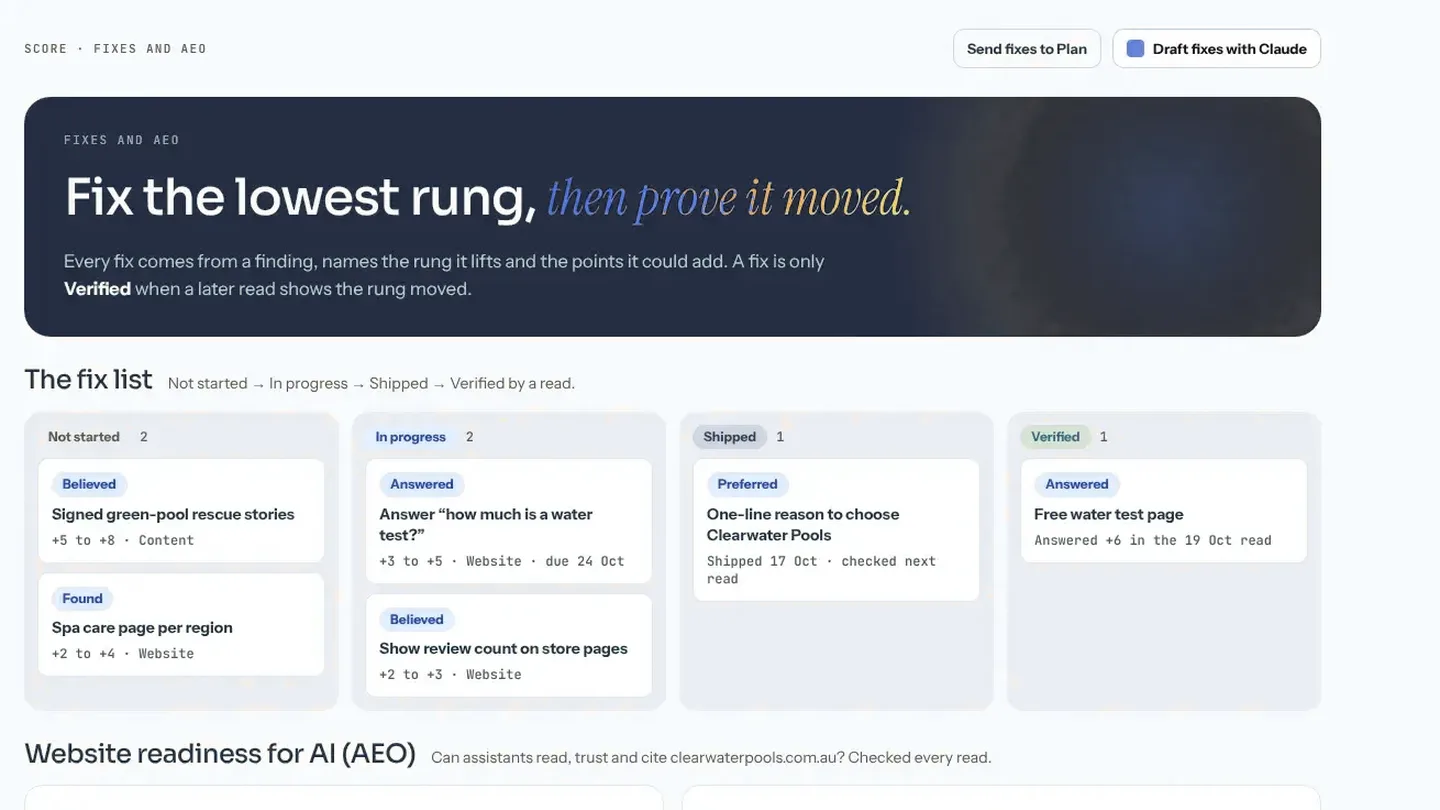
We ask the AI assistants your buyers use the questions they really ask, many times each, at every step of their journey. Then we show where you’re picked, where you’re passed over, and who wins instead.
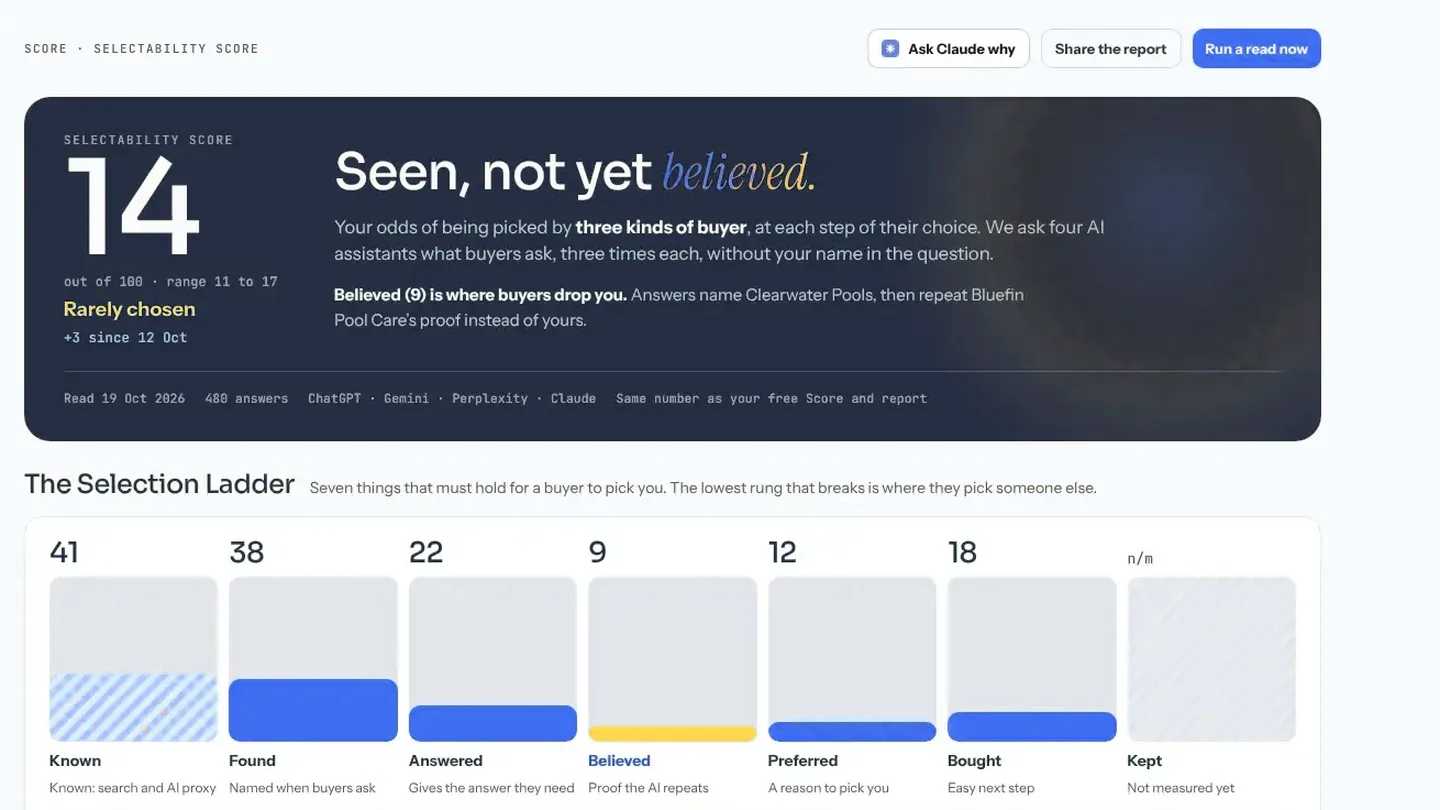
Your free Selectability Score asks the AI assistants the questions your buyers ask, without your name in them. You see who gets picked, at which moment, and the three gaps to fix first.
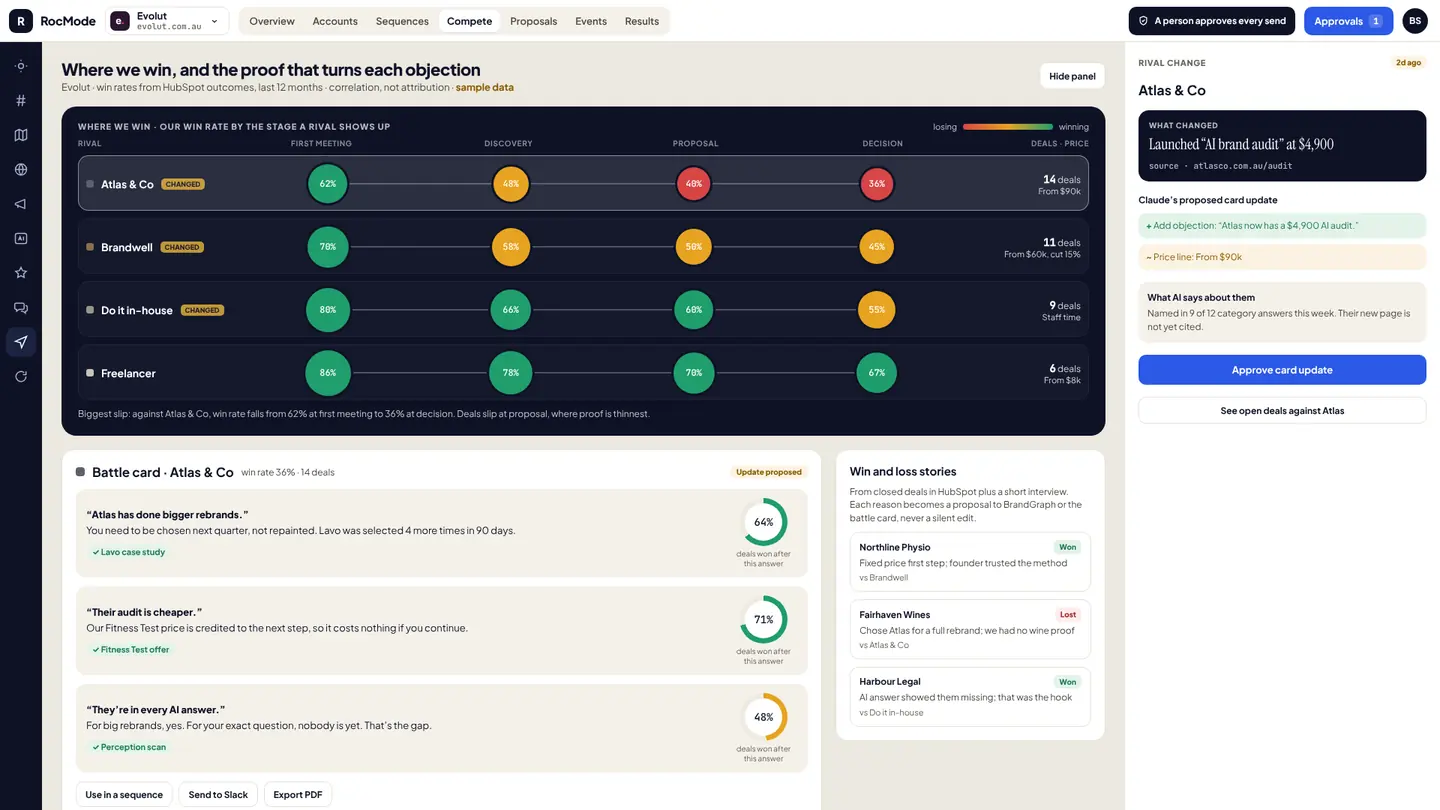
Four builds didn't get a chapter of their own: outbound, events, partners and customers. The same questions apply to each. What's it for? Which stages does it serve? What's the method? How do you know it worked?
Outbound and account-based
What it is for. Reaching named firms before they start looking, so you're the firm they remember when they do.
Which stages. Known first, for a short list of firms you've chosen. Then Believed, if what you send is worth keeping.
Two findings pull against a cold pitch. Gartner surveyed 646 B2B buyers in August and September 2025, and 67% said they'd prefer to buy without a sales rep (Gartner). And John Dawes of the Ehrenberg-Bass Institute estimates that only about 5% of business buyers are in the market for a category at any one time (Ehrenberg-Bass). So most cold messages reach people who aren't buying, and who'd rather not be sold to when they are.
The method. Choose the firms first, from your segments, and name the moment each is most likely to be in: usually the trigger. Then send something worth keeping, about their problem rather than your service. An invented engineering consultancy writes to the owners of forty plants in its sectors with one page on the capacity most lines leave unused, and asks for nothing. When an owner replies, the pitch takes over.
How you know it worked. Replies and meetings from the named list. Then whether those firms turn up later by other routes: a search for your name, a visit to the site, a referral. The number of messages sent tells you nothing.
Events
What it is for. An event puts you in a room with buyers, and the people they trust. Buyers can judge you in person, before they have to decide anything.
Marketers rate them highly. The Content Marketing Institute surveyed 980 B2B marketers for its 2025 report. In-person events and webinars topped the channels said to produce the best results, at 52% and 51% (CMI). That's marketers' own opinion, but it's reason enough to run events properly, rather than to run more of them.
Which stages. Known and Believed, in person. Events matter most in owner-led and committee buying, where a face and a conversation carry weight.
The method. Go with moments in mind, not a stand and a bowl of mints. Before the event, list who'll be there, which moment each is in, what they need to believe and the next step. Bring proof from someone like them. Follow up within a day, with the answer to the question they asked you. At a trade forum, invented Fieldline skips the stand: a customer's operations manager gives a talk on travel time, and the team books second conversations with those who stayed to ask questions.
How you know it worked. Count the conversations that moved a moment forward: a meeting booked, a question answered, a pilot agreed. Badge scans tell you who walked past, not who moved.
Partners and channels
What it is for. A partnership borrows belief. A partner who already has the buyer's trust says you're good, and puts you where the buyer already is.
Which stages. Believed first, through the partner's word. Then Found, because partners list you in places buyers look, and machines read those places too. A partner directory is a structured page that names you and says what you do: the kind of page an AI assistant can retrieve. That's my reading, not a measured result.
The method. Choose partners whose customers share your moments, and make the listing say your reason in your one truth's words, with one piece of proof. The invented bookkeeper for cafés lists herself in her accounting software's directory of advisers. Xero's, for one, invites owners to "find experts based on your industry, location, and specific accounting needs" (Xero). So her listing says "cafés" in the first line, not "small business".
How you know it worked. Count customers who arrived through each partner, and whether they bought. Ask an AI assistant the partner's customers' question, and see whether the partner's page brings you up.
Customers: onboarding, loyalty, community and referral
What it is for. Making staying the easy, safe choice, and turning customers into the people who bring the next one.
Which stages. Kept first. Then, through what customers say and write, Believed and Known for the buyers who come next.
The method. Start with the handover. The first weeks decide whether the promise made in the pitch survives the work, so onboarding is the first moment of Kept, not an admin task. Then keep the promise. No programme repairs a broken one. Points for their own sake are a discount with extra steps. Byron Sharp and Anne Sharp studied a large loyalty programme: only two of its six member brands showed substantial "excess loyalty", and those gains showed up among non-members too (Sharp and Sharp).
Community does work points can't. Customers who help each other write the evidence that tomorrow's buyers read. So host the conversation, answer in it and never edit the criticism out.
How you know it worked. Renewal and repeat rates, first. Then the share of new customers who came by referral, and fresh customer-written reviews each month. Points redeemed and members signed up are diagnostics.
Whose evidence this is. The Content Marketing Institute's survey records marketers' opinions, sponsored by The MX Group. Xero describes its own directory. Gartner's figure is a stated preference from its own survey of buyers. The 95:5 rule is a rule of thumb from buying cycles, not a measurement of any one market. Peer-reviewed: Sharp and Sharp, in the International Journal of Research in Marketing.
And the nods
Some channels never need a build of their own, but each needs a home. Sponsorship sits with advertising. Analyst relations, awards and word of mouth sit with PR and reviews. Affiliates, marketplaces, associations and employee advocacy sit with partners and creators. Account management and customer service sit with customers. CRM, SMS and chat sit with email and automation. Packaging and physical spaces sit with the website, as the other place a buyer checks what you said. Each gets a short section in its build's playbook.
It's a lot
Read end to end, Part four is a lot: fourteen builds in six categories, all saying one thing at every moment that matters. That's what being selected takes. It's also why most brands do a little of everything and none of it well.
Nobody does all of it at once. Start with fifteen moments and one build. Pick the build that serves the stage where you lose the most buyers. Do it properly, then add the next.
The harder question is knowing where you're losing them. Part five answers it.