Your buyers ask AI who to pick. Make sure it’s you.
Gets you selected acrossChatGPTClaudeGeminiPerplexity
RocMode shows you whether AI picks you or your rival, finds the work that changes it, builds that work, and sends it to you to approve. Then it proves what moved.
We ask ChatGPT, Claude, Gemini and Perplexity the questions your buyers ask, and show where they pick you and who they pick instead. Free, no login. What’s the Score? Or sign up free and try everything for 14 days.
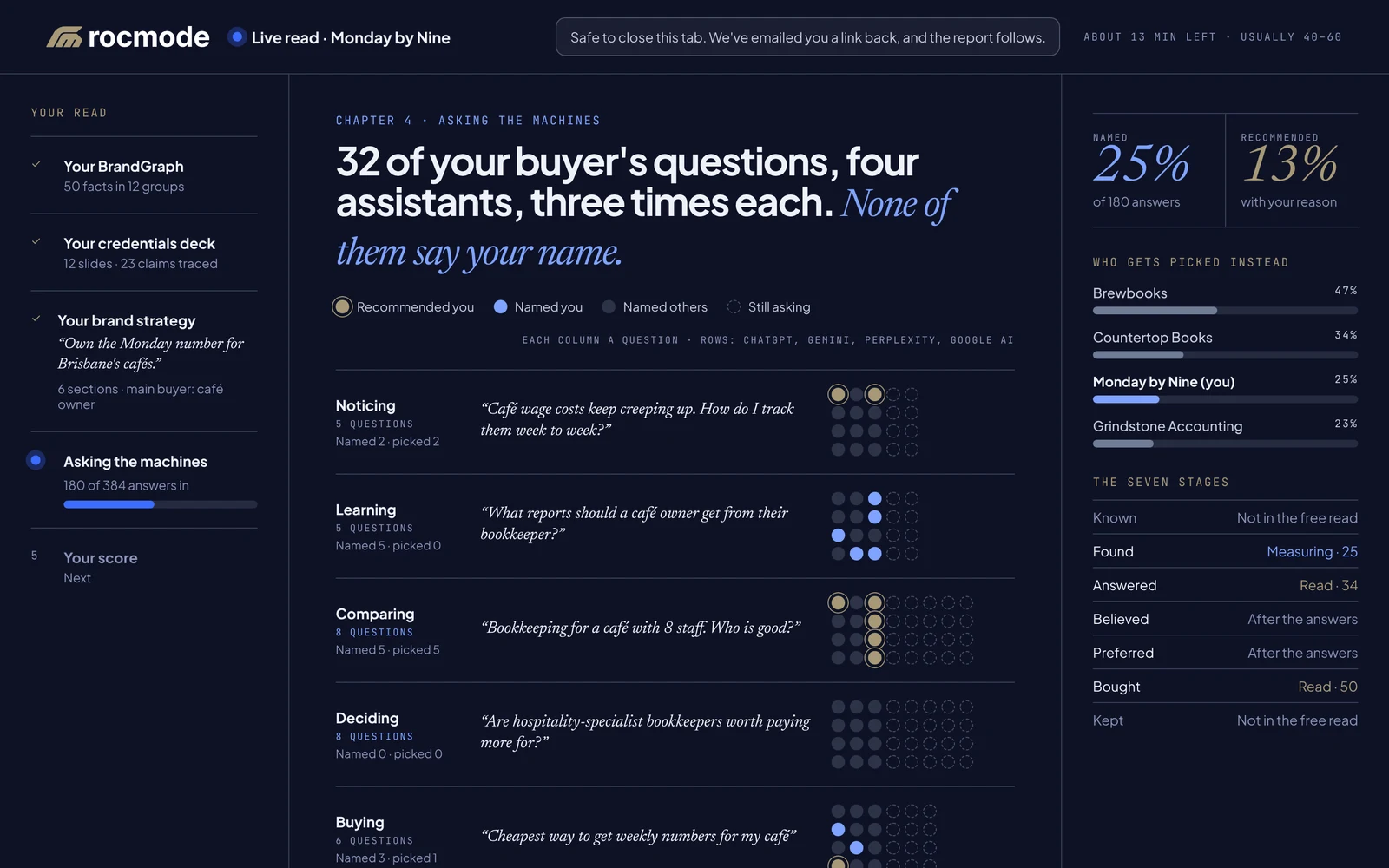
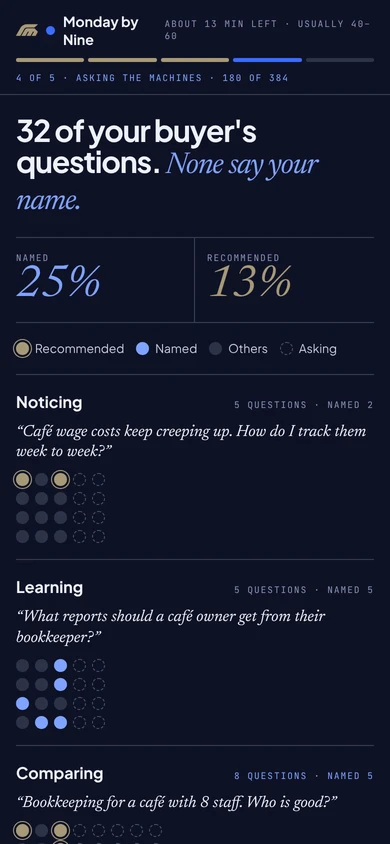
RocMode · Live read · Monday by Nine (example)
Asking ChatGPTBefore
The AI marketing and sales platform
Marketing and sales, rebuilt for the age of AI.
Your website in. A whole marketing and sales team’s work out. RocMode learns your brand from your site, then does the work: strategy, website, ads, social, PR, partners, email, design, and the deck that wins the deal. You approve every piece.
Other tools do one job. This does all of them, as one story.
Other AI guesses. This works from your facts and proof.
Other tools stop at the post. This follows it to the signed deal, and learns what won.
How it works
KnowWhere you really standActWhat to fix firstCreateWe build the work. You approve itProveDid it move?
Know · Step 1 of 10
It gets you. It gets your customers. It connects the dots.
Everything about your brand, your buyers and your rivals, sorted and connected.
Then it works out what to say, where, when and why. It’s the brain behind every step.
Builds: Customers · Offerings · Rivals · Proof
RocMode · BrandGraph · sample data
Following one momentCISO · Comparing · “Who’s the best managed security provider for a hospital group?”Moment found
Brand core3 found
Voice3 found
Visual identity3 found
Products and services3 found
Pricing3 found
Personas and markets3 found
Pains, gains, jobs3 found
Journeys and objections3 found
Proof and trust3 found
Content3 found
Competitors and partners3 found
Team2 found
Halvard Security35 facts
Two hospital case studies/partners
FactClaimProofAI-suggestedExample: Halvard Security, an invented managed security provider.
Reading halvardsecurity.com.au, socials, reviews and listings…
Halvard SecurityBrandGraph
12areas, all connected
3personas
15moments
6rivals
Sample data
Your customers
Customers
›
Personas
›
Journeys
›
Pains, jobs, objections
›
Moments
What you sell
Products and services
›
Offerings
›
Value proposition
›
Differentiation
Your rivals
Competitors
›
Industry
›
Expectations
›
Gaps to exploit
Moments + offerings
Opportunities
›
Campaigns
›
Ads
›
Sales
Content gaps
›
Content
›
Website
So it knows
What to say.Where. When. Why.
Moment foundCISO · Comparing · “Who’s the best managed security provider for a hospital group?”
Know · Step 2 of 10
Your strategy, from everything it knows.
Positioning built from your offerings and the gaps your rivals leave.
Claims you can’t back get cut before anyone sees them.
Seen isn’t selected. AI picks the brands it can tell apart.
Every era of marketing had its visibility number, and AI mentions are just the newest. Most AI tools still sell you visibility. But being mentioned isn’t being chosen, and for the first time you can measure the pick itself.
BroadcastAwareness
Media buyingReach
SearchRankings
SocialFollowers
AIMentions
What countsSelected
What AI made cheap
Making things.
Posts, pages, ads and reports in minutes
Anyone with a login can do it
Your competitors have the same tools
Sell on volume and you compete on price.
What AI made measurable
Being chosen.
Brand ABrand BYouBrand CBrand D
Buyers ask AI who to pick, and it names a few brands
You can ask the same questions and see who’s named
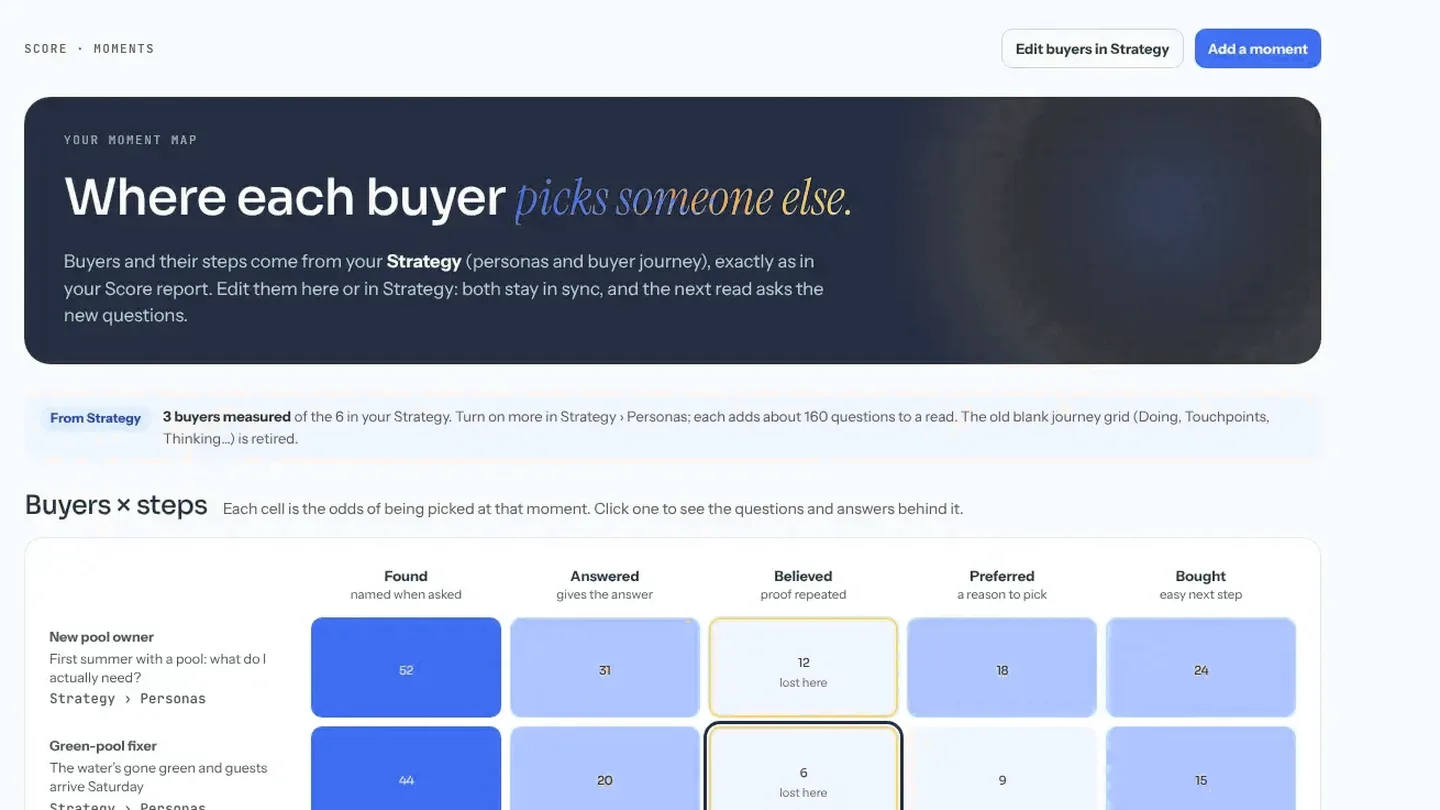
So you can see, moment by moment, where you win and lose
Compete on this and you compete on results.
See it on your brand
See how often AI picks you. Free.
We ask the AI assistants your buyers use the questions they really ask, many times each, at every step of their journey. Then we show where you’re picked, where you’re passed over, and who wins instead.
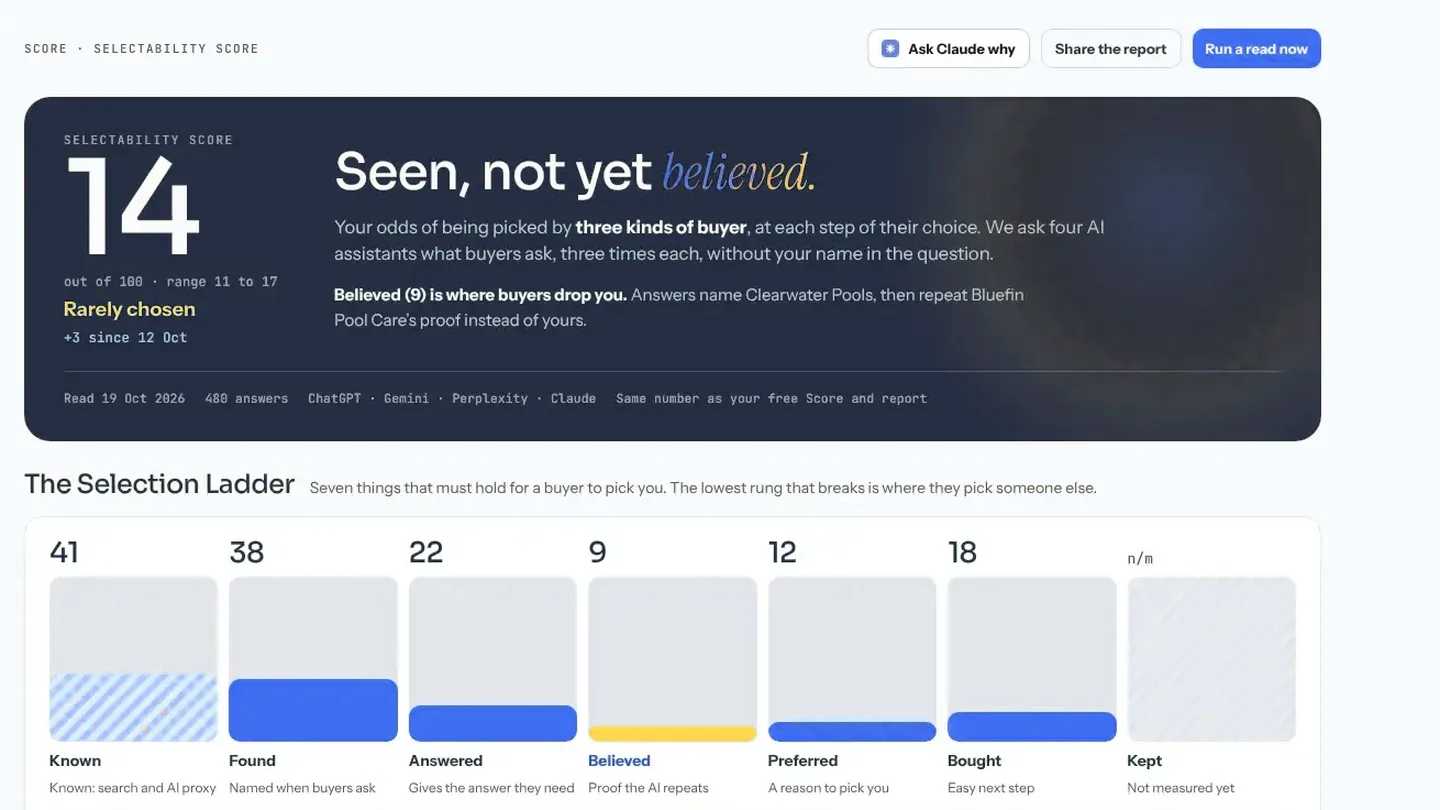
Your free Selectability Score asks the AI assistants the questions your buyers ask, without your name in them. You see who gets picked, at which moment, and the three gaps to fix first.
So far a choice has been a list, a moment and a way of buying. It's also a person, and people don't choose the way a spreadsheet does.
Good enough beats best
People rarely compare every option. They take the first one that clears the bar. Herbert Simon called this satisficing. It's why buyers pick from a list written on day one. So being on that list matters more than being slightly better than whoever is on it.
Familiar feels safe
A name people have met before feels like the safer pick, even when they can't say why. In 1968 Robert Zajonc showed that "mere repeated exposure" to something improves people's attitude towards it (Zajonc).
Feeling first, reasons after
It was around 2020, and I'd made up my mind about Intercom long before I compared anything.
I'd been on their website a few times and I loved it. The story pulled me in. The design was beautiful, and the product was explained completely without ever going on too long. I'd been building websites for more than twenty years by then, and I was impressed. Some of the suppliers I dealt with used it too, so I'd been on the other end of it as a customer, and I'd enjoyed that.
So when the question came up of which chatbot to put on websites, ours and our clients', it was Intercom's to lose.
We did a proper competitive review. It showed Intercom was well and truly the most expensive, about four times the price of the others in most cases. I argued for it anyway, for my own business and to clients, and most of them took the bite and bought it too.
Being fair to the numbers, it probably shouldn't have won. The alternatives cost much less and were good enough for most of what people needed. But Intercom had already won the emotional argument with me. I'd made the decision on feeling, then gone looking for the rational case to back it up.
The review was real work. The answer was in my head before it started.
Les Binet and Peter Field studied campaigns in the IPA's effectiveness databank. Emotional campaigns were almost twice as likely as rational ones to report very large profit effects (IPA). Their later business-to-business work found emotion did more there too, over the long term (Chapter 23).
Those are award entries, successes by selection, but they fit what psychologists find: people are poor witnesses to their own reasons.
Reasons still matter, because a buyer has to explain the choice to a partner, a boss or a board. The feeling picks, and the reason defends.
Losses loom larger than gains
A loss hurts about twice as much as an equal gain pleases, though less when the stakes are small. So in a serious purchase, the buyer fears choosing wrong more than they hope to choose right. That's why so many deals end in doing nothing.
We follow other people
In 2006 three researchers built an online music market for 14,341 people. Only some could see what others had downloaded (Salganik, Dodds and Watts). Where people could see each other's choices, the hits were bigger and harder to predict. Quality sets the range. Other people's choices decide where in the range you land.
A hard choice stalls
The famous finding that too many options paralyse people is weaker than its fame. A review of 50 experiments found an average effect of almost zero (Scheibehenne and colleagues).
A later meta-analysis of 99 results found when it does bite (Chernev, Böckenholt and Goodman): complex options, a hard decision, and a buyer unsure what they want. So the number of options isn't the problem. The difficulty of choosing is.
What it asks of you, stage by stage
Stage
The psychology at work
What it asks of you
Known
Familiar feels safe
Show up often, and look the same every time
Found
Good enough beats best
Be on the first list
Answered
A hard choice stalls
Make your answer the easy one to use
Believed
We follow other people
Let other people say it for you
Preferred
Feeling first, reasons after
Give a feeling, and a reason to defend it
Bought
Losses loom larger
Take the risk out of the last step
Kept
Good enough beats best
Keep clearing the bar, so they never start looking
The table is my reading of the evidence, not a measured result.
The machine has no feelings, though it has habits of its own. It can do the comparing, but it's still the person who feels, fears and decides.
Whose evidence this is. The IPA is an agency trade body. LinkedIn, which funded the B2B work, sells advertising. The other sources are peer-reviewed.
Try this
Write the feeling your offer should leave, and the one sentence a buyer would use to defend it to their boss.