Your buyers ask AI who to pick. Make sure it’s you.
Gets you selected acrossChatGPTClaudeGeminiPerplexity
RocMode shows you whether AI picks you or your rival, finds the work that changes it, builds that work, and sends it to you to approve. Then it proves what moved.
We ask ChatGPT, Claude, Gemini and Perplexity the questions your buyers ask, and show where they pick you and who they pick instead. Free, no login. What’s the Score? Or sign up free and try everything for 14 days.
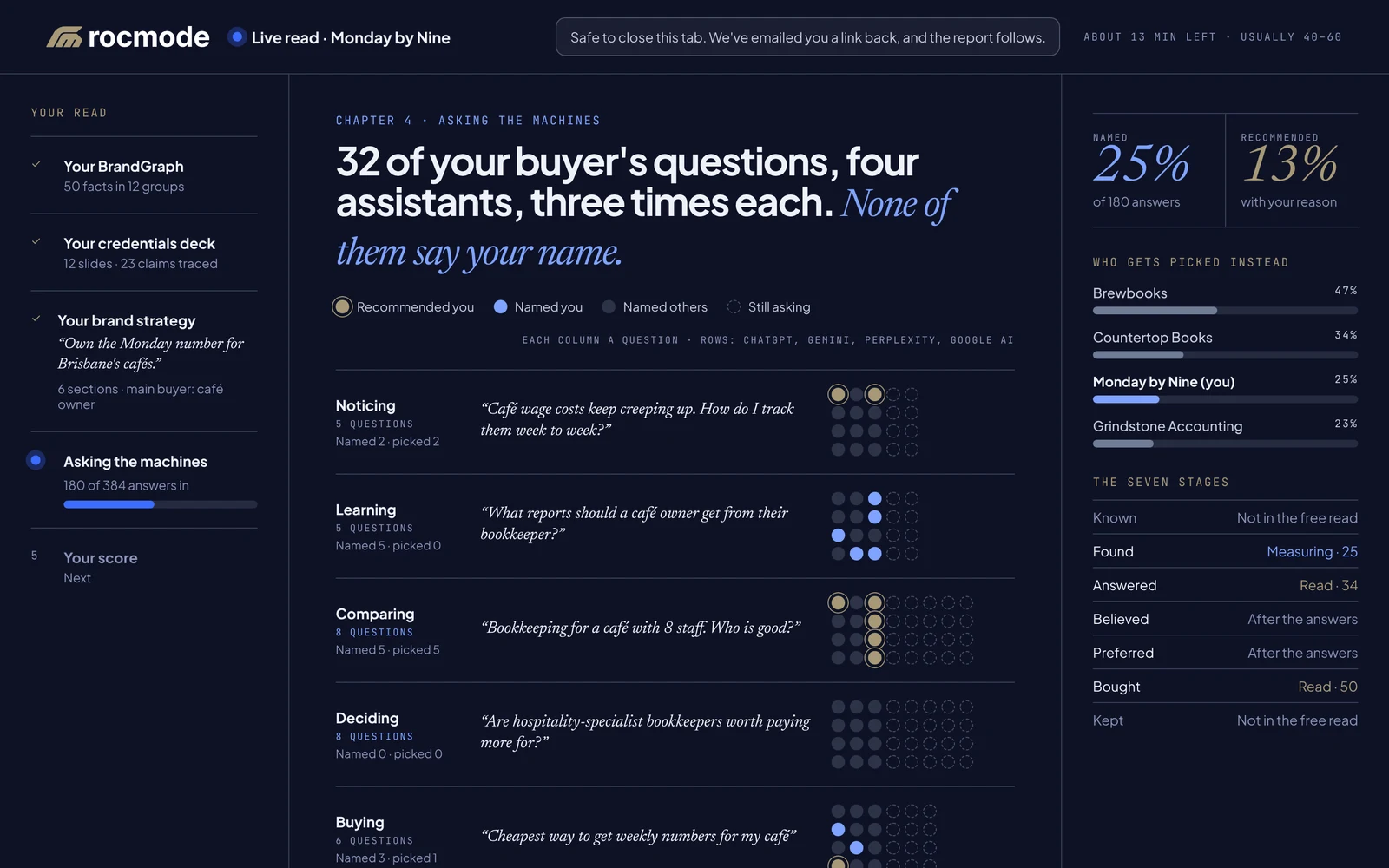
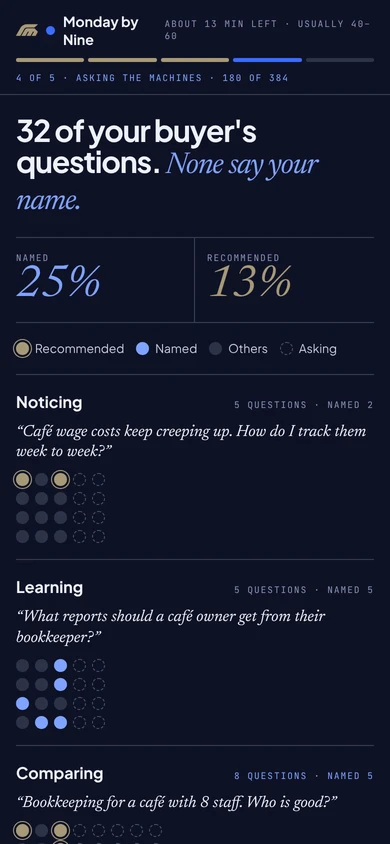
RocMode · Live read · Monday by Nine (example)
Asking ChatGPTBefore
The AI marketing and sales platform
Marketing and sales, rebuilt for the age of AI.
Your website in. A whole marketing and sales team’s work out. RocMode learns your brand from your site, then does the work: strategy, website, ads, social, PR, partners, email, design, and the deck that wins the deal. You approve every piece.
Other tools do one job. This does all of them, as one story.
Other AI guesses. This works from your facts and proof.
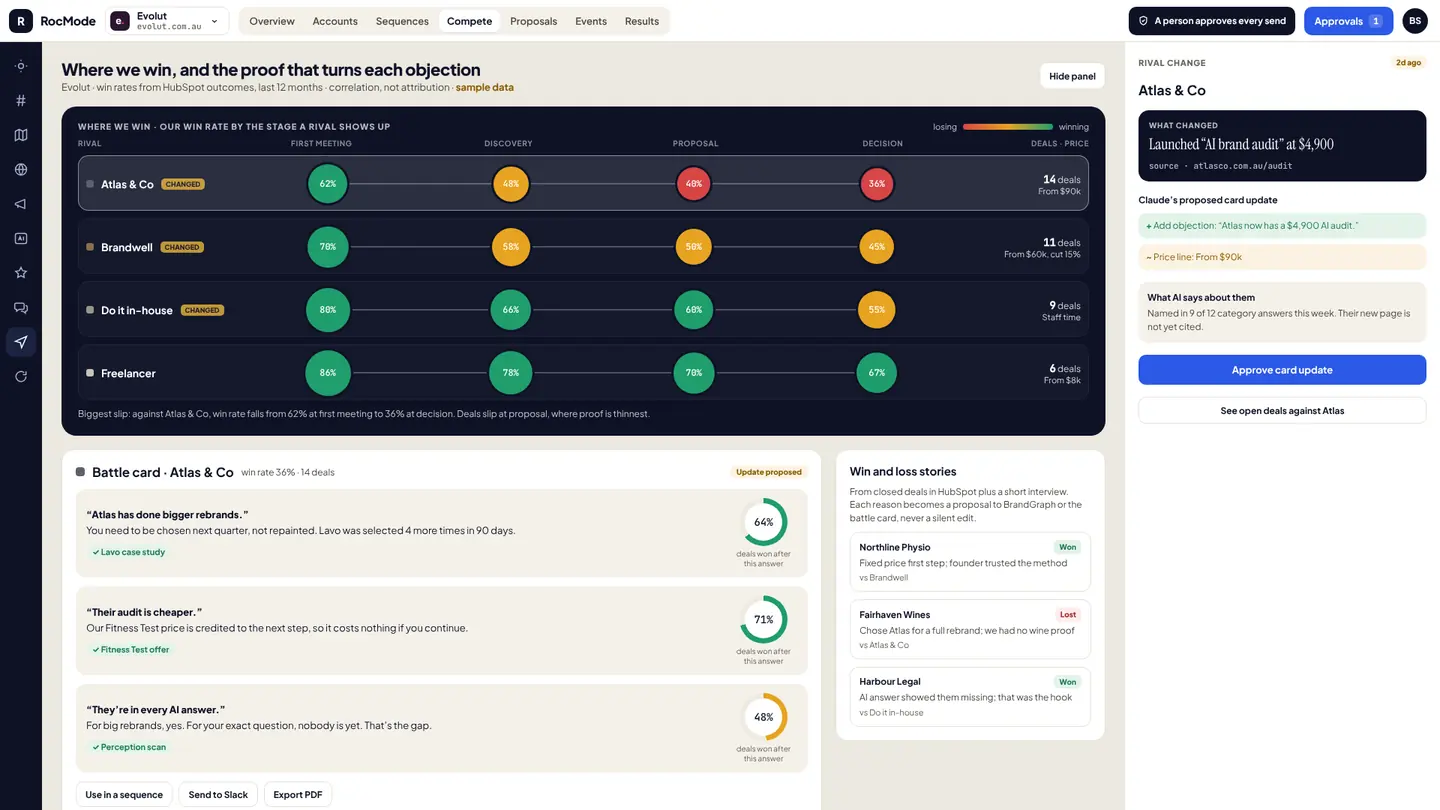
Other tools stop at the post. This follows it to the signed deal, and learns what won.
How it works
KnowWhere you really standActWhat to fix firstCreateWe build the work. You approve itProveDid it move?
Know · Step 1 of 10
It gets you. It gets your customers. It connects the dots.
Everything about your brand, your buyers and your rivals, sorted and connected.
Then it works out what to say, where, when and why. It’s the brain behind every step.
Builds: Customers · Offerings · Rivals · Proof
RocMode · BrandGraph · sample data
Following one momentCISO · Comparing · “Who’s the best managed security provider for a hospital group?”Moment found
Brand core3 found
Voice3 found
Visual identity3 found
Products and services3 found
Pricing3 found
Personas and markets3 found
Pains, gains, jobs3 found
Journeys and objections3 found
Proof and trust3 found
Content3 found
Competitors and partners3 found
Team2 found
Halvard Security35 facts
Two hospital case studies/partners
FactClaimProofAI-suggestedExample: Halvard Security, an invented managed security provider.
Reading halvardsecurity.com.au, socials, reviews and listings…
Halvard SecurityBrandGraph
12areas, all connected
3personas
15moments
6rivals
Sample data
Your customers
Customers
›
Personas
›
Journeys
›
Pains, jobs, objections
›
Moments
What you sell
Products and services
›
Offerings
›
Value proposition
›
Differentiation
Your rivals
Competitors
›
Industry
›
Expectations
›
Gaps to exploit
Moments + offerings
Opportunities
›
Campaigns
›
Ads
›
Sales
Content gaps
›
Content
›
Website
So it knows
What to say.Where. When. Why.
Moment foundCISO · Comparing · “Who’s the best managed security provider for a hospital group?”
Know · Step 2 of 10
Your strategy, from everything it knows.
Positioning built from your offerings and the gaps your rivals leave.
Claims you can’t back get cut before anyone sees them.
Seen isn’t selected. AI picks the brands it can tell apart.
Every era of marketing had its visibility number, and AI mentions are just the newest. Most AI tools still sell you visibility. But being mentioned isn’t being chosen, and for the first time you can measure the pick itself.
BroadcastAwareness
Media buyingReach
SearchRankings
SocialFollowers
AIMentions
What countsSelected
What AI made cheap
Making things.
Posts, pages, ads and reports in minutes
Anyone with a login can do it
Your competitors have the same tools
Sell on volume and you compete on price.
What AI made measurable
Being chosen.
Brand ABrand BYouBrand CBrand D
Buyers ask AI who to pick, and it names a few brands
You can ask the same questions and see who’s named
So you can see, moment by moment, where you win and lose
Compete on this and you compete on results.
See it on your brand
See how often AI picks you. Free.
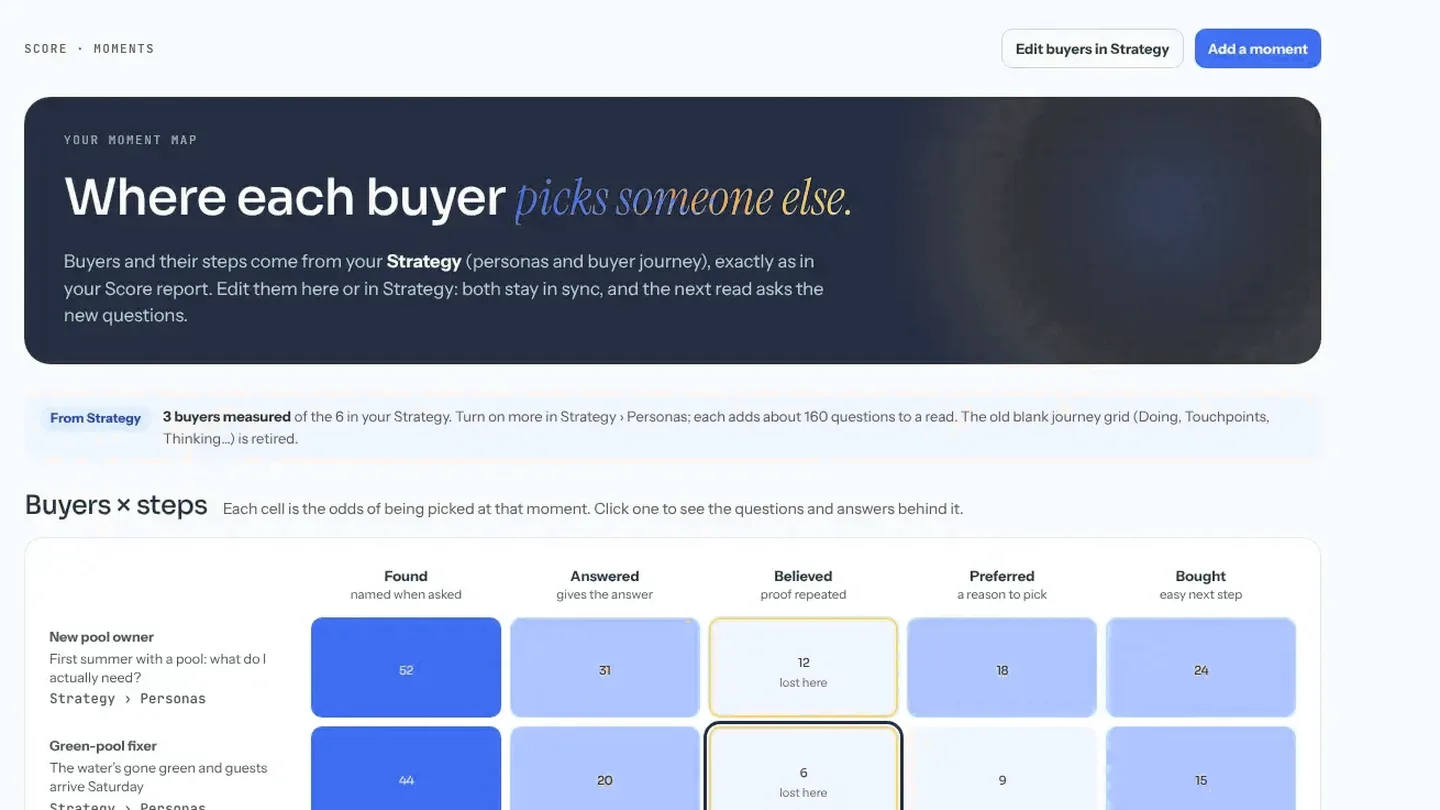
We ask the AI assistants your buyers use the questions they really ask, many times each, at every step of their journey. Then we show where you’re picked, where you’re passed over, and who wins instead.
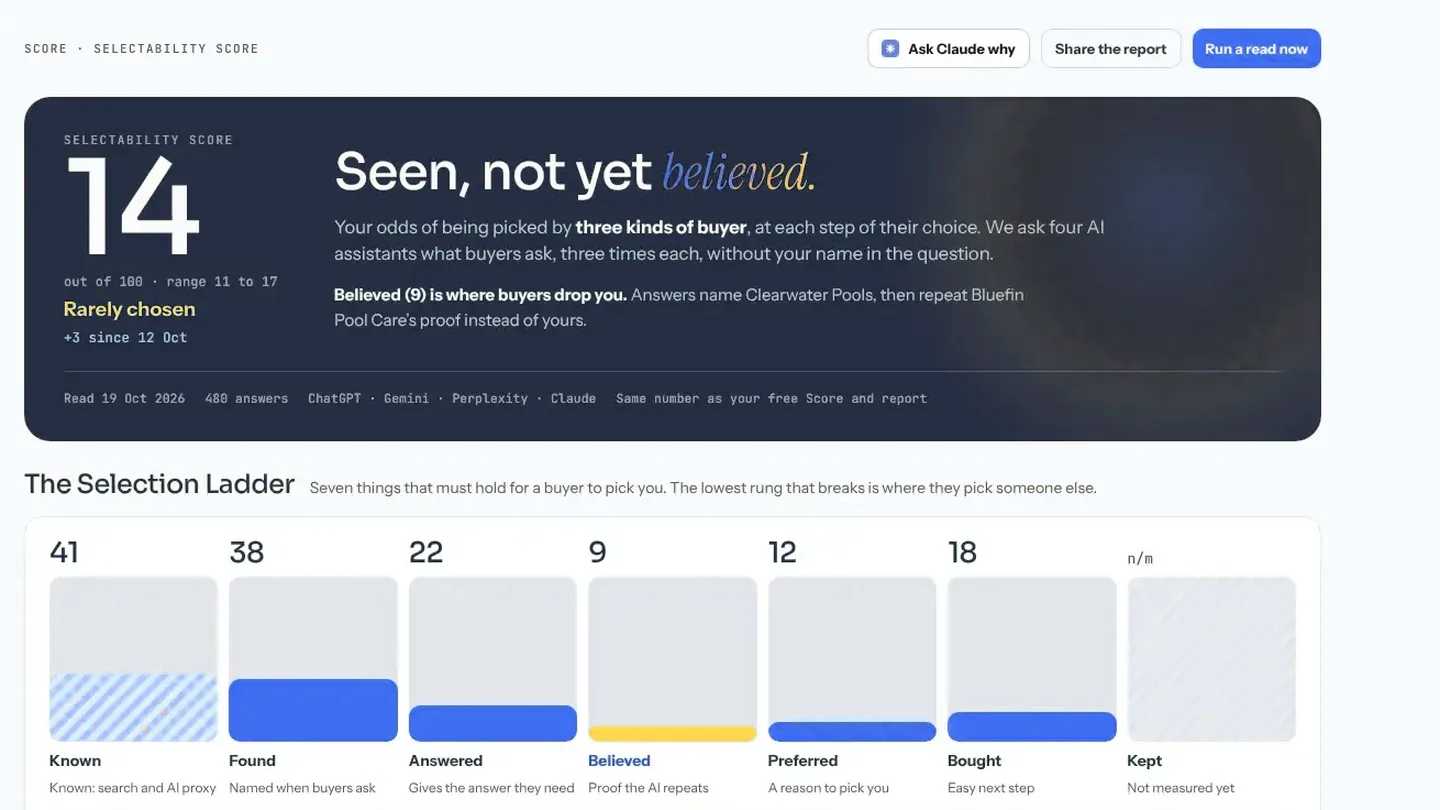
Your free Selectability Score asks the AI assistants the questions your buyers ask, without your name in them. You see who gets picked, at which moment, and the three gaps to fix first.
Most pitch decks are written for the meeting the seller attends. They open with the company's story, a wall of client logos and a tour of features. The presenter fills the gaps and handles questions as they come.
Then the meeting ends and the real decision starts. The person who liked you, your champion, has to make your case to finance, to IT and to the boss. You're not there. Neither is the voice-over that made slide nine make sense.
And now there's a fourth reader. Buyers check what a rep says against AI, and what AI says against a rep. So the better question isn't whether the meeting went well. It's whether the champion could make your case without you, and whether it would survive a finance lead checking it with an assistant.
What it is for
A pitch gives people who never met you a reason to say yes, and nothing to fear. I call the place where that happens the second meeting: the one your champion runs, without you, a week after yours.
It serves three stages directly. Preferred, because it carries your reason into a room you're not in. Believed, because it brings proof from someone like them. Bought, above all, because it names the cost of doing nothing and takes the risk out of acting.
It doesn't serve Known or Found. A pitch only reaches buyers who already have you on the list. It's mostly a confirming job, too. Buyers bought from their early favourite 77% of the time in 6sense's survey. So the pitch rarely wins a deal from nowhere. It confirms a lead or loses it.
Every member of the committee can say no. Three CEB researchers, writing in HBR, described groups "all with different roles and priorities, and all with veto power" (HBR). The champion has to teach your case to them, and the pitch is the material they teach from.
The anatomy of a good one
A good pitch is a case a stranger can make. The order holds whether you use seven slides, a memo or seven minutes of talk.
Their moment, in their words [Known · Answered]. "Our technicians spend half the day driving" beats any headline you could write.
The cost of doing nothing [Bought]. Doing nothing is often your real rival. Put a figure on carrying on as before, in their numbers, worked out with the champion. Use a figure finance would sign; an inflated one dies in the second meeting.
What good looks like [Preferred]. Teach before you sell. CEB's researchers found the best suppliers created "shared language and perspectives around problems and solutions" (HBR).
Your reason, which a rival wouldn't say [Preferred]. One reason that passes the opposite test (Chapter 11), and who it doesn't suit.
Proof from someone like them [Believed]. One customer of their size, with a number and a name they could call. Use exactly the figure your website uses.
The risk removed [Bought]. A small first step, a way out and someone to call, on the slide, not only in the contract.
A plain recommendation [Bought]. Name one option and say why, then a next step with a date and an owner.
The mistake most teams make
They write the deck about themselves, for the first meeting. The founding story, the logo wall, the feature tour, three tiers with no advice. Nobody in the second meeting asks for any of it.
Material the reader doesn't need does harm, not just no good. Richard Mayer reviewed experiments on learning and found people learned more deeply when extraneous material was left out, in 10 of 11 tests (Mayer). Those are lab studies of learning, not sales. But the champion's task is a learning task. Every slide they must skip or explain is a cost. And a menu of three tiers hands the hard choice to the person who isn't in the room.
My working rule, which no sales study I know of tests: send the pitch first, and use the meeting for questions.
How you know it's working
Retire meetings booked, deck views and "great meeting". Watch the no-decision rate on deals that reached a pitch; the forward test, meaning how often the champion's forwarded version keeps your reason and numbers intact; new questions per meeting, falling over time; and machine match, the share of your claims that assistants state the same way.
An example
I learned this one the hard way. In 2023 we pitched a new website to a services firm with offices in four cities, with a polished online proposal: our process, our guarantee, our price. We lost. When I asked for candid feedback, the head of marketing gave it: "the successful proposal was more in depth and personalised to the project. It included some initial design ideas and site structure suggestions which were based on the brief. It gave me more confidence they were on the right track."
The winner hadn't out-credentialled us. It had shown its thinking about her problem, and that's something a champion can carry into a room.
The full playbook. The Pitch Playbook, with the pitch audit scorecard, the seven-slide pitch skeleton and the one-page champion summary, is free at rocmode.com/playbooks.
Whose evidence this is. 6sense sells intent data. CEB, now part of Gartner, sold sales research and advice, and Gartner sells research and advice. Academic: Mayer's review of lab experiments on learning. No study I found tests pitch structure against win rates; the anatomy is my inference.