Your buyers ask AI who to pick. Make sure it’s you.
Gets you selected acrossChatGPTClaudeGeminiPerplexity
RocMode shows you whether AI picks you or your rival, finds the work that changes it, builds that work, and sends it to you to approve. Then it proves what moved.
We ask ChatGPT, Claude, Gemini and Perplexity the questions your buyers ask, and show where they pick you and who they pick instead. Free, no login. What’s the Score? Or sign up free and try everything for 14 days.
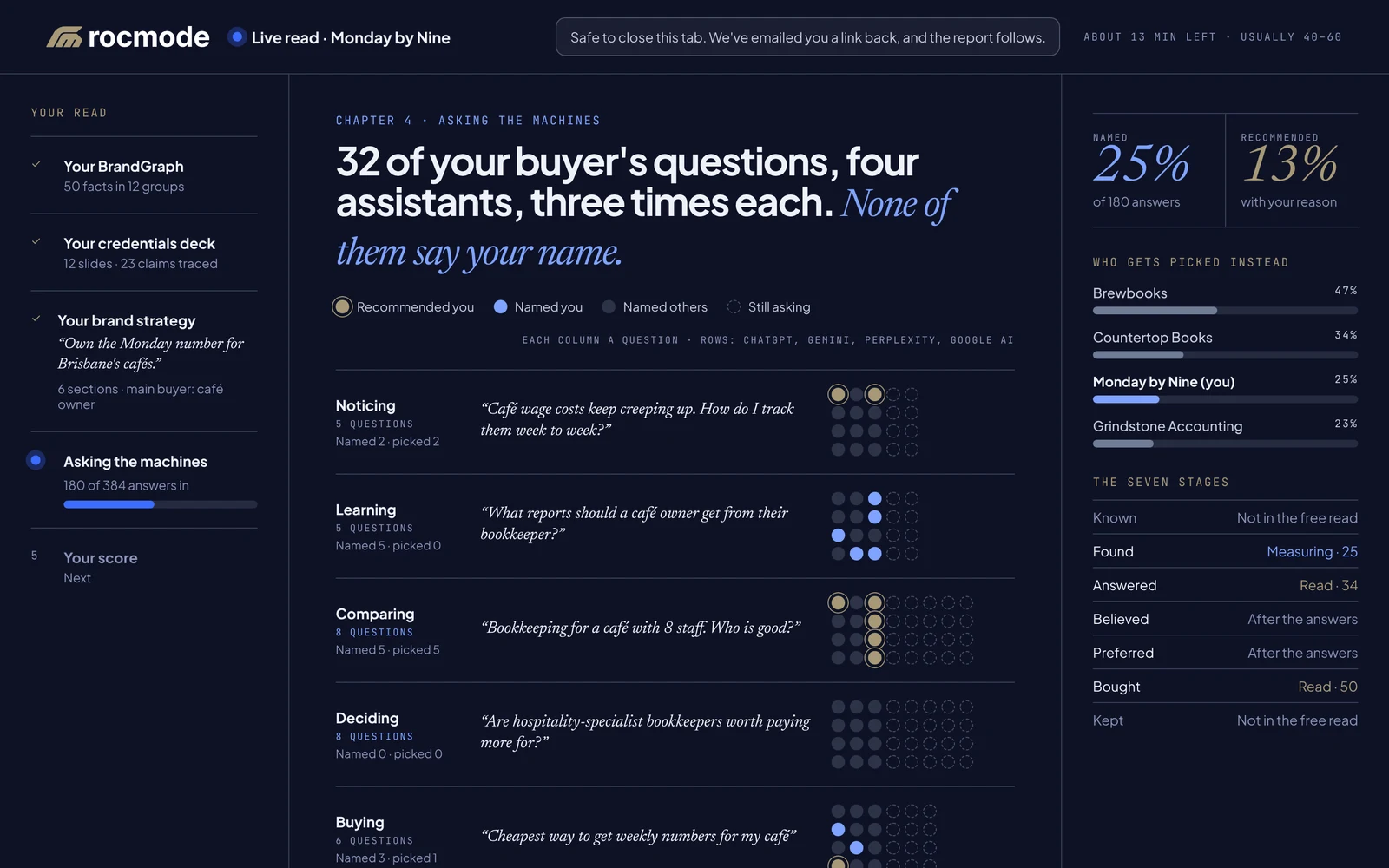
RocMode · Live read · Monday by Nine (example)
Asking ChatGPTBefore
The AI marketing and sales platform
Marketing and sales, rebuilt for the age of AI.
Your website in. A whole marketing and sales team’s work out. RocMode learns your brand from your site, then does the work: strategy, website, ads, social, PR, partners, email, design, and the deck that wins the deal. You approve every piece.
Other tools do one job. This does all of them, as one story.
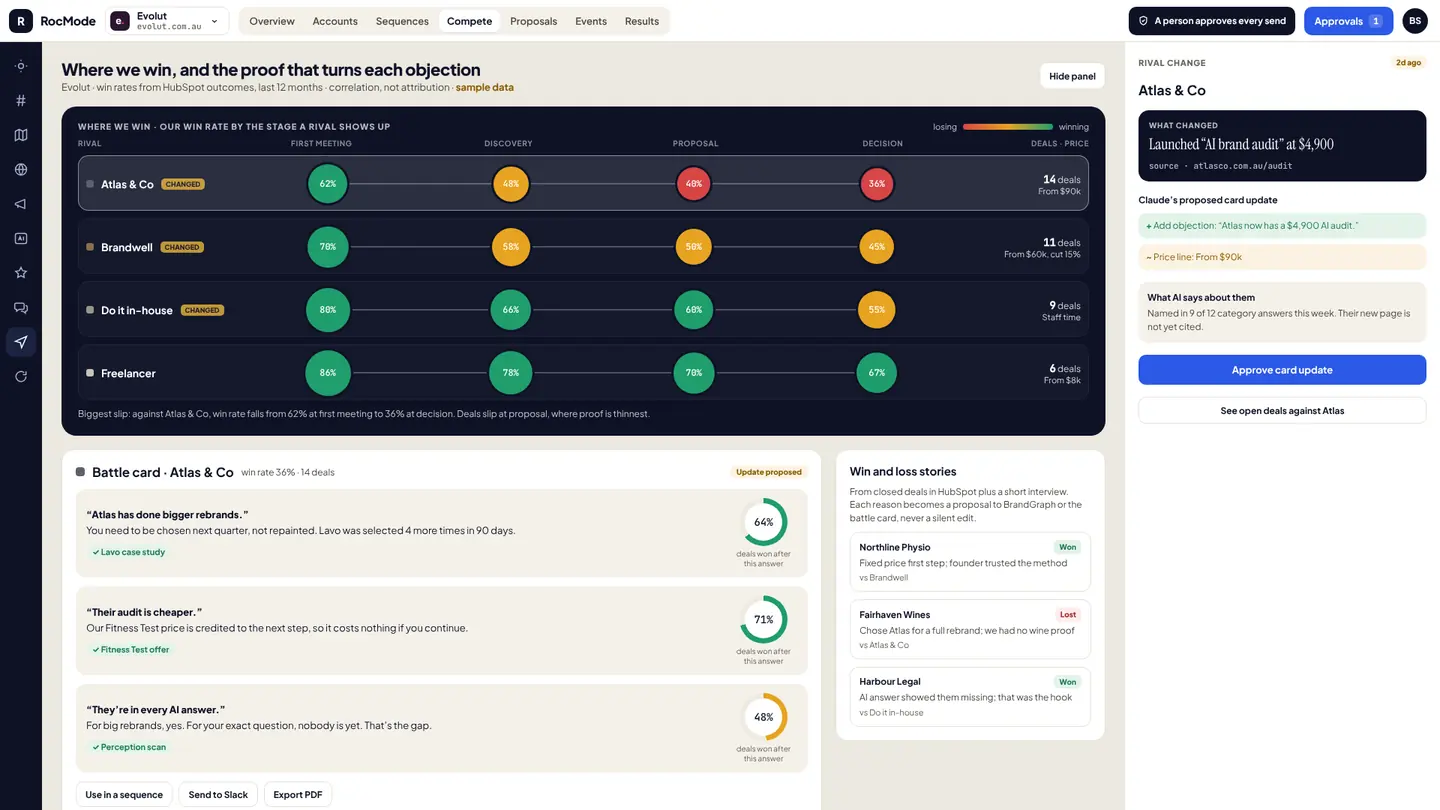
Other AI guesses. This works from your facts and proof.
Other tools stop at the post. This follows it to the signed deal, and learns what won.
How it works
KnowWhere you really standActWhat to fix firstCreateWe build the work. You approve itProveDid it move?
Know · Step 1 of 10
It gets you. It gets your customers. It connects the dots.
Everything about your brand, your buyers and your rivals, sorted and connected.
Then it works out what to say, where, when and why. It’s the brain behind every step.
Builds: Customers · Offerings · Rivals · Proof
RocMode · BrandGraph · sample data
Following one momentCISO · Comparing · “Who’s the best managed security provider for a hospital group?”Moment found
Brand core3 found
Voice3 found
Visual identity3 found
Products and services3 found
Pricing3 found
Personas and markets3 found
Pains, gains, jobs3 found
Journeys and objections3 found
Proof and trust3 found
Content3 found
Competitors and partners3 found
Team2 found
Halvard Security35 facts
Two hospital case studies/partners
FactClaimProofAI-suggestedExample: Halvard Security, an invented managed security provider.
Reading halvardsecurity.com.au, socials, reviews and listings…
Halvard SecurityBrandGraph
12areas, all connected
3personas
15moments
6rivals
Sample data
Your customers
Customers
›
Personas
›
Journeys
›
Pains, jobs, objections
›
Moments
What you sell
Products and services
›
Offerings
›
Value proposition
›
Differentiation
Your rivals
Competitors
›
Industry
›
Expectations
›
Gaps to exploit
Moments + offerings
Opportunities
›
Campaigns
›
Ads
›
Sales
Content gaps
›
Content
›
Website
So it knows
What to say.Where. When. Why.
Moment foundCISO · Comparing · “Who’s the best managed security provider for a hospital group?”
Know · Step 2 of 10
Your strategy, from everything it knows.
Positioning built from your offerings and the gaps your rivals leave.
Claims you can’t back get cut before anyone sees them.
Seen isn’t selected. AI picks the brands it can tell apart.
Every era of marketing had its visibility number, and AI mentions are just the newest. Most AI tools still sell you visibility. But being mentioned isn’t being chosen, and for the first time you can measure the pick itself.
BroadcastAwareness
Media buyingReach
SearchRankings
SocialFollowers
AIMentions
What countsSelected
What AI made cheap
Making things.
Posts, pages, ads and reports in minutes
Anyone with a login can do it
Your competitors have the same tools
Sell on volume and you compete on price.
What AI made measurable
Being chosen.
Brand ABrand BYouBrand CBrand D
Buyers ask AI who to pick, and it names a few brands
You can ask the same questions and see who’s named
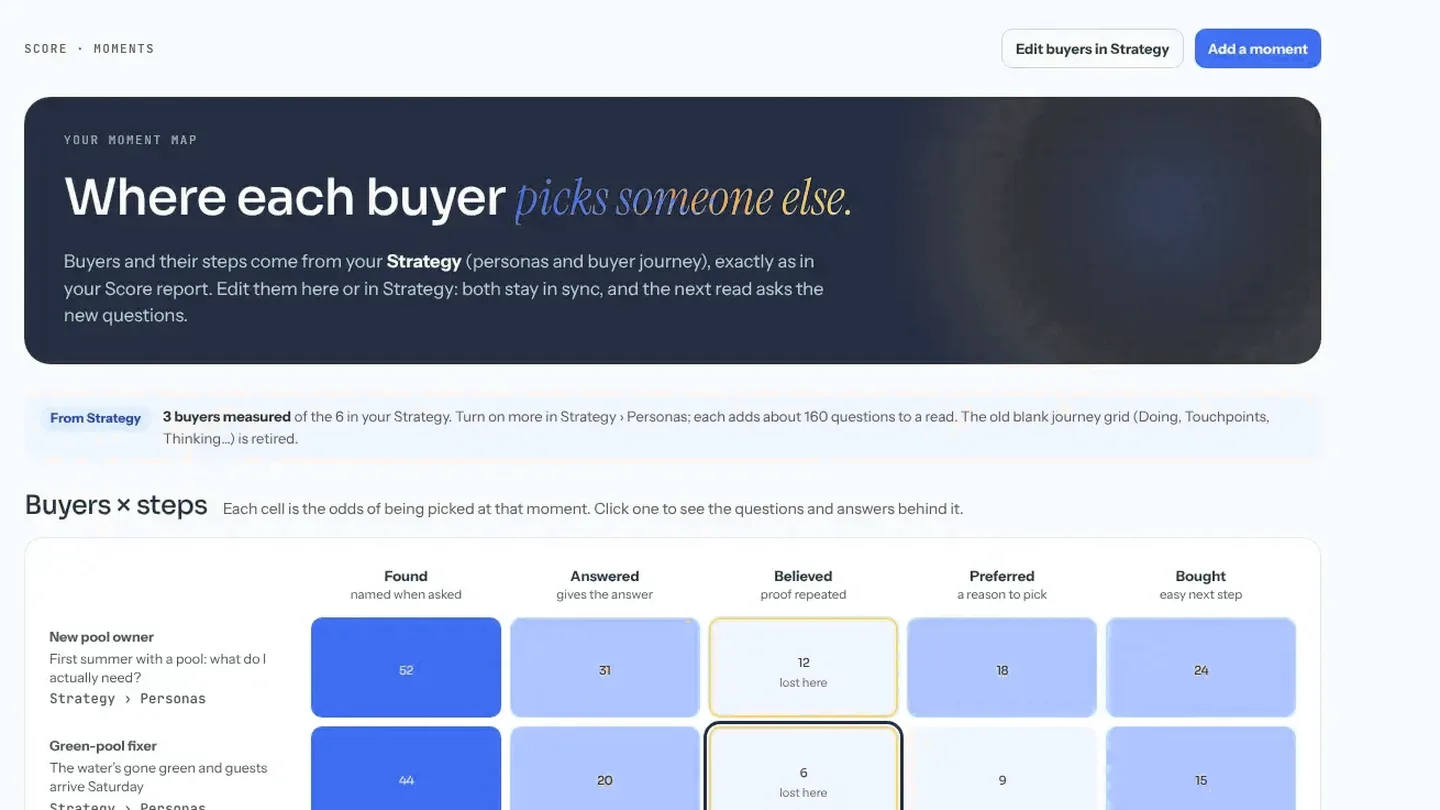
So you can see, moment by moment, where you win and lose
Compete on this and you compete on results.
See it on your brand
See how often AI picks you. Free.
We ask the AI assistants your buyers use the questions they really ask, many times each, at every step of their journey. Then we show where you’re picked, where you’re passed over, and who wins instead.
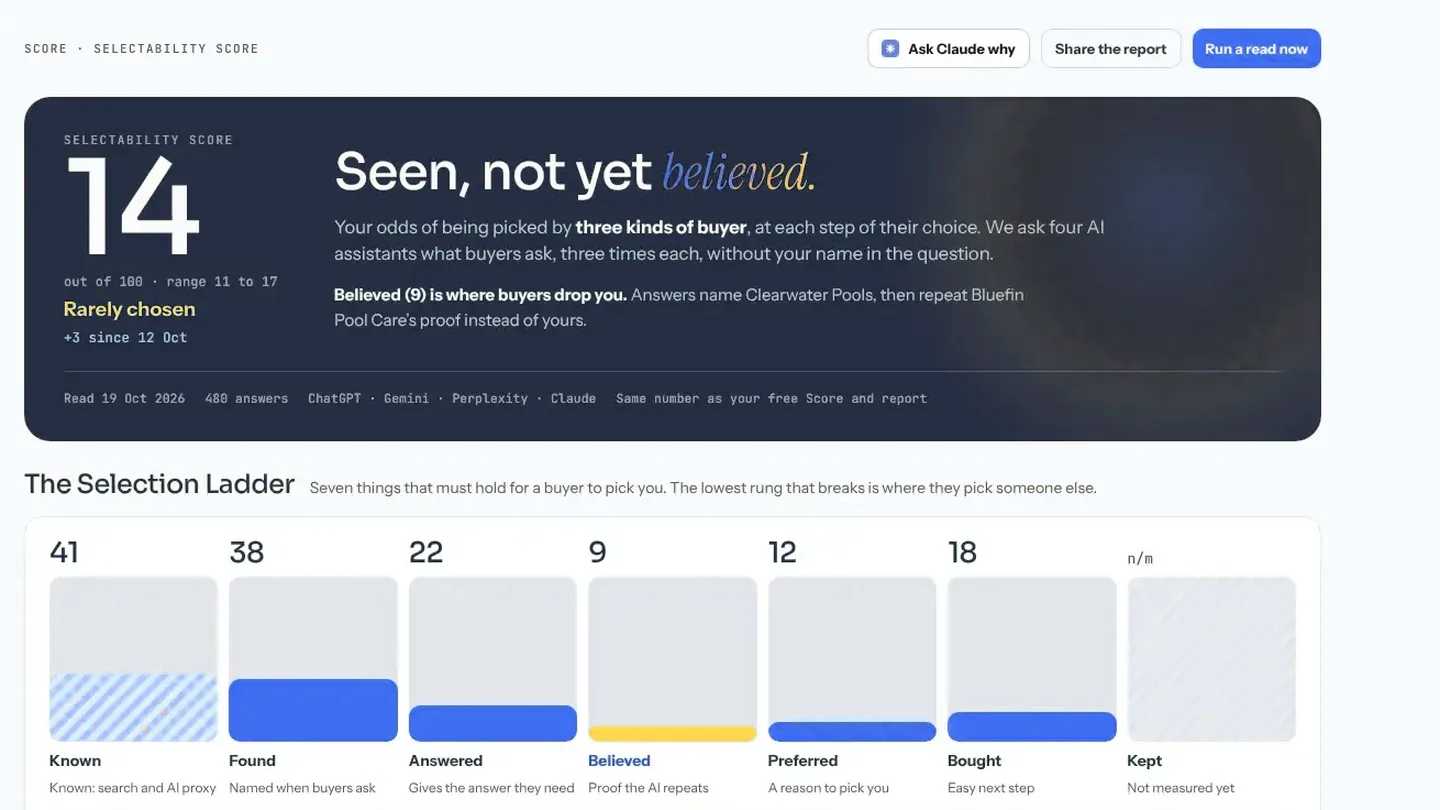
Your free Selectability Score asks the AI assistants the questions your buyers ask, without your name in them. You see who gets picked, at which moment, and the three gaps to fix first.
Every build is a different mix of the same seven stages.
Part three said what has to be true at each stage. But nobody builds a stage. A team builds things: a website, content, advertising, a pitch, email, events and a dozen more.
Those builds are usually run as separate crafts, each with its own team, agency, budget and dashboard. Each is judged on its own numbers: reach, traffic, rank, opens. None of those numbers says whether a buyer chose you.
Six categories, fourteen builds
There are more ways to reach a buyer than any team can run, so it helps to sort them by one question: who is speaking, and how did they reach the buyer? Six answers cover almost everything.
Owned: your voice, on ground you own. The website, content and social.
Paid: your voice, in space you buy. Advertising.
Earned: someone else's voice, freely given. Search and AI answers, and PR and reviews.
Partnered: someone else's voice or audience, by agreement. Partners and channels, and creators.
Direct: a person, live. Outbound and account-based selling, the pitch, and events.
Relationship: your system, talking to someone you already know. Email, automation, and customers: onboarding, loyalty, community and referral.
This extends the PESO model (paid, earned, shared, owned) that Gini Dietrich built for communications. For most firms, a person in a room and the system that remembers a customer decide as many moments as any channel, so each gets a category of its own.
That makes fourteen builds. A channel earns its own build only if it has its own shape, its own craft, and moments it leads better than anything else. Sponsorship, affiliates, awards, account management and the rest do their work through a build that already exists, so they get a short note, not a chapter. Offer, price, product and distribution aren't builds at all: they're foundations, set before any build starts.
Ten builds get a chapter here. Outbound, events, partners and customers get shorter sections at the end of Part four.
Lay the ten chapter builds against the seven stages and the picture changes.
Read across a row and you see what a build is for. Read down a column and you see something more useful: who is responsible for a stage. Believed is carried by seven builds. Known rests mostly on advertising and social. Kept rests on email and automation, and on a website most teams never think of as a retention tool.
So no build owns a stage, and no stage belongs to one team. When Believed fails, it may be the website's proof, the PR team's reviews or the pitch's case study. A team organised by craft can't see that. A team organised by stage, or by moment, can.
That's the change Part four asks for. Keep the crafts, because each needs skill. But give each stage an owner who looks across the builds, and judge every build by the stages it's meant to move, using the Selectability Score (Part five).
Brief it twice
Most marketing leaks at the brief. The IPA's BetterBriefs survey asked more than 1,700 marketers and agency staff about briefs. Eight in ten marketers said they wrote good ones, and one in ten agency staff agreed (IPA).
So use two briefs. The campaign brief carries one short idea, the moments and stages it must move, and a separate box of rules. The asset brief carries five lines for each thing you make: moment, stage, reason, proof and next step. The same five lines brief a person or an AI.
If you can only do two
A small business can't run fourteen builds. My working rule: start with the website and search and AI answers. They share the same questions and the same pages, and together they cover Found, Answered, Believed, Preferred and Bought. Add PR and reviews third, because it's the cheapest route to being believed by others. The rest can wait until those three work.
For agencies, the grid is also a menu. An agency selling one craft sells one row. The work that wins now runs down a column: an audit of one stage across every build, a source map, a body of proof.
How each chapter works
Each build chapter gives the argument: what the build is for, its anatomy by stage, the mistake most teams make and how to know it's working. The full how-to, with the briefs, templates and checklists, lives in the free Selectability Playbooks at rocmode.com/playbooks.