It gets you. It gets your customers. It connects the dots.
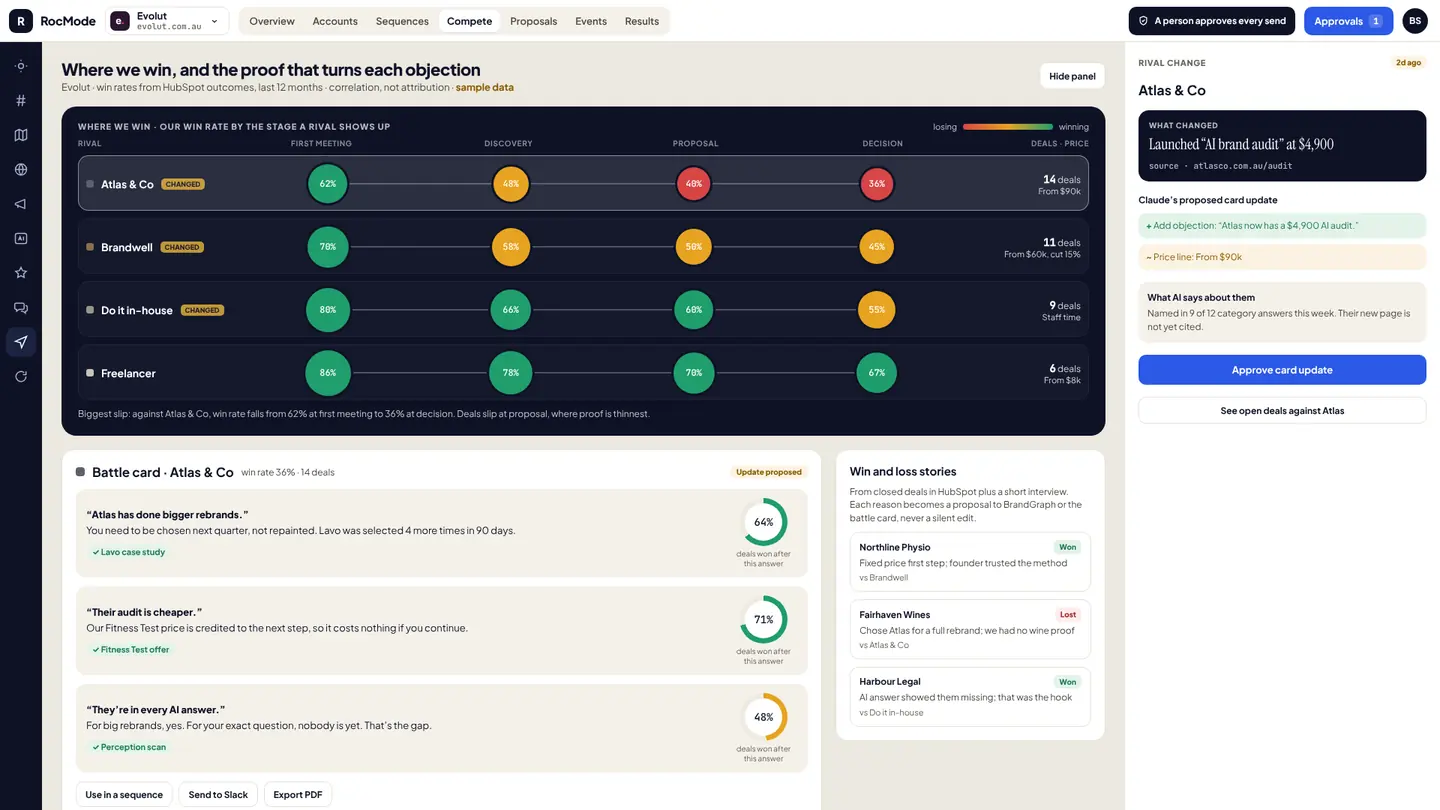
- Everything about your brand, your buyers and your rivals, sorted and connected.
- Then it works out what to say, where, when and why. It’s the brain behind every step.
Security 35 facts
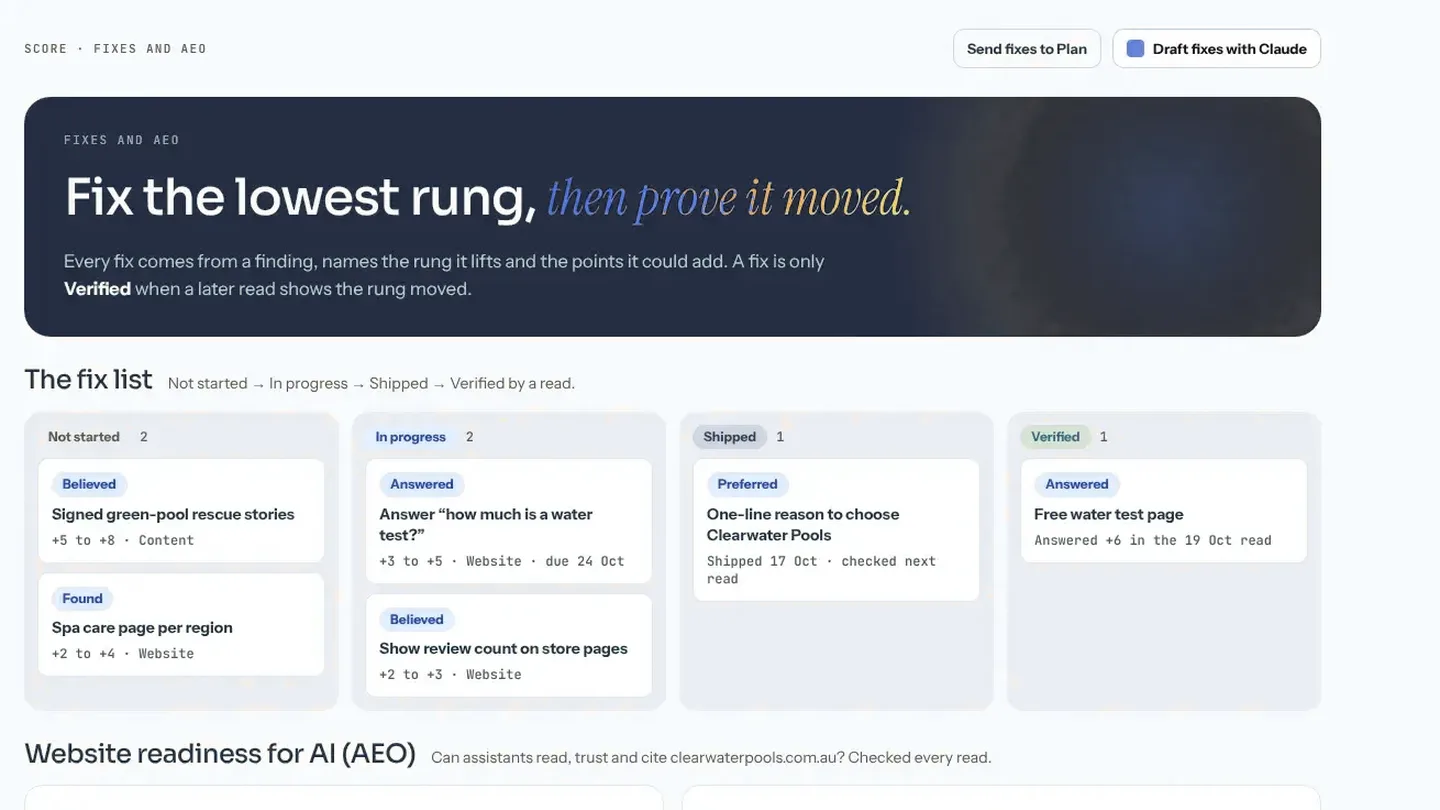
RocMode shows you whether AI picks you or your rival, finds the work that changes it, builds that work, and sends it to you to approve. Then it proves what moved.
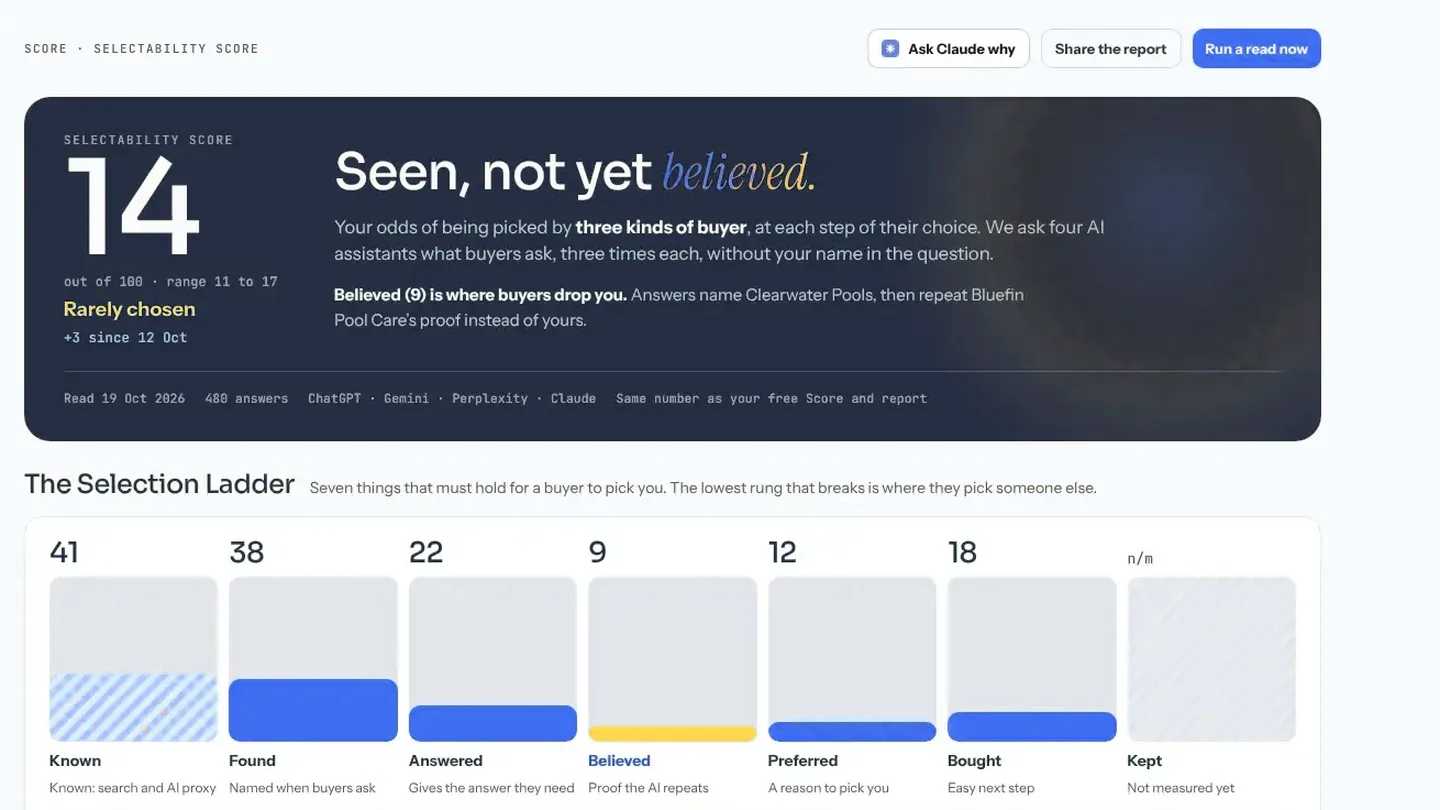
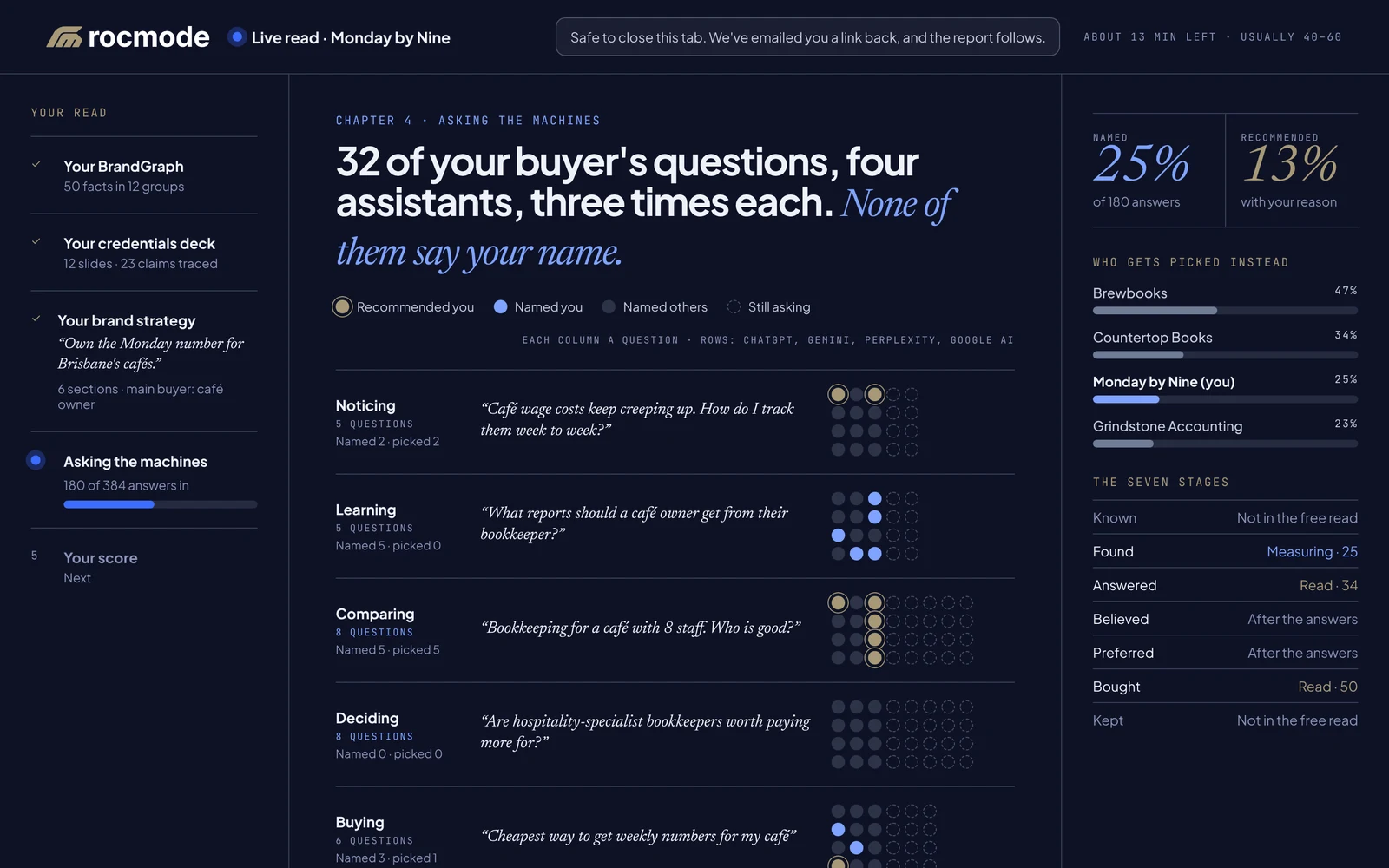
We ask ChatGPT, Claude, Gemini and Perplexity the questions your buyers ask, and show where they pick you and who they pick instead. Free, no login. What’s the Score? Or sign up free and try everything for 14 days.

Your website in. A whole marketing and sales team’s work out. RocMode learns your brand from your site, then does the work: strategy, website, ads, social, PR, partners, email, design, and the deck that wins the deal. You approve every piece.
Other tools do one job. This does all of them, as one story.
Other AI guesses. This works from your facts and proof.
Other tools stop at the post. This follows it to the signed deal, and learns what won.
None of this is your fault. Buyers changed how they choose, and most marketing hasn’t caught up.
The dashboards are green and the pipeline isn’t.
About half of new articles online are now written mainly by machines. Graphite, 55,400 URLs, 2026So AI and buyers hear five versions of you.
Not in a footnote. Nowhere.
Check yours free →Every era of marketing had its visibility number, and AI mentions are just the newest. Most AI tools still sell you visibility. But being mentioned isn’t being chosen, and for the first time you can measure the pick itself.
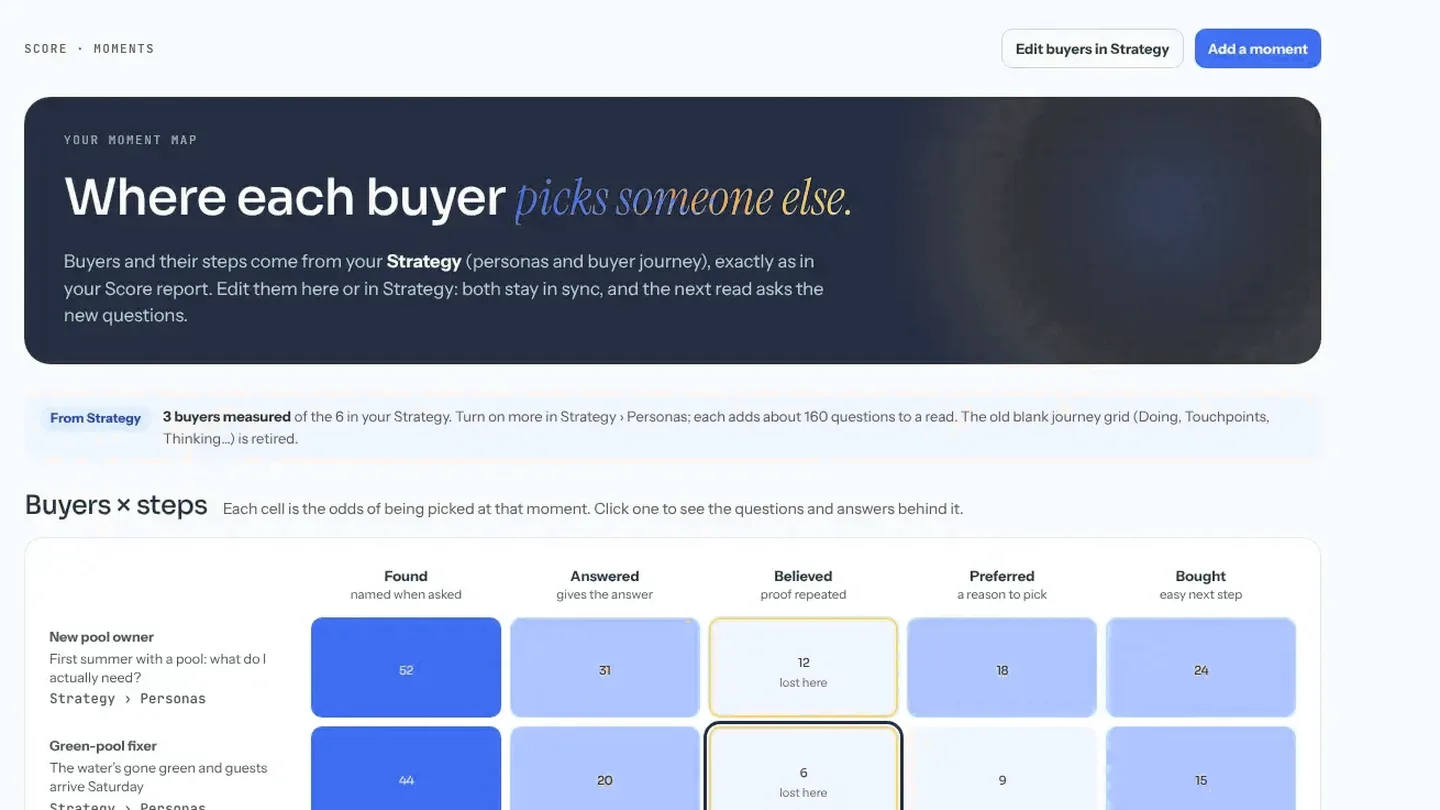
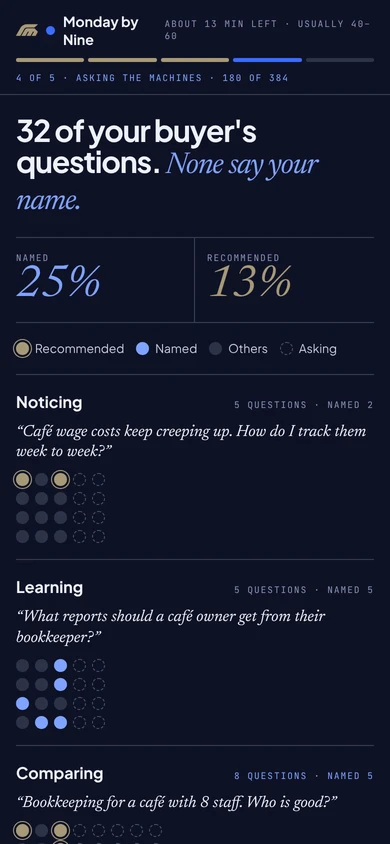
We ask the AI assistants your buyers use the questions they really ask, many times each, at every step of their journey. Then we show where you’re picked, where you’re passed over, and who wins instead.


RocMode runs on Seen Isn’t Selected and the free Selectability Playbooks. Read the thinking before you buy.
The book →We ask the assistants your buyers use, many times, at every moment, and report the rate with honest margins. Every finding has a receipt.
See a Score →The same system that finds the gap writes the page, the email and the deck that closes it.
How it works →Monday by Nine, the café bookkeeper from the book: who gets picked instead, where buyers are lost, and the three fixes that lift it most.
Open the sample →Same questions, same assistants, every month, with what we changed in between.
See our Score →The whole book. 206 pages, no email, no paywall. Plus the 10-minute manifesto and the Playbooks.
Read it free →Everything below runs on one BrandGraph, priced per brand. Start with the free Score, or try every plan free for 14 days. Cancel any time.
Your free Score shows where you’re picked, where you’re passed over, and who gets chosen instead.
Or sign up free →Your free Selectability Score asks the AI assistants the questions your buyers ask, without your name in them. You see who gets picked, at which moment, and the three gaps to fix first.
✓ Free✓ No login✓ Report by email, with a PDFRead · The manifesto
A manifesto for marketing's one job. Twelve beliefs, ten minutes. Short enough to send your chief executive.
Marketing can make more than ever, and is less sure than ever what it achieves.
We can publish a thousand pages by Friday. We can put an ad in front of anyone, a post in front of everyone, and a chatbot on every page. And still, in most firms, nobody can say with confidence why the last deal was won, or why the one before it was lost.
I don't think that's because marketers are bad at their jobs. I think it's because marketing never agreed what the job was. So it counted what it could see: reach, awareness, traffic, rankings, followers, and now AI visibility. Each was a stand-in for the thing nobody could see, which was the choice.
In 2025, 6sense surveyed about 4,000 business buyers making purchases of US$25,000 or more. Each buying group weighed about five suppliers and picked one.
All five were seen. Four lost.
What follows are twelve beliefs. Together they are the argument of the book, and the method behind the free playbooks.
Everything else either makes that more likely or guesses at whether it happened. So ask one question of every tool, channel and campaign: will this get us selected? Take any activity and keep asking “so that what?” Every chain should end on the same sentence: so that they choose us. A chain that ends anywhere else has no job to do.
Selectability is the odds that a buyer, at a given moment, picks you over the alternatives, doing nothing included. A brand can be seen everywhere and selected almost nowhere. And selectability is specific: you can be the obvious choice for one buyer at one moment, and invisible to another. One number for the whole brand hides exactly what you need to know.
The finance director building the case for the board. The owner wondering whether outside help is worth it. The plant manager who expects to be told what they already know. Every one of those is a different question, decided by different evidence, in a different place. Marketing that starts from channels ends up with a brochure. Marketing that starts from moments ends up with answers.
Visibility covers the first two. A grocery shop turns on two or three of the seven. A software contract needs all seven, for several people at once. Most marketing reports describe the first two stages in great detail and the other five not at all.
About 95% of business buyers aren't in the market for a category at any one time, by Professor John Dawes's rule of thumb at the Ehrenberg-Bass Institute. In the same 6sense survey, the winning supplier was on the first-day shortlist 95% of the time. So most marketing works long before anyone is buying, by leaving a memory filed under a moment. The ad that matters most is the one a buyer remembers a year later, when the moment arrives.
Matt Dixon and Ted McKenna analysed about 2.5 million recorded sales calls. The buyer didn't pick anyone. The biggest competitor is rarely another firm. It's doing nothing, or doing it yourself, or buying a different kind of answer altogether. Pressure loses those sales. Safety wins them: a clear price, a small first step, an easy way out.
Most firms answer none of these in public, and then wonder why their buyers go quiet. An answer is finished only when it removes the next question. Publish the price range. Publish the limits. Say who should choose someone else.
A named client, a number someone else confirmed, a review you didn't write and a reference who'll take a call: that's what belief is made of. And one contradiction anywhere can be repeated everywhere. The price on the website, the claim in the deck and the answer an assistant gives must be the same, because buyers, and machines, will notice when they aren't.
The board, a partner, themselves at two in the morning. So the reason to choose you has to be short enough to repeat and true enough to survive being checked. If your best customer can't say it in a sentence, you don't have one yet.
The buyer's is built by experience and advertising. The machine's is built from what's been written about you, much of it by other people. AI is the problem and much of the answer. The machine flooding the market with content is also the first adviser a marketer can question directly, as often as they like, in their buyers' own words. For the first time, the odds of being selected can be estimated, moment by moment, before the sale rather than after it.
A website, an ad, a pitch, an email, an event: each is a build, and each serves some moments and not others. It's “which moments does social lead, and did they move?” Give every moment one build that leads it and a few that support it. Then judge every build by the stages it's meant to move, not by the numbers it was always going to report.
Measure the odds at your moments, find the stage where each is lost, and fix the biggest gap first. Write down what you expect the fix to do. Then ask the same questions again, and record what moved against what you predicted. Drop the fixes that did nothing. Keep the ones that worked. Do it every quarter. That loop, more than any single campaign, is what makes a brand selectable.
I'd rather say this plainly than have you find it out later. Nobody has yet shown that a selectability score moves with market share. The weights in any such score are judgement until they're calibrated against real sales. And no measure of the odds outranks your own sales data where you have it. The method is published, so you can check the working, or run it yourself, by hand, for five moments this quarter.
The full argument: the seven stages one at a time, the fourteen builds and the Selectability Score. Free, on this site.
Read the book →The how-to: eleven steps, fourteen builds, one worked example, every template. Free.
Get the playbooks →I build software on this thinking, and I'd rather you knew that now. It shows which moments you win, which you lose, and the fix worth the most.
Get your score →Every brand is seen by someone. Very few are selected on purpose.Ben Stokes
Want every buyer scored, every quarter? Start a free trial
Free · three PDFs
The book, the manifesto and the Playbooks are free to read here, with no email. Leave your email and the PDFs are yours to keep.